
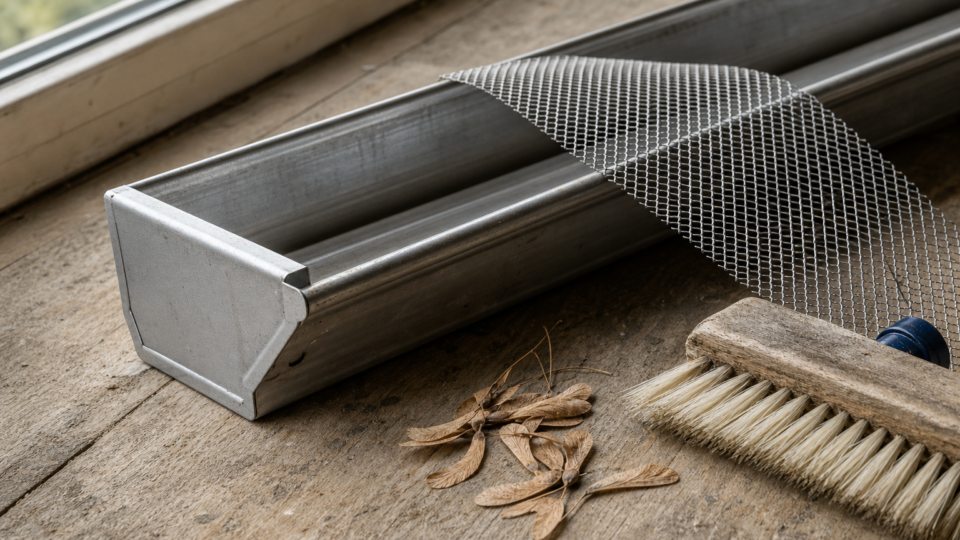
Short answer: Micro-mesh gutter guards do keep most leaves, seeds and shingle grit out of your gutters, but they are not the maintenance-free fix the sales pitch promises. The seven most common problems with micro-mesh gutter guards are debris piling on top, overflow in heavy rain, a film that builds on the mesh, wear and damage, installation errors, a high price, and maintenance that never fully goes away. If your trees are not hanging over the roof and the system is installed well, they can still be a sound purchase. Ready for quotes? Compare local pros →
In this guide
If you are asking whether micro mesh gutter guards work, you are probably holding a quote for several thousand dollars and comparing it to a ladder and a bucket. Reviews online are split. Contractors who sell the product praise it, and contractors who clean gutters for a living often tell you to skip it. You need the middle ground.
Guardian Gutter Guide does not install or sell guards, and referral fees never change what we recommend. This article was written by a former gutter installer and reviewed by a home inspector. Each problem below covers what goes wrong, why it happens and what you can do about it. A final section lays out the pros and cons so you can decide for your own house.
1. Debris piles up on top of the mesh
What goes wrong
When homeowners say their micro mesh gutter guards clogged, they usually mean the surface, not the gutter. Fine mesh stops nearly everything from dropping in, so leaves, maple seeds, pine needles and twigs rest on top of the guard instead.
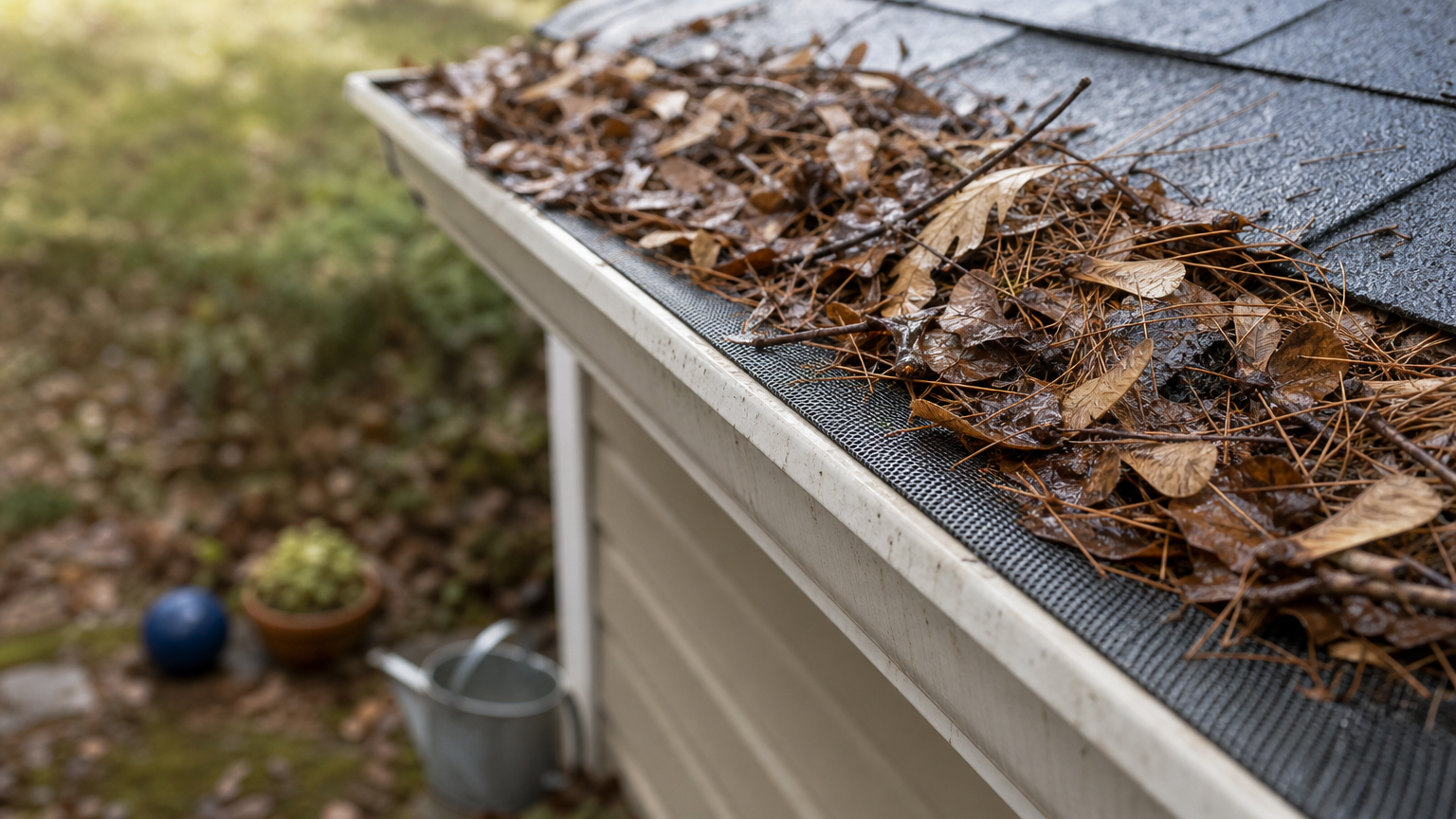
Once a mat forms, rain runs across it and past the gutter. You get the overflow you paid to prevent, and you often notice it only when water stains show up on siding or mulch washes away.
Micro-mesh moves the clog from inside the gutter to the top of the guard.
Why it happens
Most micro-mesh guards sit inside the gutter, and the gap between the gutter and the roof edge is small. That limits how much forward slope the guard can have, so it behaves like a shelf. Wind and gravity cannot shift a wet, matted layer from a shelf the way they can from a steep surface.
Your trees decide how bad it gets:
| Your yard | What to expect |
|---|---|
| Trees overhang the roof | Regular debris mats, so plan on surface cleaning, usually each fall |
| Trees nearby but not overhanging | Occasional blown-in leaves and a light sweep now and then |
| Few or no trees | Mostly fine debris, and the guard rarely needs attention |
What you can do
Start with the trees, because no guard beats an overhanging limb. Then build a short routine around the guard itself.
- Trim branches that overhang the roof.
- Brush or blow debris off the surface after leaf drop, using a soft brush or a leaf blower.
- Ask your installer how much pitch the guard will have on your roof.
- If trees overhang heavily, ask about guard designs that follow the angle of the roof instead of sitting flat.
What should this cost you?
Answer four questions and get a fair price range for your home.
2. Heavy rain sheets over the front edge
What goes wrong
A micro-mesh guard can be spotless and still let a downpour jump the gutter. Fast water skims across the mesh instead of dropping through it, then falls to the ground along your foundation. The gutter underneath may be nearly empty while water pours off the front edge.
You will see this as splash marks on siding, mud streaks at the base of walls, or mulch pushed out of beds. It tends to show up in the biggest storms, which are the ones gutters exist for.
A clean guard can still overflow if the water never goes through the mesh.
Why it happens
Two things work against you. First, surface tension: water fills the tiny openings and forms a thin film across them, so new water lands on top of that film instead of passing through. Second, roof speed: some roofs deliver water faster than fine mesh can take it in.
These spots are the usual trouble areas:
- Roof valleys, where two roof planes dump into one spot
- Long, steep roof runs
- Water falling from an upper roof onto a lower one
- Metal roofing, which sheds water quickly
- 5-inch gutters on large roof areas, since a 6-inch gutter carries more water
What you can do
Test the system once in a real storm. Stand under cover and watch where water goes at the valleys and below steep sections.
If water overshoots, ask the installer what fix they offer before you pay the final invoice. When you are replacing gutters anyway, upsizing to 6-inch and adding a downspout are cheap fixes compared with replacing a guard. Be wary of any quote that claims the mesh handles any rainfall. Ask for the reasoning, not just the brochure.
3. Pollen, grit and growth coat the mesh over time
What goes wrong
Fine mesh can lose water intake gradually without ever looking clogged. Pollen, shingle grit, dust and tree oils build a thin coating on the wires, and in damp shade, moss or algae can take hold. From the ground, the guard looks fine.
In one long-running side-by-side test of a heavily advertised brand, the guard took in noticeably less water in its second year than in its first. One test is not a rule, but it matches what installers describe. Performance fades slowly, and the first sign is overflow in a storm your gutters used to handle.
A micro-mesh guard can look perfect from the ground and still be sealing over.
Why it happens
Tiny openings hold onto tiny particles. Asphalt shingles shed granules, and new roofs shed the most. Those granules mix with pollen and sap into a film that ordinary rain does not fully rinse off. Low-slope installs make it worse because water and debris sit longer on the surface.
Conditions that speed it up:
- A shaded, north-facing roof edge that rarely dries out
- A humid climate
- Heavy pollen or sap trees nearby
- A recently installed asphalt shingle roof
What you can do
Gentle cleaning once or twice a year beats a big cleanup after the damage is done. Pick your timing around the seasons: after spring pollen and after fall leaf drop.
- Rinse with a garden hose and a soft brush.
- Skip the pressure washer, which can bend the mesh and force grit into the weave.
- Ask whether the surface is designed to resist growth. Some makers weave copper into the mesh, but ask for independent test evidence rather than a claim.
- If you see a green or dark film, clean it early.
4. Thin mesh and cheap frames wear out
What goes wrong
Micro-mesh is thin by design, and thin parts get damaged. Mesh can dent, bend or sag under a heavy load of wet debris, snow or a fallen branch. Frames can warp, leaving gaps at the edges.
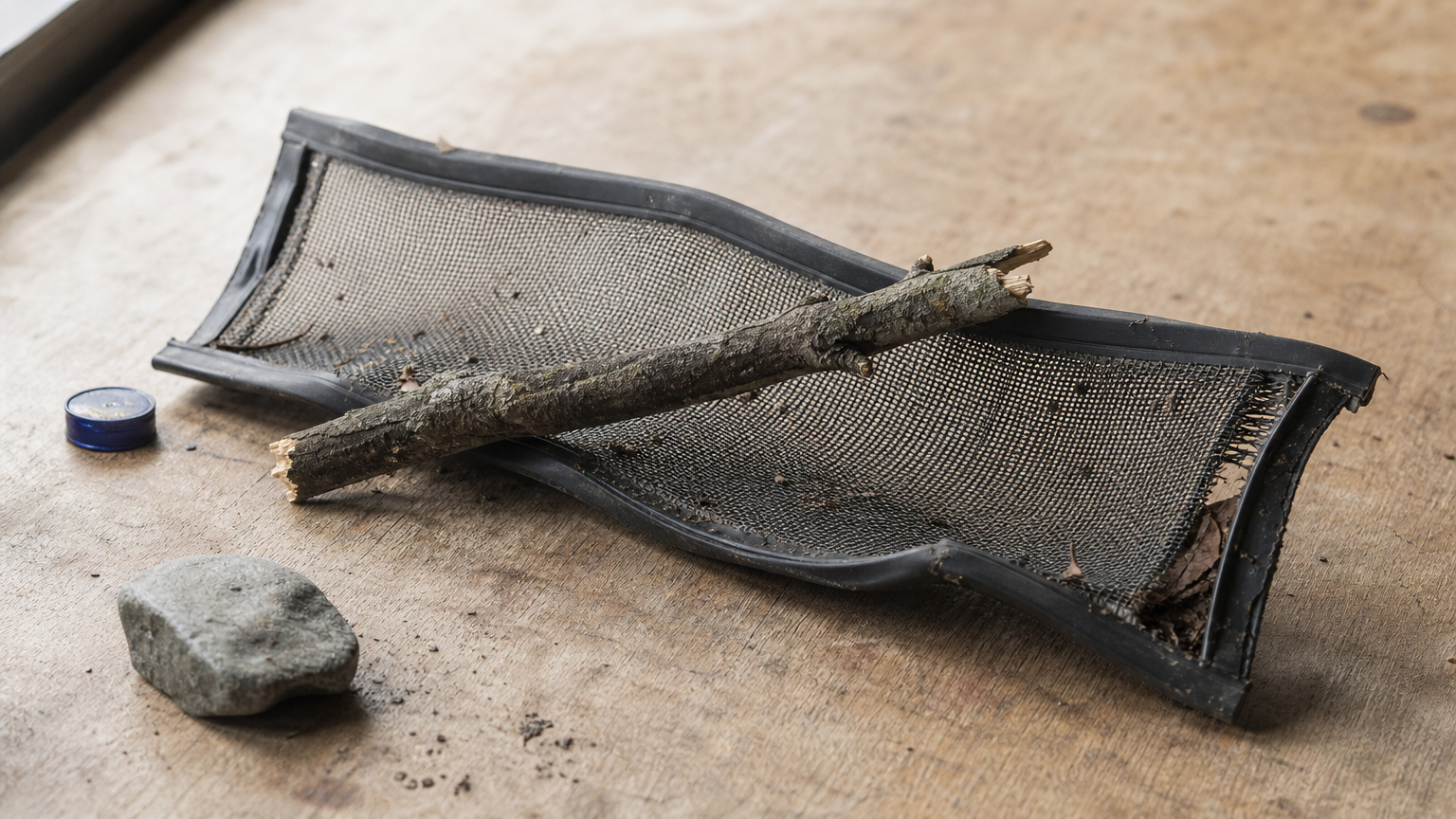
A damaged section lets debris into the gutter, and now you have a clog you cannot see. Worse, you may have to dig it out through a bent guard, which is harder than cleaning a plain gutter.
A guard is only as durable as its weakest part, and the weak part is usually the frame.
Why it happens
Quality varies widely between products. Plastic frames can expand and contract at a different rate than the metal mesh they hold, which stresses the joints every day as the roof heats and cools. Snow and ice load the guard in winter, and animals, branches and hail add random damage.
| Weak point | What it looks like | Why it matters |
|---|---|---|
| Plastic or thin frame | Warping, gaps, sagging sections | Debris gets in and the guard shifts |
| Thin mesh | Dents, bends, sagging under weight | Mesh can tear or collapse into the gutter |
| Snow and ice | Bent edges, sections pulled loose | Guards do not prevent ice dams |
| Animals, branches, hail | Chewed or torn spots | An opening lets debris straight in |
What you can do
Ask what the frame and mesh are made of before you ask the price. Aluminum frames with stainless steel mesh are the common durable pairing. Plastic parts are a reason to look harder at the warranty and the install method.
Walk your gutter line after each winter and after any big storm. If you live where heavy snow slides off the roof, ask the installer how the product holds up to snow load. Fix small damage early, since a one-foot gap lets in as much debris as no guard at all.
5. Installation mistakes and roof edge concerns
What goes wrong
Micro-mesh performance depends heavily on the install. A guard set too flat, left loose, or fitted over a sagging gutter will collect debris and overshoot water far more than the same product installed well. Gaps at corners, end caps and downspouts are other common flaws.
Some systems also tuck under or attach near the first course of shingles. That raises a fair question about the roof edge and your shingle warranty, and you should have the answer before work starts.
Installation decides how well a micro-mesh guard performs, and you cannot easily judge it from the ground.
Why it happens
Installers often work fast, and crews differ in skill. Gutters that were never perfectly pitched toward the downspouts are not fixed by a guard on top. Some roofs have drip edges or shingle overhangs that make clean installation harder.
Shingle makers have their own warranty terms, and the guard maker may have its own approvals. Some contractors say a correct install never voids a shingle warranty, but you should confirm the terms for your roof rather than assume.
What you can do
Treat the install as part of the product and check it like one.
- Repair or re-hang sagging gutters first.
- Ask how the guard attaches and whether it touches the shingles.
- Get the shingle warranty answer in writing from your roofing manufacturer or your roofer.
- Confirm who does the work, the company’s own crew or a subcontractor.
- Walk the finished job and look at corners, end caps and downspout openings.
6. The price is high compared with the payoff
What goes wrong
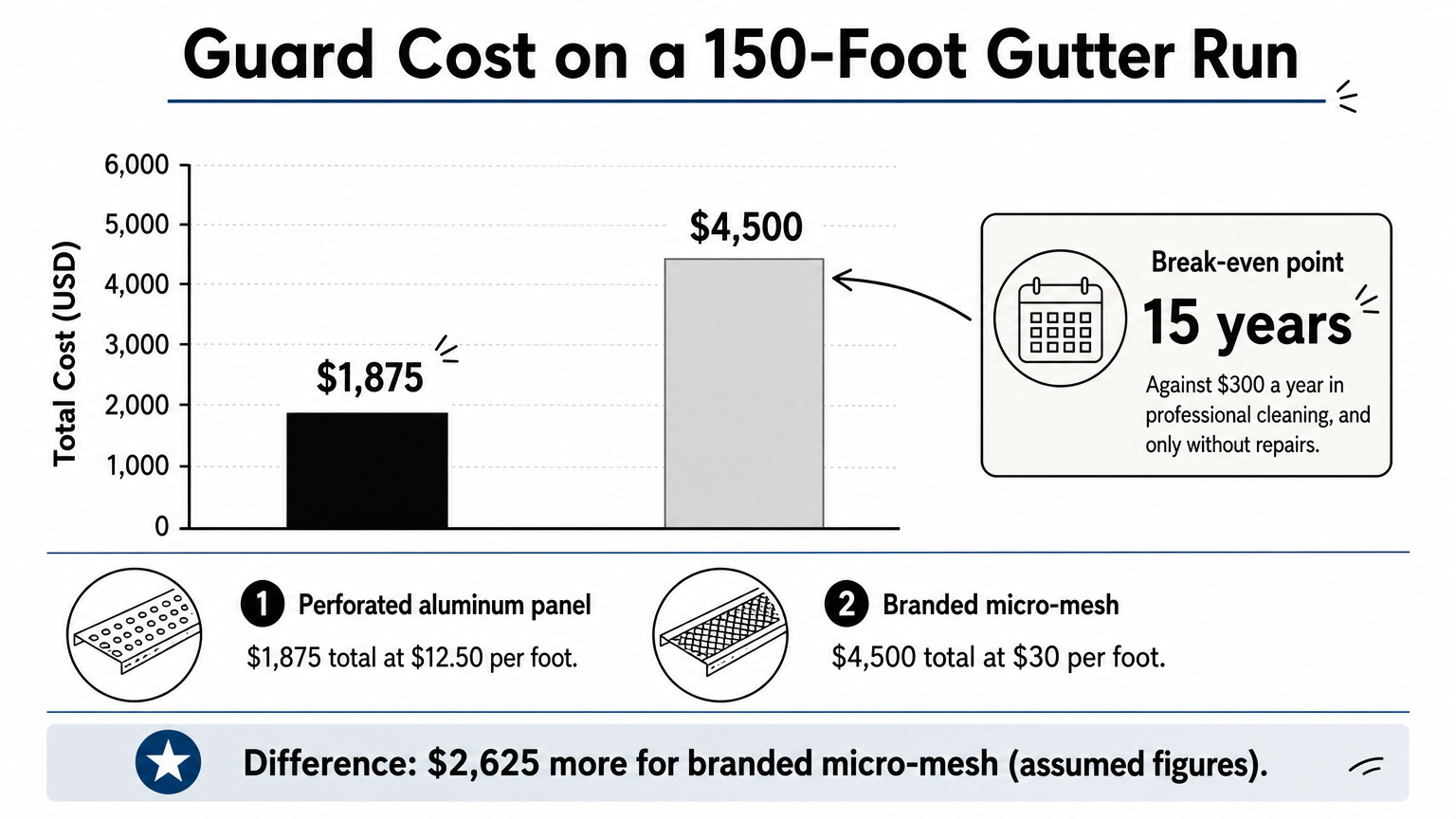
Micro-mesh is usually at the top of the price range for gutter guards. Contractor-reported installed prices have run from roughly $10 to $15 per foot for perforated aluminum panels to $30 per foot or more for branded micro-mesh systems. Your quote will differ by region and roof access.
The problem is not that the price is high. It is that similar-looking guards that sit inside the gutter can behave similarly on a flat install, so you may be paying for mesh detail that your trees and roof do not reward.
Pay for micro-mesh only if the extra fine filtering solves a debris problem you actually have.
Why it happens
Fine stainless mesh, metal frames and a longer install all cost more. Branded systems also carry sales costs, and in-home sales presentations often open with a high number. Homeowners who say no to the first price often see it drop.
Here is a worked example with assumed figures. Take a 150-foot gutter run:
| Option | Per foot | Total |
|---|---|---|
| Perforated aluminum panel | $12.50 | $1,875 |
| Branded micro-mesh | $30 | $4,500 |
| Difference | $2,625 |
If a professional cleaning costs $150 and you pay for two a year, that is $300 a year. At that rate, $4,500 takes 15 years to break even, and only if the guard needs no repairs.
What you can do
Run the same math with your own footage and your own cleaning price. The cost estimator on this site gives you a range by guard type, home size and region.
- Get three written quotes with the per-foot price shown.
- Ask each bidder to quote a cheaper guard type as well, so you can see the gap.
- Compare warranties line by line.
- Walk away from any price that is only good if you sign today.
7. Maintenance never reaches zero and warranties will not cover it
What goes wrong
Many guards are sold as "never clean your gutters again." In practice you still clean the surface, and you still need to watch what happens below the mesh. Fine sediment, shingle grit and seeds can settle in the gutter or downspout, and you cannot see them from the ground.
Marketing claims in this category have drawn legal attention. LeafFilter faced a class-action lawsuit over claims about its guards shedding debris, which the company settled. That case is a reminder to question maintenance-free promises from any seller.
If a guard needs no care, the seller should be willing to put that in writing.
Why it happens
Warranties typically cover defects in materials and workmanship. They usually do not cover debris sitting on top of the guard, a film that builds up, or overflow caused by a clogged surface. The gap between what the ad says and what the warranty covers is where homeowners get frustrated.
Hidden clogs are the second trap. A guard hides the gutter from view, so a blocked downspout can run all season before water finally backs up and shows itself.
What you can do
Read the warranty before you sign, not after the first storm. Look for what it excludes.
- Ask what happens if debris builds up on the surface.
- Check each downspout outlet once a year, using a hose to confirm flow.
- Note the date of each cleaning so you can see how often it is needed.
- Get promises such as "no cleaning needed" in writing, or treat them as sales talk.
Do micro-mesh gutter guards work, and who should still buy them
Pros and cons at a glance
Yes, they work when the conditions fit, and the micro mesh gutter guards pros and cons come down to fine filtering against the problems above. They filter small debris better than most guard types, but they depend on pitch, placement and upkeep.
| Pros | Cons |
|---|---|
| Keep out fine debris like shingle grit, seeds and blossoms | Debris can pile on top when trees overhang |
| Fewer ladder trips for gutter cleaning | Can overshoot in heavy rain, especially at valleys |
| Stainless mesh with metal frame can last many years | Surface film and growth reduce intake over time |
| A cleaner gutter interior | Highest cost among common guard types |
| Works well with the right install | Results depend on installation quality |
Micro-mesh works best on roofs with light tree cover and a good install, and worst under overhanging oaks and pines.
When they make sense
They fit best if trees are not overhanging, and if your gutters collect small debris that larger openings let through. They also suit homeowners who cannot or do not want to climb a ladder and who accept a quick surface rinse each year.
Before buying, check the five basics:
- Do trees overhang the roof?
- Are there valleys or steep sections that dump a lot of water?
- Are the gutters level, sound and 6 inches wide where the roof is large?
- Does the quote show per-foot pricing and a written warranty?
- Has the shingle warranty question been answered in writing?
When to look at something else
If heavy leaf drop is overhead, you may do better with a guard shaped to shed leaves or with regular cleaning by a pro, and you can price both. Perforated aluminum screens, reverse-curve guards and foam or brush inserts each carry their own tradeoffs, covered in our guard type reviews.
If your gutters are already sagging or leaking, repair them first. A guard on a failing gutter only hides the problem and makes the repair harder.
The bottom line on micro-mesh
Micro-mesh gutter guards work best when you know their weak spots. Debris on top, overflow in heavy rain, a film on the mesh, wear, a poor install, a high price and ongoing maintenance are all real. None of them rules the product out, but each one should shape the quote you accept.
Decide with your trees, your roof and your budget in mind, not with a sales pitch. Run the break-even math, ask about the shingle warranty, and read what the warranty excludes. If a quote still makes sense after that, you are buying with open eyes.
When you are ready to compare real numbers, get a free gutter guard installation quote and see an estimated cost range first, then talk to local contractors on your own terms.
What should this cost you?
Answer four questions and get a fair price range for your home.