
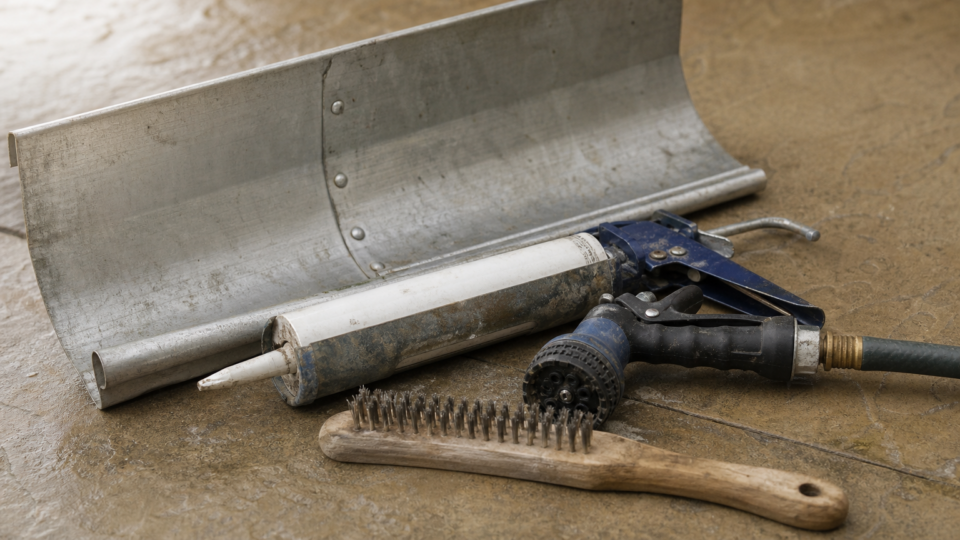
Short answer: Gutter leak repair cost is the price you pay to find and seal the spots where water escapes your gutters, most often at seams, corners, end caps and downspout outlets. Sealing one or two leaking seams usually runs $100 to $250, and a typical repair visit for one run or problem area averages about $300. The price climbs toward $600 or more once a sagging run or rotted fascia is involved. Ready for quotes? Compare local pros →
In this guide
This guide covers what drives that number, how to estimate your own before you call anyone, how a leaking gutter joint is actually fixed, and the point where replacing the run beats another patch. Every range is a national figure. Your quote will shift with the installer, roof access and local labor rates.
Guardian Gutter Guide is an independent resource, not a contractor. Marcus Delaney, a former gutter installer with 12 years of experience, writes our guides, and Dana Whitfield, a residential home inspector, reviews them. The goal is simple: you should know what a fair quote looks like before you talk to anyone.
Why gutter leak repair costs vary so widely
Leak repair prices vary because you pay for more than sealant. You pay for finding the leak, reaching it safely and fixing whatever the water has already damaged. Two homes with the same drip can receive quotes that are hundreds of dollars apart.
Typical prices by type of fix
Most leak jobs fall into the categories below. Seamless gutters cost slightly more to fix than sectional ones, because they are formed from one piece of metal and a damaged section often needs partial replacement instead of a spot seal.
| Repair | Typical cost | What it covers |
|---|---|---|
| Seal one or two leaking seams | $100 to $250 | Clean, dry and re-seal the joint |
| Sectional gutter repair | $100 to $225 | Several seams or a cracked piece |
| Seamless gutter repair | $125 to $250 | Corners, end caps, spliced sections |
| Re-hang a sagging run | $100 to $600 | New hangers and corrected slope |
| Replace a damaged section | $5 to $18 per foot | Cut out the bad piece, fit a new one |
| Rotted fascia behind the gutter | $300 to $800 add-on | Replace the board before re-hanging |
Across these jobs, the national range runs from about $150 to $600, and the average quote sits near $300 for one run or one problem area. Many small contractors also set a service minimum, often around $100, so a single pinhole leak rarely costs less than that.
What moves your price up or down
Six factors do most of the work in a quote:
- Number of leaking seams. Sectional gutters have a joint roughly every 10 feet, and each one is more labor. Some contractors price per leak point, around $40 each.
- Material. Vinyl and aluminum are cheap to fix. Steel costs more, and copper needs a specialist who can solder.
- Height. A two-story home typically costs about twice as much to repair as a single-story home, because of the ladder or lift work.
- Access. Dense landscaping, a steep roof pitch or a long carry adds labor.
- Fascia condition. Soft, rotted wood behind the gutter adds a separate repair.
- Region. Local labor rates and overhead change the final bill.
Material alone shifts the typical repair bill like this:
| Gutter material | Typical repair cost |
|---|---|
| Vinyl | $100 to $350 |
| Aluminum | $150 to $400 |
| Steel | $230 to $600 |
| Copper | $300 to $1,000 |
What the leak is telling you
Leaks show up at joints for two main reasons. Sealant dries out and cracks after years of sun and freezing, or the run sags and pulls the seam open. Resealing a seam that is open because of sag fails within a season, because the cause is still there. If you see water standing in the gutter after the rain stops, the pitch or the hangers need attention, and that belongs in the price.
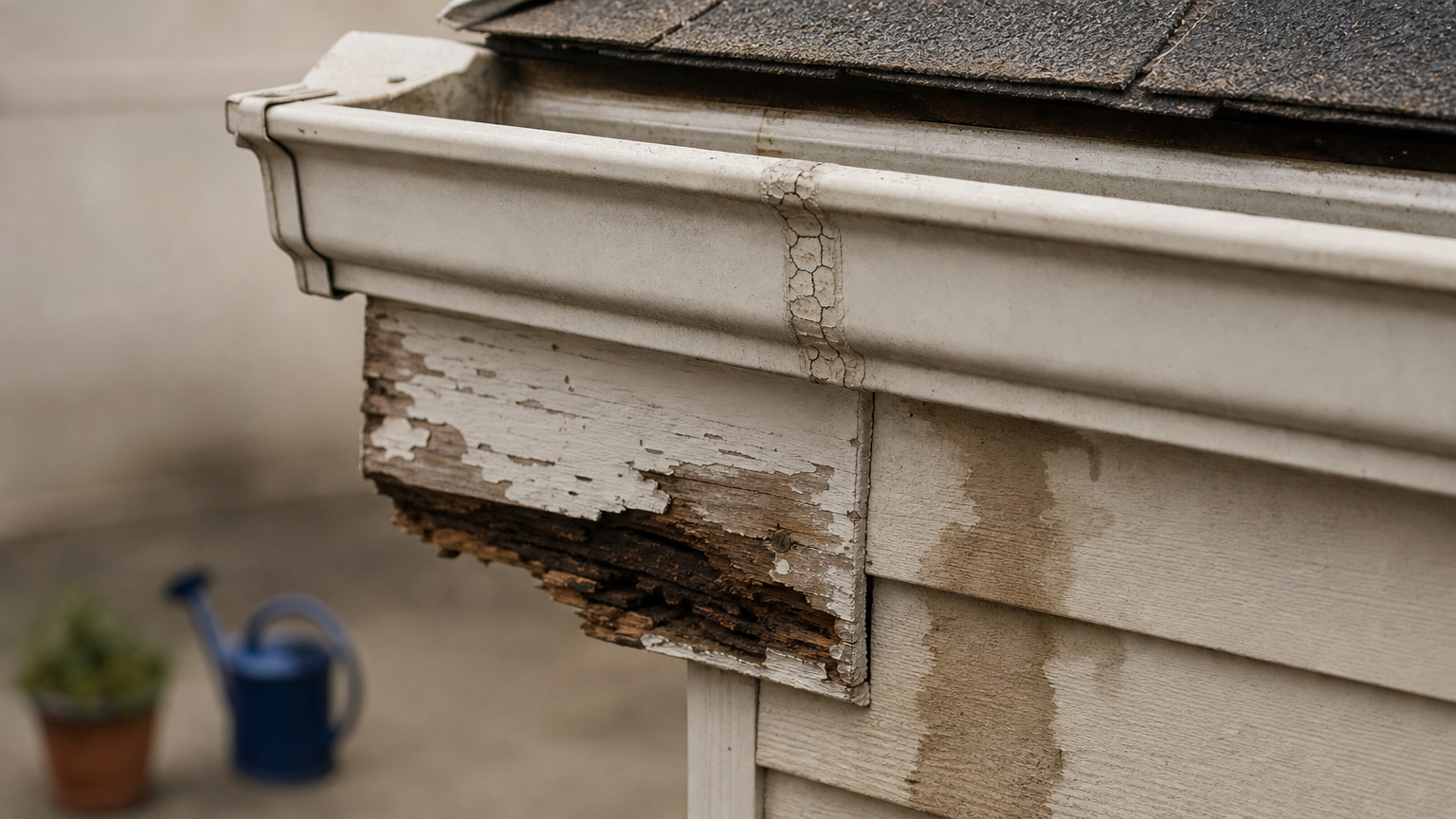
Hidden damage is the second reason to act early. Look for stains on siding, peeling paint on the fascia, soft wood under the gutter and soil washed out near the foundation. A $150 reseal ignored for two years can turn into an $800 fascia job.
A leak fix that ignores the cause is the most expensive repair, because you pay for it twice.
What should this cost you?
Answer four questions and get a fair price range for your home.
How to estimate your gutter leak repair cost yourself
You can estimate your gutter leak repair cost in four steps: find every leak, note your gutter type and material, record the height of the house, and match the job to the ranges above. Twenty minutes with a garden hose gives you a number you can compare against any quote.
Find and count every leak
A hose test finds leaks faster than waiting for rain. Do it like this:
- Clear loose debris from the run so water flows freely.
- Start at the high end and run water into the gutter, working toward the downspout.
- Watch from the ground, or have a helper watch while you run the water. Do not lean off a ladder.
- Sketch the house and mark each drip. Note whether it is a seam, a corner, an end cap, a downspout outlet or a hole in the metal.
- After you stop the water, check for pools. Standing water means a slope problem.
The sketch matters more than it seems. A contractor who sees your count of leak points cannot easily pad the job.
A worked example
Take a single-story home with sectional aluminum gutters, three leaking seams and one leaking corner. This is an illustration, not a quote.
| Item | Estimate |
|---|---|
| Three seam reseals at about $40 each | $120 |
| Corner reseal and re-rivet | $60 |
| Total, ladder access | about $180 |
The same job on a two-story home that needs a lift lands near $360. Both totals sit inside the typical $150 to $400 band, so neither should raise a flag. A quote of $900 for the same four leaks would be worth questioning. Our cost estimator can give you a range by project type, home size and region before you request anything.
What a fair quote should list
A good written quote names the work, not just the total. Look for these items:
- The number and location of leak points
- Whether they re-seal, re-fasten or replace parts
- Cleaning and drying the joint before sealing
- A check of the fascia and hangers
- A water test after the repair
- A workmanship warranty in writing, often one to three years on repairs
- Ladder or lift access
Get two or three quotes. Contractors assess the scope differently, and the spread tells you what is normal in your area.
A fair quote names each leak point, so you can check the total against your own count.
How leaking gutter joints get fixed, and what each fix costs
Leaking gutter joint repair cost depends on which of three fixes the joint needs: a reseal, a re-fasten plus reseal, or a new part. A reseal is the cheapest and fits inside the $100 to $250 range for one or two seams.
The three fixes
- Reseal. The seam is still tight but the old sealant has cracked. The installer scrapes it out, cleans and dries the metal, and lays a fresh bead of gutter sealant inside the joint.
- Re-fasten and reseal. The seam has opened because of sag or loose rivets. The installer re-hangs the run, re-rivets the joint and then seals it. It takes more time and sometimes new hangers.
- Replace the part. A corner, end cap or outlet is cracked, rusted or bent. A rusted section can be cut out and replaced at about $5 to $18 per foot.
Seamless gutters have few seams, so their leaks tend to sit at corners, end caps and downspout outlets. Sectional gutters leak at the seams between 10-foot pieces. Rust holes are a different problem. Sealant on a rusting steel gutter buys a season or two, and it is a sign the metal is near the end of its life.
Doing a reseal yourself
A reseal is the one leak repair most homeowners can handle, and the materials are cheap. A tube of gutter sealant is typically under $15 at a home improvement store. The steps:
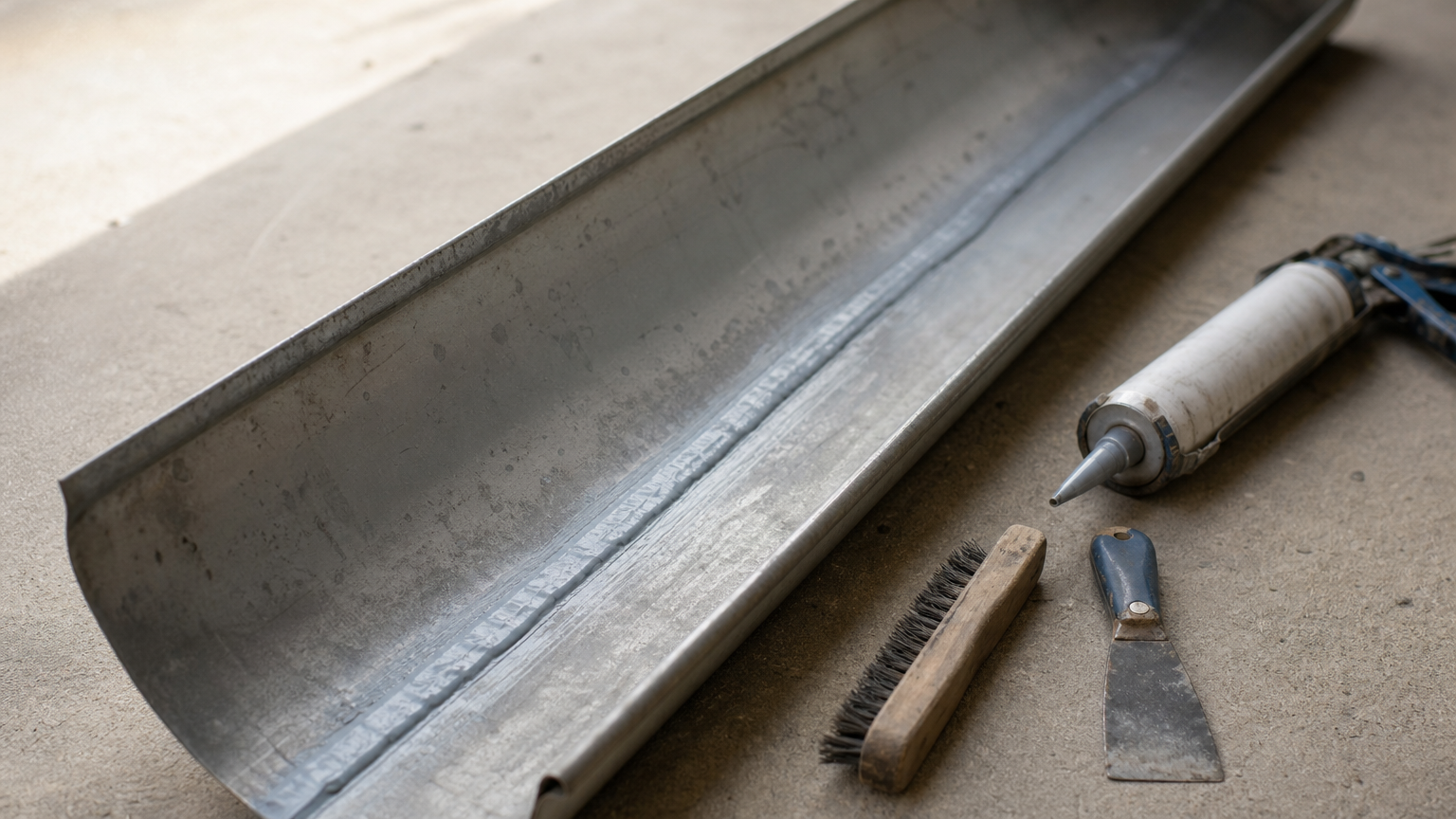
- Remove debris and scrape out all the loose, old sealant.
- Wire-brush bare metal and wipe the joint clean.
- Let the gutter dry completely.
- Apply sealant along the inside of the seam, extending past the joint on both sides, and smooth it.
- Let it cure for the time on the label, then test with a hose.
Use a sealant rated for your gutter material, and a vinyl-specific product on vinyl. Do it yourself only on a single-story home from a stable ladder. For two stories, rotted fascia or copper gutters, hire a pro. The real cost of a bad fall is far higher than the $100 you save.
Resealing a low seam yourself is a smart $15 job, but a fall from a ladder is the most expensive way to save $150.
When repairing a gutter leak stops making sense
Replace instead of repair when the repair costs more than about half of a replacement, when the gutters are near the end of their life, or when leaks keep reappearing along the same run. Each of these means you are paying for patches on a system that is going to fail anyway.
The 50 percent test with real numbers
Seamless aluminum gutters cost about $6 to $14 per linear foot installed, with steel at $9 to $20 and copper at $25 to $45. Downspouts run $5 to $10 per foot and corners $15 to $40 each. Gutter length follows your roofline, not your floor area. A 2,000-square-foot two-story home often has around 130 feet of gutter, and a single-story of that size can reach 180 feet or more. A typical two-story home usually lands between $1,100 and $2,800.
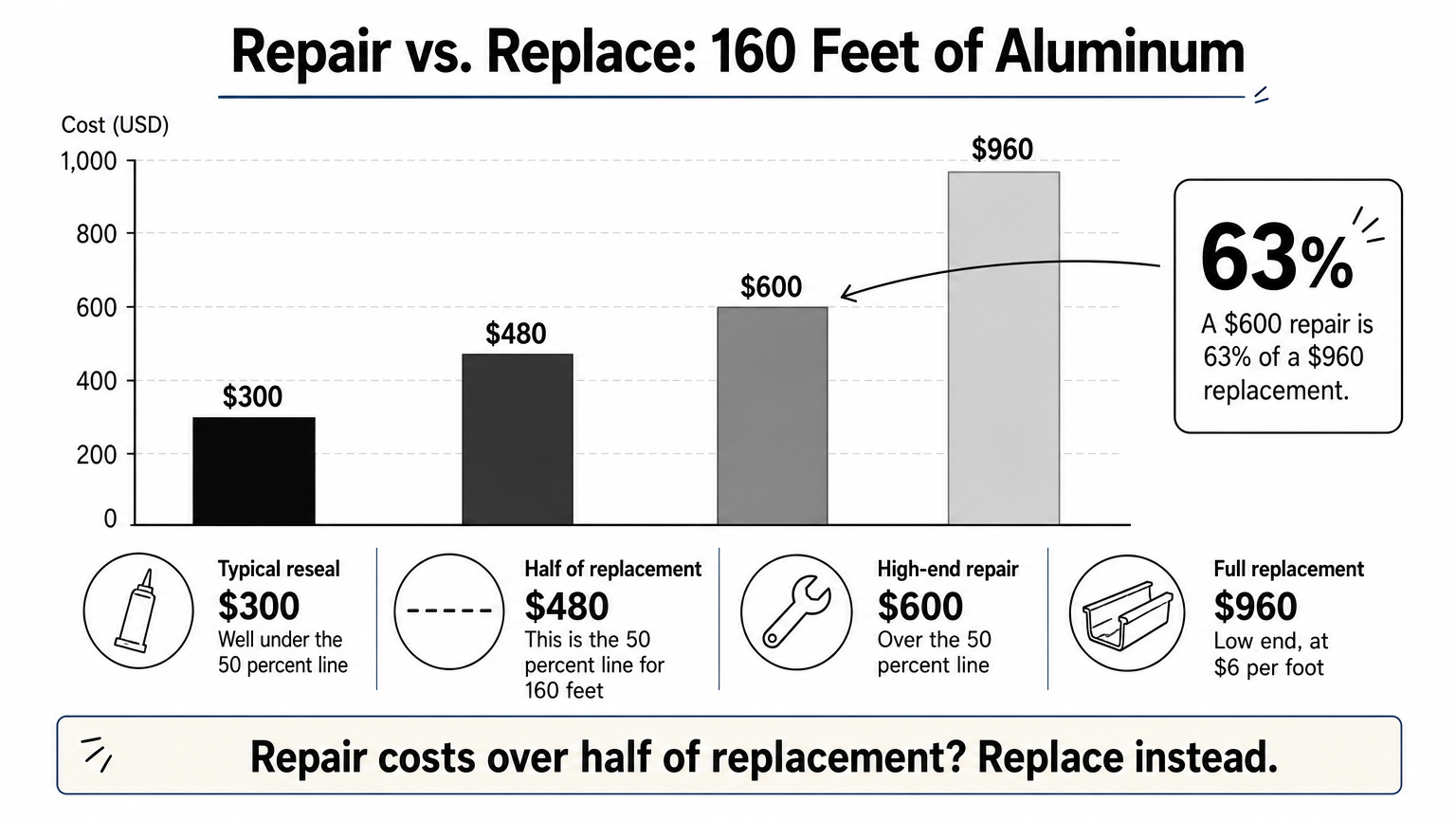
Now work an example for 160 feet of seamless aluminum:
| Item | Low | High |
|---|---|---|
| Replacement at $6 to $14 per foot | $960 | $2,240 |
| Half of replacement (the 50 percent line) | $480 | $1,120 |
| Typical $300 reseal | 31% of low-end replacement | Well under the line |
| High-end $600 repair | 63% of low-end replacement | Over the line |
A $300 reseal is clearly worth it. A $600 repair against a $960 replacement is not, because the new gutters last 20 to 30 years. Replacement is usually done in one day, and fascia repair adds a day. Guards installed with new gutters usually cost 10 to 20 percent less than a separate visit.
Signs that a patch will not hold
Treat any of these as a vote for replacement:
- The gutters are 20 years old or more
- Leaks in three or more places on the same run
- Rust flaking or holes through the metal
- A seam that leaks again after a proper reseal
- Sagging combined with soft or rotted fascia
- Cracked, brittle vinyl
One of these alone does not decide it. Two or more usually do.
Does homeowners insurance cover gutter leaks?
Homeowners insurance usually covers gutter damage from a sudden event such as wind, hail or a fallen branch. It usually does not cover leaks that come from age, wear or lack of maintenance. Check your policy, because wording varies.
Even when a claim is valid, the deductible is often higher than a typical $300 leak repair, so a claim rarely makes sense for small jobs. It matters more when a storm has damaged a whole run.
If the repair costs more than half of a replacement, or the gutters are past 20 years, put the money toward new gutters.
Fix the leak once
Gutter leak repair cost comes down to the number of leaking seams, your material, your home’s height and whether the fascia is sound. Expect about $100 to $250 for a seam or two, an average near $300 for a repair visit, and a replacement decision once the repair passes half of the new-gutter price. Find the cause before you pay for the patch.
Count your leaks with a hose, compare the number to the ranges above, and ask each contractor to list every leak point and a water test in writing. If you are ready to compare real numbers, you can request a free gutter repair estimate and see local quotes with no pressure.
What should this cost you?
Answer four questions and get a fair price range for your home.