
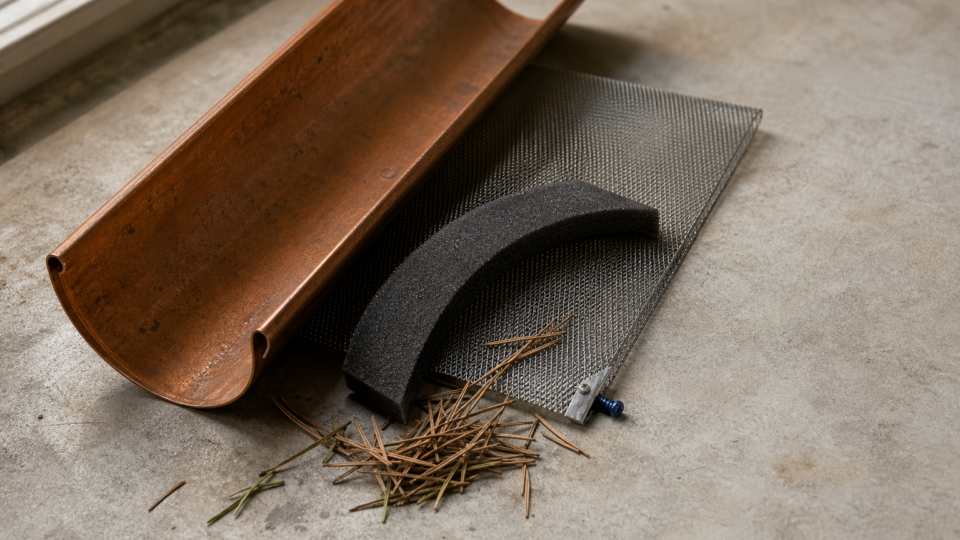
Short answer: The best gutter guards for half-round gutters depend on what falls on your roof. Fine-mesh guards suit pine needles and seeds. Hinged metal screens suit leaves on a budget. Foam inserts are a cheap DIY fix, and copper or zinc guards suit homes that need to match their gutters. Every one of them must be made for the half-round profile, because a standard K-style guard will not fit. Ready for quotes? Compare local pros →
In this guide
Half-round gutters are a smaller market than K-style, so fewer guards exist and a wrong purchase is easy. A guard has to match your gutter’s size, bead and hanger style, and then it has to handle your debris. Guardian Gutter Guide is an independent resource that sells and installs nothing and endorses no single brand, so this list compares guard types rather than ranking brands.
Below you get a short fit check, five picks that each cover how the guard works, who it suits and what it costs, and a table for matching a pick to your debris, roof and climate. Prices are material costs or national ranges. Actual quotes vary by installer, roof access and local labor rates.
How to tell if a guard fits half-round gutters
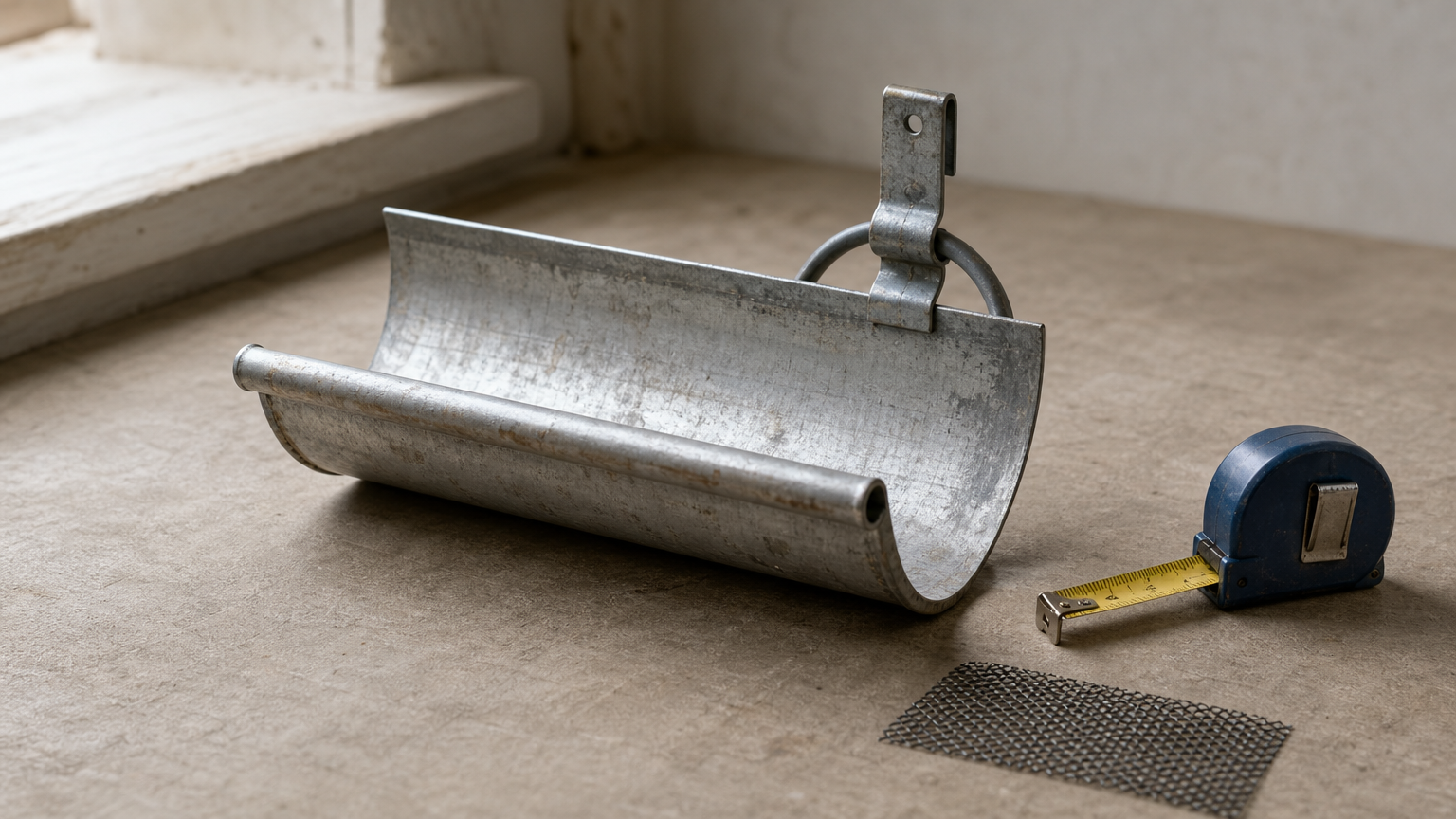
A guard fits half-round gutters only when its maker says it is made for that profile and for your gutter’s size. Half-round gutters have a curved trough, a bead along the front edge and hangers that differ from K-style. A K-style screen or foam insert will not sit right, and you should not bend or compress one to make it fit.
Size, bead and hangers
Start with the nominal size, which is usually 5 or 6 inches. Then check the details that vary between gutters of the same size. Two 6-inch half-round gutters can differ in opening width, depth and bead shape, and any of those can decide whether a guard seats correctly.
A guard that fits one 6-inch half-round gutter does not automatically fit another.
Confirm these before you order:
- Nominal size and actual opening width
- Bead style, traditional single bead or reverse bead
- Hanger type and position, such as external circle hangers or hidden hangers
- Space between the gutter and the roof edge
- Gutter material, so the guard metal will not corrode against it
What no guard can fix
No guard ends maintenance. Fine debris can still pass through or collect on top, so you still need to inspect the guard, the outlets and the downspouts at least once a year. Leaves pile up on the surface after storms, and that is normal.
Guards also do not repair an undersized gutter, a restricted downspout or too few outlets, and they do not prevent ice dams. People often assume half-round gutters perform better or worse than K-style. They are chosen mostly for looks, so judge a guard by how it handles your debris, not by the gutter shape.
What should this cost you?
Answer four questions and get a fair price range for your home.
1. Fine-mesh guards for pine needles and small debris
Fine-mesh guards are the best half-round pick for needles, seeds and mixed tree debris. They cost the most of the common options but hold up longest.
How it works
A fine-mesh guard stretches a stainless steel or brass screen across a metal frame that sits over the gutter. Water clings to the mesh and passes through, while leaves, needles and seeds stay on top. Half-round versions are made for the common 5- and 6-inch profiles.
Some designs fasten to the front and back of the gutter and never slide under the shingles. That matters if your roof warranty limits what you can tuck beneath them. Read the maker’s installation instructions before you buy.
Who it suits
Choose fine mesh when you have pines, mixed trees or heavy seed and bud drop. The openings are small enough to stop pine needles that slip through a coarse screen.
If needles or seeds are your main debris, fine mesh is the only screen style that really stops them.
Expect to brush the surface now and then. Pollen, dirt and shingle grit can coat even fine mesh and slow water intake. Check roof valleys and dormers first, because concentrated runoff tests the guard there before anywhere else.
Cost and drawbacks
Fine mesh is the premium choice. Retail listings for copper-framed half-round micromesh start around $24 per linear foot in materials. Professionally installed guards of all types run $7 to $35 per linear foot. Micro-mesh typically lasts 15 to 25 years, which spreads the cost over a long life.
Drawbacks to weigh:
- Fewer half-round models exist than K-style
- The frame metal must be compatible with your gutter
- The surface needs occasional brushing
- Careful installation matters, so many owners hire a pro
2. Hinged metal screens for leaves on a budget
A hinged metal screen is the best-value guard for half-round gutters under maples, oaks and other broad-leaf trees. It blocks big debris and lets you lift the panel to reach the gutter.
How it works
The screen is a perforated or expanded metal panel that spans the gutter and lifts on a hinge. Water drops through the holes, and leaves sit on top or blow off. Half-round versions come in aluminum or steel for 5- and 6-inch gutters.
Because the panel follows the gutter’s curve, it rests on or clips to the front bead. Depending on the model, it sits above or around the hangers. Check where your hangers sit, since they can interfere with the hinge line.
Who it suits
Pick this when leaves are the main problem and you want a durable metal guard at a modest price. The hinge is the selling point. You can reach the trough without removing anything, which makes the yearly check easy.
A hinged screen is the easiest guard to live with if your trees drop big leaves and not needles.
Skip it for pine needles, small seeds and roof grit. The openings are large enough that these pass through or lodge in the holes and then need hand clearing.
Cost and drawbacks
Retail listings put hinged aluminum or steel screens at about $4 per foot and up in materials. Mill finish aluminum does not rust like iron, but it can corrode where it touches copper or sits on a damaged coating. Use fasteners that suit the metal.
Drawbacks to weigh:
- Needles and fine debris get through
- Steel needs a protective coating for long life
- Hinge and hanger positions must line up
3. Foam filter inserts for a low-cost DIY fix
Foam inserts are the cheapest way to slow clogging in half-round gutters. They suit light debris, short-term protection and tight budgets, but they wear out sooner than metal.
How it works
The insert is porous polyether foam shaped to the curve of a half-round trough. It sits inside the gutter. Water soaks into the foam and flows through to the trough, while leaves stay near the surface.
The shape matters. A K-style or rectangular insert should not be squeezed into a half-round gutter, because it will leave gaps or block flow. Buy foam made for 5- or 6-inch half-round and confirm it clears your hangers.
Who it suits
Foam works for DIY homeowners who want fast, low-cost protection. It also helps if you plan to replace the gutters soon, since you will not be paying for a guard that outlives them.
Foam slows clogs cheaply, but it is a short-term fix, not a lifetime one.
It struggles under pines. Needles, pollen, roof granules and decomposed leaves collect in the foam, and a clogged insert can send water over the front edge. Plan to inspect it each season and clean or replace it.
Cost and drawbacks
Specialty retailers list half-round foam at roughly $2.50 to $5 per foot. Foam and plastic screens typically last 3 to 8 years. Over the 15 to 25 years a micro-mesh guard can last, you may buy foam several times, so the savings shrink.
Drawbacks to weigh:
- Short lifespan
- Debris soaks into the material
- Needs regular cleaning or replacement
4. Copper screens for copper half-round gutters
A natural copper screen is the right pick when your gutters are copper. It matches the metal, weathers alongside it and avoids the corrosion that comes from mixing metals.
How it works
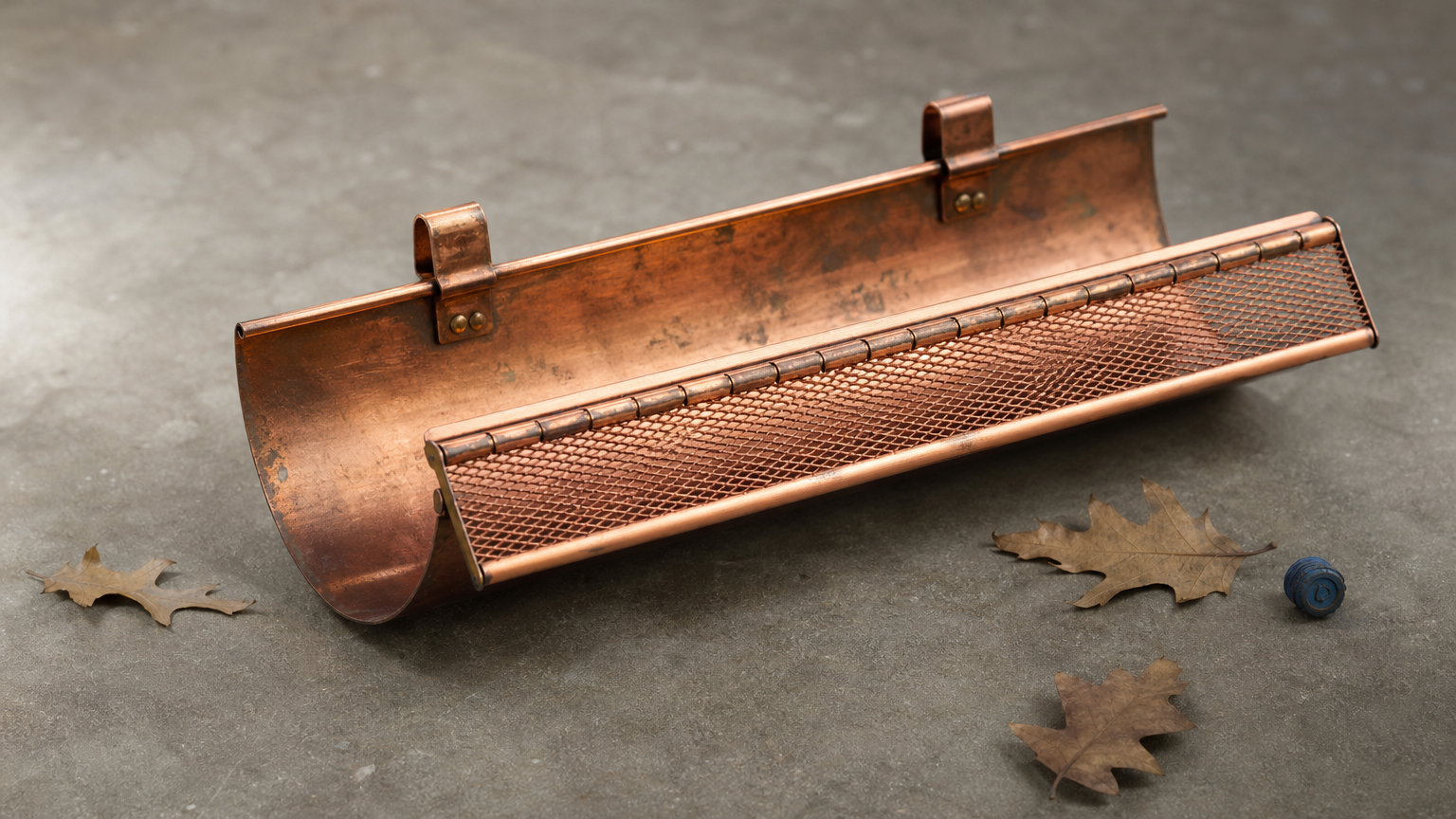
Copper screens are usually clip-on or hinged panels that attach to the front bead. Many use copper clips, so there are no steel fasteners to start a reaction. Water passes through the openings and leaves stay on top.
Copper changes color as it ages, from bright copper to brown and then blue-green patina. The guard and gutter will not always weather at the same pace, because water flow and exposure differ. A slight mismatch for the first few years is normal.
Who it suits
Choose copper if your gutters are copper, especially on historic or architectural homes where appearance matters. Never put natural copper on aluminum or galvanized gutters. Contact or runoff speeds corrosion in those metals.
Copper goes on copper gutters only, or you trade a clog problem for a corrosion problem.
Do not confuse copper-looking finishes with the real thing. Copper Penny and Designer Copper aluminum are prefinished aluminum, not natural copper, so a copper guard there creates the same corrosion risk.
Cost and drawbacks
Hinged copper screens run around $12 per foot and up in materials at retail listings. The gutters themselves are a premium purchase too, at $25 to $45 per foot installed. A guard is a small add-on to a copper system, but it is a real one.
Drawbacks to weigh:
- Coarse openings let needles and seeds through
- Color differences between guard and gutter
- Strict metal compatibility rules
5. Zinc and Euro Copper guards for matched systems
System-specific guards are the right pick for preweathered zinc and Euro Copper gutters. These are premium systems, and the guard must be made for the exact system.
How it works
Preweathered zinc has a factory-developed gray finish and is not galvanized steel. Euro Copper is a separate European half-round system with its own gutter sizes, beads, hangers and outlets. A listed size in the 7.5-inch range shows how different it is from standard U.S. 5- and 6-inch half-round.
Guards for these systems are formed to the system’s profile and attach to its bead and hanger arrangement. Use fasteners suited to zinc or copper, and confirm the section length and outlet clearance before you order.
Who it suits
This pick suits owners who already have a zinc or Euro Copper system, or who are specifying one on a custom or restoration project. A guard sized for a standard U.S. half-round gutter should not go on a Euro Copper system because the widths look similar.
On a Euro Copper or zinc system, similar width is not compatibility. Buy the system’s own guard.
Zinc guards keep weathering and may not hold exactly the same shade as the gutter. Plan for that, and ask the supplier which guard style they recommend for your debris.
Cost and drawbacks
At one specialty retailer, preweathered zinc guards list around $65 each and Euro Copper guards around $180 each. Cost per foot depends on piece length, so confirm the length before comparing them with other options. Expect a higher price and fewer places to buy.
Drawbacks to weigh:
- Highest price of the five picks
- Few sources and limited styles
- Mistakes on sizing are expensive
How to choose by debris, roof and climate
Match the guard to your main debris first, then to your gutter material, then to your budget. Roof shape and climate adjust the choice but rarely reverse it.
Pick by debris
Look up at the trees over your roof. The debris they drop sets the opening size you need, and the gutter metal narrows the field further.
| Main debris or situation | Best fit | Watch for |
|---|---|---|
| Broad leaves and twigs | Hinged metal screen | Needles pass through |
| Pine needles | Fine mesh | Needs occasional brushing |
| Seeds, pollen, shingle grit | Fine mesh | Surface coating |
| Mixed trees | Fine mesh | Higher cost |
| Light debris, tight budget | Foam insert | Replace in 3 to 8 years |
| Copper gutters | Copper screen | Never use on aluminum |
| Zinc or Euro Copper system | System-specific guard | Exact fit |
Choose for your debris first, because the wrong opening size is the fastest way to fail.
What 150 feet costs
A typical two-story suburban home has 150 to 200 feet of gutter. Here is a 150-foot run priced for materials only, using the retail figures above.
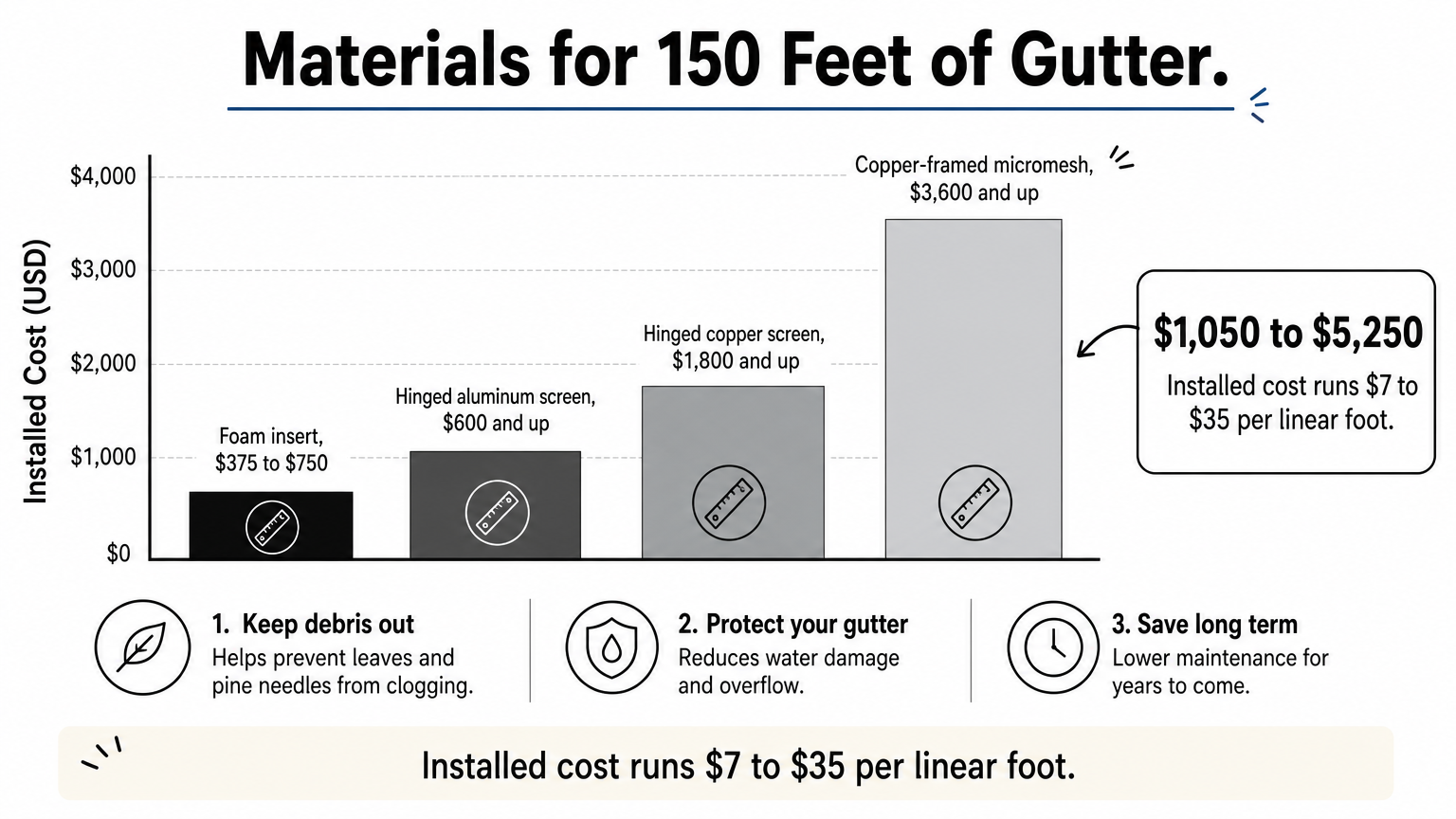
| Option | Materials per foot | Materials for 150 feet |
|---|---|---|
| Foam insert | $2.50 to $5 | $375 to $750 |
| Hinged aluminum or steel screen | about $4 and up | $600 and up |
| Hinged copper screen | about $12 and up | $1,800 and up |
| Copper-framed micromesh | about $24 and up | $3,600 and up |
Professional installation of any guard type runs $7 to $35 per linear foot, or $1,050 to $5,250 for the same 150 feet. Get at least two quotes. Ask each installer which half-round product they would use and how it attaches to your bead and hangers.
Roof and climate factors
In heavy rain, roof valleys and dormers push concentrated runoff onto short stretches of guard. Water intake depends on rainfall intensity, roof size, guard openings and how clean the surface is. If your gutters overflow in storms, ask about extra outlets before you blame the guard.
Snow and ice raise a separate issue. A guard is not an ice-dam fix or a snow guard, and wet leaves, snow and ice add weight, so the hangers must carry the load. Do not treat a guard or gutter as a ladder support or walking surface.
Choosing your half-round guard
Pick by debris. Fine mesh handles needles and seeds, a hinged metal screen handles leaves, foam covers a tight budget for a few seasons, and copper or zinc guards belong on copper, zinc or Euro Copper systems. Before you buy, confirm the guard is made for your gutter’s size, bead and hangers, and plan on a yearly check.
Half-round fits are fiddly, so many homeowners let an installer handle it. If you want a cost range first and then local quotes with no pressure, use the free quote page for gutter guard installation. Tell each contractor you have half-round gutters, and ask what they would install.
What should this cost you?
Answer four questions and get a fair price range for your home.