
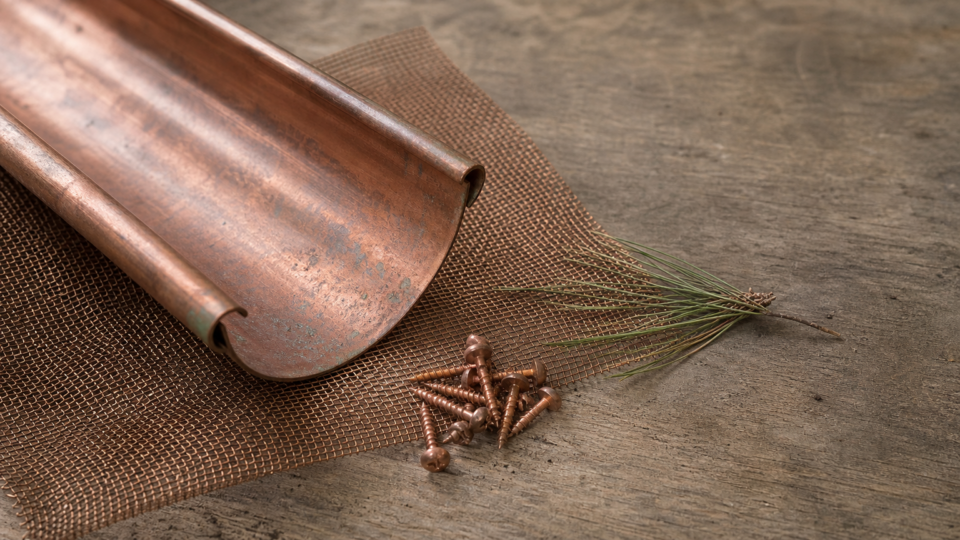
Short answer: The best gutter guards for copper gutters are made of copper or stainless steel, because those metals avoid the pairing that causes corrosion. Copper micro mesh suits homes under pines and shingle roofs that shed grit. A copper screen suits leaf-heavy yards on a tighter budget. A solid copper cover from an installer suits owners who want a custom look. An aluminum guard only works when an installer keeps it from touching the copper. Ready for quotes? Compare local pros →
In this guide
Most guards on the market are aluminum or galvanized steel, and general "top rated" lists rarely check how they behave on copper. A wrong pick can corrode within a few seasons and leave marks on a gutter you paid a premium for. Below are five compatible types, with how each works, who it suits and what to check before you buy. A final section covers sizing for K-style and half-round profiles.
Guardian Gutter Guide is independent and is not a contractor, and contractors cannot pay to be recommended here. Marcus Delaney, a former gutter installer with 12 years of experience, wrote this guide. Dana Whitfield, a residential home inspector, reviewed it.
Why most gutter guards clash with copper
Most gutter guards clash with copper because they are aluminum or galvanized steel, and two dissimilar metals that touch in wet conditions corrode each other. Once you know which metals are safe, your shopping list gets short fast.
What galvanic corrosion does
Rain and dew connect the two metals, and a small electrical current starts to flow. The less noble metal pays for it. Next to copper, that means aluminum or galvanized steel, so the guard, its brackets and its screws corrode first.
Next to copper, the guard is the part that gives up first, so the metal of the guard matters more than the mesh.
The result is white powdery residue, failed fasteners and a guard that loosens or collapses within a few years. The corroding parts can also stain or damage the gutter where they sit. The copper rarely loses the fight, but you still pay for the repair.
Which metals are safe near copper
Use this list as a filter before you compare brands:
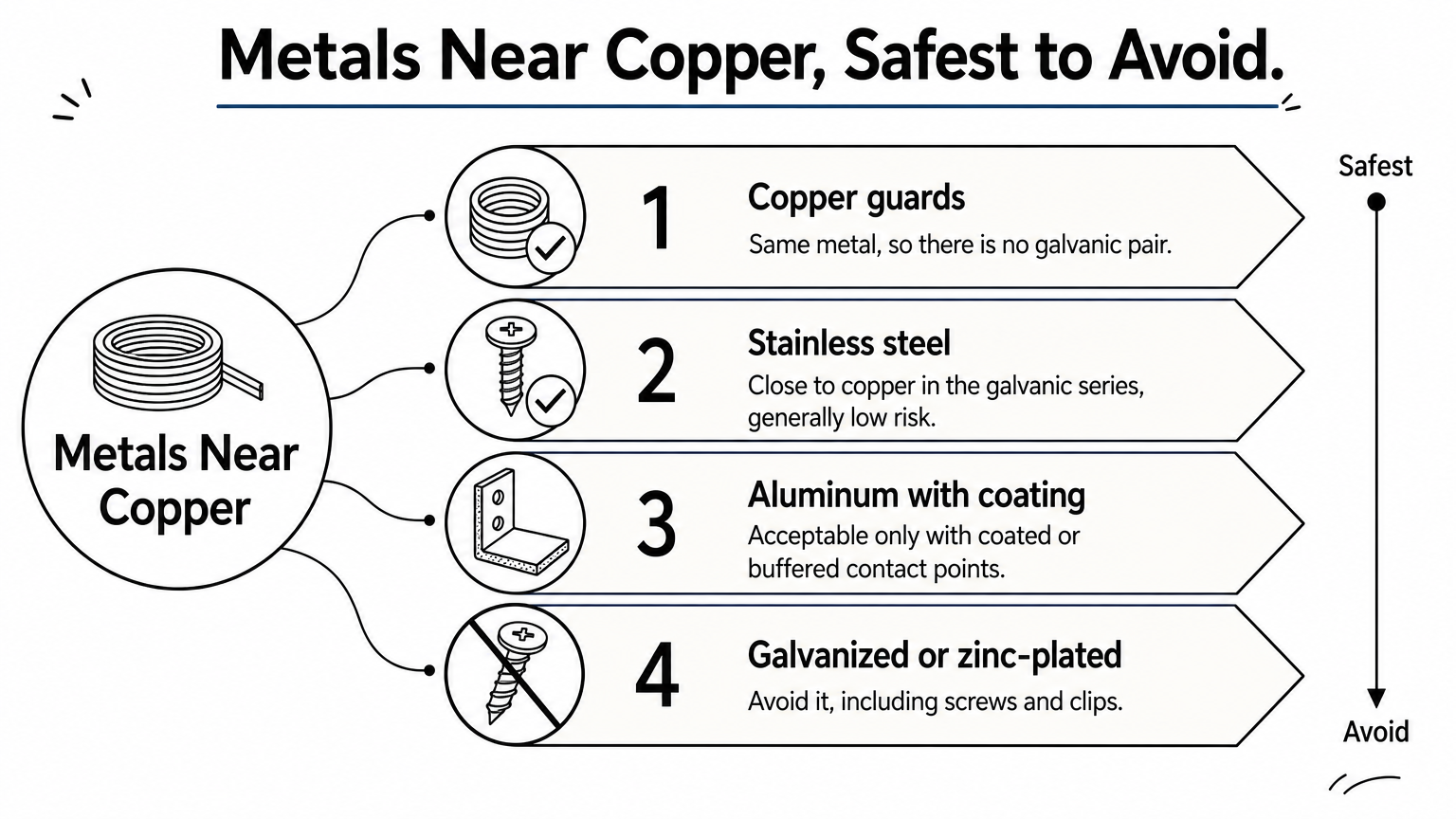
- Copper: the same metal, so there is no galvanic pair. The safest choice.
- Stainless steel: close to copper in the galvanic series. Generally a low-risk pairing, especially when contact is limited.
- Aluminum: acceptable only with coated or buffered contact points.
- Galvanized or zinc-plated steel: avoid it, and that includes screws and clips.
Fasteners matter as much as the guard. A copper guard held on with zinc-plated screws recreates the problem in miniature. Use copper or stainless screws, and ask what the brackets are made of before you buy.
What should this cost you?
Answer four questions and get a fair price range for your home.
1. Copper micro mesh on a copper frame
Copper micro mesh is the best all-around choice for copper gutters, because it matches the metal and has the finest openings.
How it works
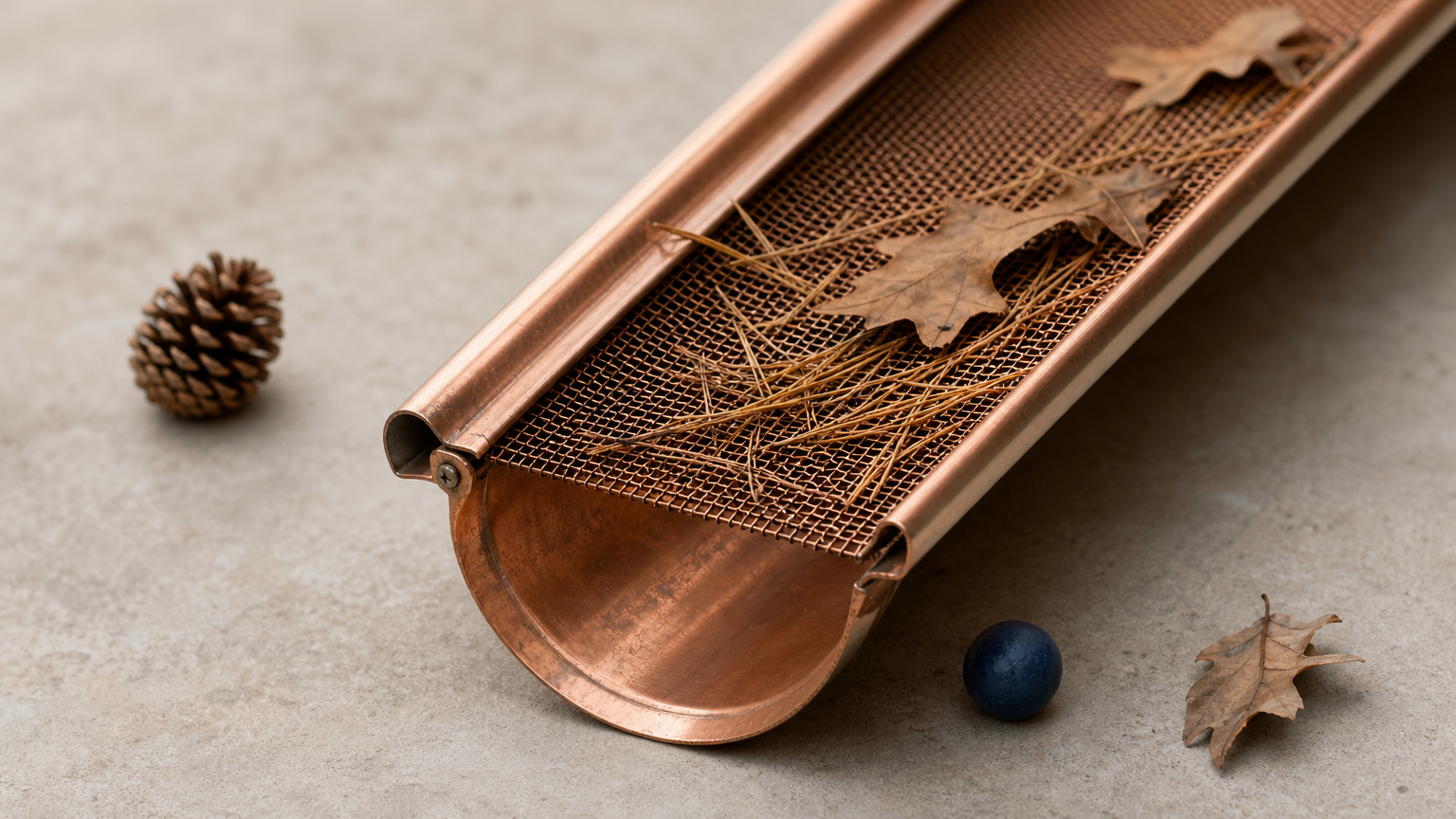
Copper micro mesh gutter guards stretch a fine copper screen over a rigid frame that sits across the gutter opening. Water clings to the mesh and drops through, while leaves, pine needles and roof grit stay on top and shed in wind and rain. Every part is copper, so there is no galvanic pair. One example is the LEAF4GO Elite Micromesh Copper cover for 5-inch gutters, which is sold as stopping leaves, pine needles and roof grit.
The mesh also weathers with your gutters. It darkens, then moves toward brown and eventually green patina, so the guard and the gutter age together instead of one looking new beside the other.
Copper micro mesh is the cleanest match: the same metal as your gutters with the finest openings on this list.
Who it suits and what to check
This is the pick for homes under pines, for shingle roofs that shed grit, and for owners who want the strongest protection and accept a premium price per foot. Check these points before you buy:
- Fine pollen and seed fuzz can film over any micro mesh, so plan an occasional rinse or soft brush.
- Many micro mesh systems tuck under the first row of shingles. Confirm that this will not affect your shingle warranty.
- Confirm your gutter width, usually 5 or 6 inches, before you order.
2. Stainless steel mesh with a copper base
A stainless mesh on a copper base gives you micro mesh filtering with copper against your gutter, often at a lower material cost than all-copper mesh.
How it works
This hybrid pairs a stainless steel micro mesh screen with a copper base, so the part touching your gutter is copper and the fine screen is stainless. Hallett’s Dynamic Flo guard is one example, and it is sold by the piece. Stainless sits much closer to copper than aluminum does in the galvanic series. That makes it a generally low-risk pairing, and the copper base limits contact further.
The fine screen blocks the same small debris as copper micro mesh. Stainless also resists rust, so the screen stays flat and rigid over time.
A copper base keeps the metal against your gutter matched while stainless handles the fine filtering.
Who it suits and what to check
Choose this if you want micro mesh performance and would like to spend less than an all-copper mesh costs. Stainless is cheaper than copper, but compare the per-foot price rather than assuming. Watch for these:
- Verify that the base is solid copper, not a copper-colored coating on another metal.
- Expect the mesh to stay silver while the base patinas, so the look differs from all-copper.
- Use copper or stainless fasteners only.
3. Copper screen, perforated or woven
A copper screen is the simplest all-copper guard, and it works best where leaves are the main problem.
How it works
A copper gutter screen is a perforated or woven copper sheet that lies across the gutter. Its openings are larger than micro mesh, so it stops leaves, sticks and acorns while finer grit drops through. K&M sells one in 16 oz and 20 oz copper, in 5-foot lengths, for K-style, box and half-round gutters.
The ounce rating is the sheet weight per square foot. Sixteen-ounce copper is about 0.0216 inch thick, and 20-ounce is about 0.027 inch. The thicker 20 oz sheet holds its shape better, which matters in half-round and box gutters, where a thin screen can sag.
If you choose a copper screen, pay for the heavier gauge so it stays flat.
Who it suits and what to check
This suits leaf-heavy yards with oak and maple, and owners who want all-copper without paying for micro mesh. Keep these limits in mind:
- Pine needles and shingle grit pass through, so you still need an occasional flush.
- Ask how the screen is held down, because a loose edge can lift in wind.
- Cutting at corners and downspout outlets leaves sharp edges, so wear gloves.
4. Solid copper cover from an installer
A solid copper cover is the custom option, and it makes sense when you want a clean look and will hire a professional.
How it works
A solid cover has no openings across the top. Water follows the curve of the cover and enters through a slot at the front edge, while leaves slide off. Some installers fabricate these in copper and fit them with coated brackets so the metals never touch. Because the cover is built to your gutter, it can suit half-round and box profiles where stock guards fit poorly.
Solid covers work on surface adhesion. On a dry day, debris blows off. In rain, wet debris can ride the water into the front slot, and a heavy downpour can overshoot the opening on a steep roof.
A solid copper cover looks the cleanest, but ask how it behaves in a downpour, not only on a dry day.
Who it suits and what to check
This is for owners of copper homes who want a low-profile, custom look and plan to hire out the work. Cost includes labor and fabrication, so get written quotes. Our cost estimator can give you a range by guard type, material and linear feet before you call anyone. Ask each installer:
- Is the cover itself copper, and what are the brackets and screws made of?
- What touches the gutter, and how is that contact isolated?
- What does the warranty cover, in writing, and who clears a clog if one happens?
5. Aluminum guard with isolated contact points
An aluminum guard on copper is a workaround, not a match, and I would only choose it when copper is out of budget and the installer isolates every contact point.
How it works
Aluminum guards can sit on copper only when two conditions hold. Contact must be occasional, such as a bracket here and there, not a guard resting along the whole gutter lip. And a barrier must sit wherever the metals touch. Installers use a rubber-type coating such as Plasti Dip on the brackets for this.
A flat aluminum screen laid along the copper lip is continuous contact, so it fails the test. Aluminum is lighter and cheaper than copper, which is why people are tempted.
Aluminum on copper only works when the two metals barely touch and a coating separates them where they do.
Who it suits and what to check
This fits a tight budget with an experienced installer who will explain each contact point. I would not treat it as a casual DIY job. Before you agree, ask about:
- How long the coating lasts, since it can wear where brackets flex.
- Whether any screw, clip or end cap touches the copper uncoated.
- A written statement of how the guard is isolated.
How to match a guard to your gutter profile
Match the guard to your gutter’s profile and width first, then to your debris. The best gutter guard for copper gutters is useless if it does not fit.
Compare the five types side by side
| Option | Metal | Debris it stops | Best for |
|---|---|---|---|
| 1. Copper micro mesh | All copper | Leaves, needles, roof grit | Pines and gritty shingles |
| 2. Stainless mesh, copper base | Stainless and copper | Leaves, needles, roof grit | Micro mesh on a tighter budget |
| 3. Copper screen | All copper | Leaves, sticks, acorns | Leaf-heavy yards |
| 4. Solid copper cover | Copper, coated brackets | Large debris | Custom look, hired install |
| 5. Aluminum, isolated | Aluminum plus coating | Depends on design | Last resort on a budget |
Measure and size for half-round and K-style
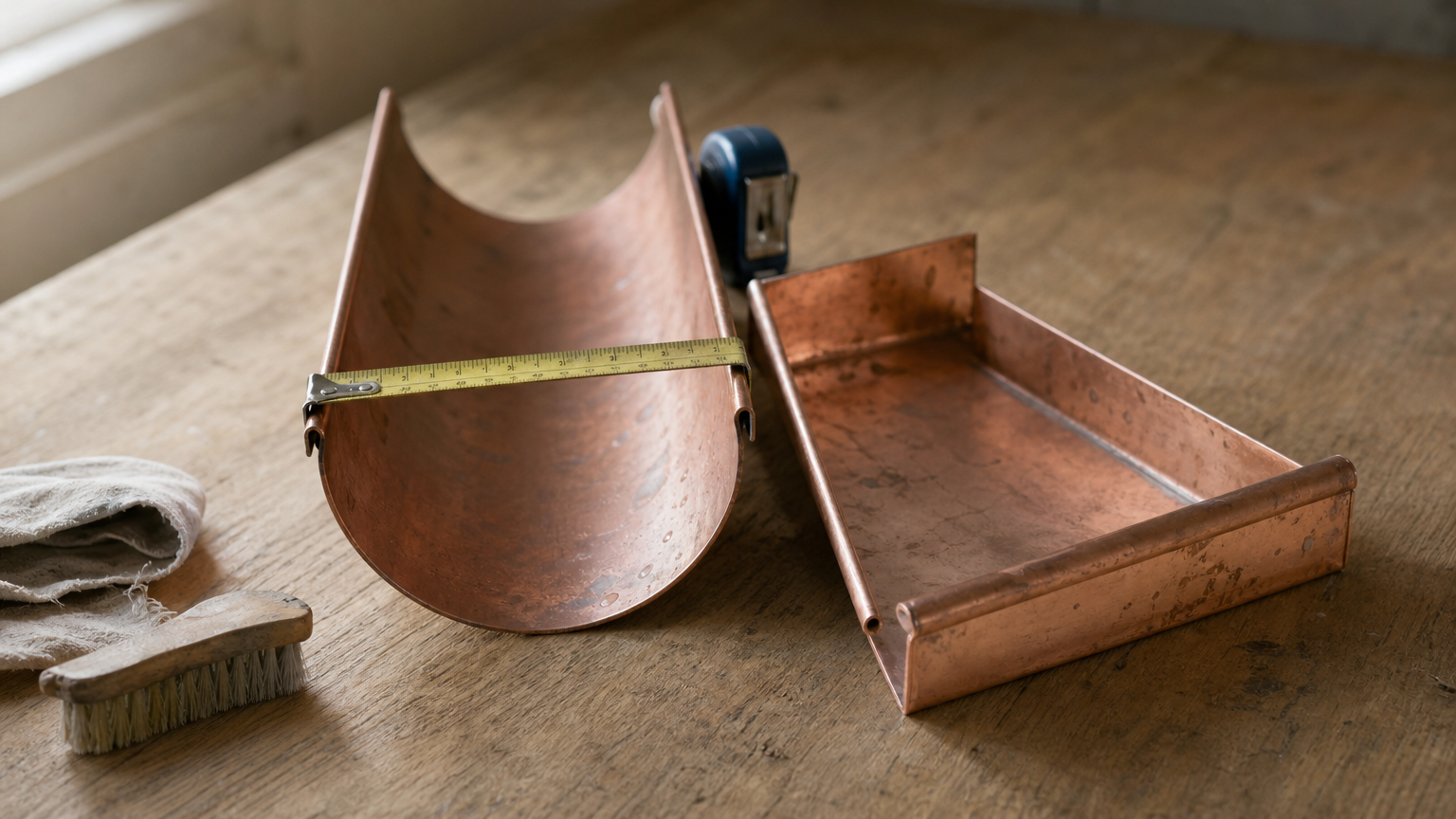
Measure the width across the top of the gutter. Five and six inches are the common sizes, and a 5-inch guard on a 6-inch gutter leaves a gap. Half-round gutters have a curved bowl, so a flat screen spans the opening and can sag. Look for a guard formed to the curve, such as Rapid Materials’ 5-inch round copper leaf guard, which is described as fully compatible with copper gutters. K-style gutters have a flat bottom, and many copper screens fit both profiles.
Here is a worked example. A house has 150 linear feet of gutter, and the screens come in 5-foot lengths. That is 150 divided by 5, or 30 pieces. Order about 32 to cover cuts at corners and downspout outlets, and measure each run separately before you buy.
Pick the metal first, then the mesh
For copper gutters, choose the metal before you choose the mesh. Copper micro mesh is the best overall pick, a stainless mesh on a copper base is the value variation, a copper screen is the simple leaf solution, and a solid copper cover is the custom route. Use aluminum only with documented isolation, and keep zinc-plated fasteners off the roof entirely.
If you would rather have a pro fit it, request a free gutter guard installation quote and tell the contractor your gutters are copper before they measure.
What should this cost you?
Answer four questions and get a fair price range for your home.