
Short answer: The best gutter guards for oak trees are stainless steel micro-mesh and solid reverse-curve hoods. Micro-mesh keeps sticky tassels, leaves and grit out of the gutter, but you still rinse the top once or twice a year. A reverse-curve hood sheds acorns and leaves best and suits you if you want to rinse from the ground. Aluminum screens, brushes and foam inserts struggle under oaks and mostly add work. Ready for quotes? Compare local pros →
In this guide
An oak drops three different kinds of debris on a schedule. Sticky tassels come in spring, and acorns and leaves come in fall. Most guards handle one of these well and fail on another. That is why so many homeowners pay for guards and still end up on a ladder.
This guide ranks four guard types by how they handle each oak problem, what they cost, and who they fit. A former gutter installer wrote it and a home inspector reviewed it. We do not sell or install anything, and we do not endorse a brand. Contractors cannot pay to appear here.
What oak trees drop and what each debris does
An oak sheds tassels, acorns and leaves at different times, and each one breaks a different kind of guard. Know which of the three hurts you most, because that decides which type to buy.
Tassels, acorns and leaves are three different problems
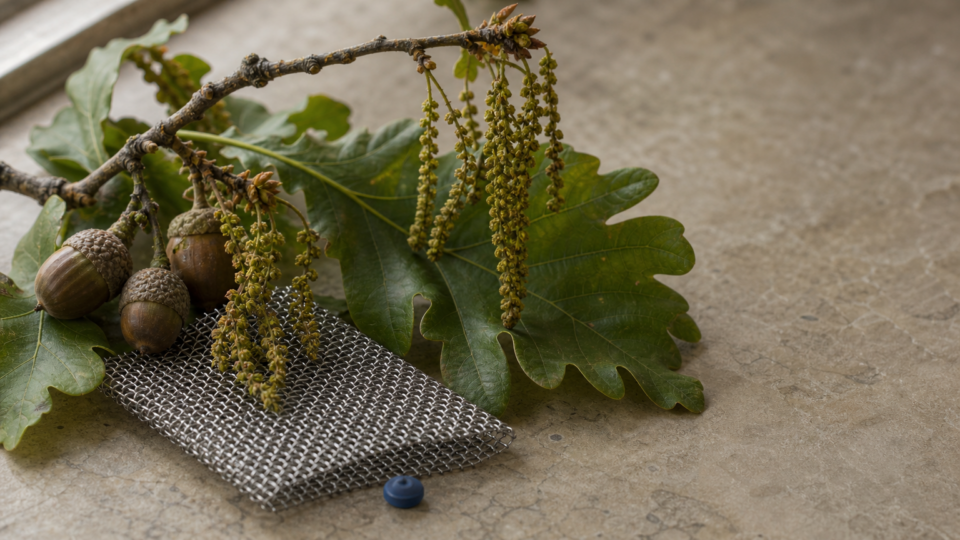
Tassels (catkins) are the stringy flowers that fall in spring, usually over a few weeks. They are sticky, they cling to textured surfaces, and they mat together. Open holes let the small pieces through, and fine mesh lets them sit on top.

Acorns and leaves arrive in fall. Acorns are hard and round, so they roll off a smooth, pitched surface but jam downspouts when they get inside. Leaves are heavy and flat. They pile on low-slope guards and rot in place. Some oaks also hold dead leaves into winter, so the debris season can run longer than you expect.
Tassels clog by sticking, acorns clog by rolling in, and a guard has to beat both.
How the four guard types compare
The table sets each type against the three debris problems. Details and costs follow in each item.
| Rank | Guard type | Tassels | Acorns | Leaves | Verdict for oaks |
|---|---|---|---|---|---|
| 1 | Stainless micro-mesh | Blocked, but mat on top | Sit on top, roll off on pitch | Blocked | Best for heavy canopy |
| 2 | Reverse-curve hood | Dry ones blow off, wet ones can enter the slot | Roll off | Slide off | Best for low upkeep |
| 3 | Aluminum screen | Slip through and stick | Mostly blocked | Pile up and rot | Light oak cover only |
| 4 | Brush and foam | Trapped inside the guard | Sit on top | Pile up | Skip under oaks |
What should this cost you?
Answer four questions and get a fair price range for your home.
1. Stainless steel micro-mesh
Stainless micro-mesh ranks first because its holes are too fine for tassels, shingle grit and most seeds to enter. It is the best pick when oaks hang directly over your roof.
Performance with oak debris
Micro-mesh does not make tassels disappear. Sticky catkins mat on top of the mesh in spring, and a thick mat can slow water until rain spills over the front edge. A hose rinse or a soft brush once tassel season ends clears it.
Acorns and leaves sit on top and often blow or roll off if the roof has enough pitch. Slope matters more than most buyers realize. A mesh tucked under the first shingle course tilts forward and sheds debris. One that sits flat inside the gutter holds more on top.
Micro-mesh stops tassels from entering the gutter, but you still have to wipe them off the top.
Best fit, cost and upkeep
Choose micro-mesh if you have a heavy oak canopy and accept one quick rinse or brush per year. Ask for stainless steel mesh on a rigid frame. Cheap aluminum mesh on a plastic frame can sag and warp. LeafFilter and Gutterglove are two well-known micro-mesh names. Compare how each one mounts on your roof before you compare prices.
- Cost: professional installs fall inside the $7 to $35 per linear foot range, and national brands sit at the top of it.
- Lifespan: 15 to 25 years.
- Upkeep: a rinse after tassel season, and a gentle brush after leaf drop if debris builds up.
2. Reverse-curve hoods
A solid reverse-curve hood ranks second because it handles acorns and leaves better than anything else, with the least upkeep. Its weak spot is wet tassels.

Performance with oak debris
A reverse-curve guard is a smooth, solid hood. Water clings to the curve and drops into the gutter through a slot at the front, while debris slides off the top. Acorns and leaves roll off a dry hood easily. Dry tassels blow away once the sun dries them.
Wet tassels are the problem. Debris carried by rainwater can ride into the front slot, and sticky catkins collect there. In a hard downpour on a steep roof, water can also sheet past the front edge. You also cannot reach the gutter without lifting the hood.
A reverse-curve hood sheds acorns best, but the front slot is where oak tassels collect.
Best fit, cost and upkeep
Choose a reverse-curve hood if you want to rinse from the ground and keep off the ladder. Look for a smooth, solid top without texture, because sticky tassels grab textured surfaces. Brand names confuse this one. LeafGuard is a reverse-curve style, while LeafFilter is a micro-mesh, so compare designs rather than names. Skip this type on very steep roofs or where downpours are common.
- Cost: inside the $7 to $35 per linear foot range, with national brands at the top.
- Lifespan: 15 to 25 years.
- Upkeep: hose off the top and check the front slot after tassel season.
3. Aluminum screen guards
An aluminum screen ranks third because it is cheap and blocks acorns, but it fails against tassels. It only suits a roof with light oak cover.
Performance with oak debris
A screen has holes large enough for small debris to pass. Tassels thread through the openings and stick to the screen and the gutter below. Leaves land on top and rot in place, so you end up cleaning both the screen and the gutter underneath. That is more work than no guard at all.
Acorns are the one thing a screen handles reasonably, since they are too big for most openings. A screen full of wet leaves can still send water over the front edge in a heavy rain.
A screen turns oak season into two cleaning jobs, the top and the gutter underneath.
Best fit, cost and upkeep
Screens suit a shed, a garage or a roof with one small oak branch overhead. They also suit a homeowner on a tight budget who will clear the top. Snap-in screens are a common DIY project. Under a full oak canopy, spend the money on micro-mesh or a hood instead.
- Cost: DIY screen materials run $1 to $4 per foot.
- Lifespan: plastic screens last 3 to 8 years. Metal ones vary with material and sun exposure.
- Upkeep: clear the top several times a year, and check the gutter underneath.
4. Brush and foam inserts
Brush and foam inserts rank last. They sit inside the gutter, where tassels and pollen collect, and they hold moisture against your fascia. Under oaks, skip them.
Performance with oak debris
Brush guards are bristles that fill the gutter. Tassels and fine debris wedge between the bristles and break down into a wet mat. You pull the brushes out, shake them clean and put them back, which defeats the purpose of a guard.
Foam inserts work for a season. Then pollen, grit and rotting leaf bits pack into the foam and it becomes a sponge sitting against the fascia. Acorns and leaves collect on top of both types.
Brush and foam do not keep debris out of the gutter, they only give it somewhere to hide.
Best fit, cost and upkeep
Almost no oak home is a good fit. A brush guard can work as a short-term fix on a shed or a rental, or under pines where needles are the main debris. Foam is the one to avoid most, because trapped moisture can rot fascia boards over time.
- Cost: DIY materials run $1 to $4 per foot.
- Lifespan: 3 to 8 years for foam and plastic.
- Upkeep: pull and clean brushes several times a year, and replace foam when it packs solid.
How to choose and what to check before you buy
Pick the guard by the worst debris your oak drops, then check the quote for the details that decide how it performs in real life. A good choice fits your canopy, your roof pitch and your tolerance for chores.
Match the guard to your oak canopy
If branches hang directly over the roof, pick stainless micro-mesh or a smooth reverse-curve hood. If oaks stand farther back and drop only some debris, a screen can work for now. Pitch matters too. Low-slope roofs let debris sit, while steeper ones shed acorns but can overshoot a hood in heavy rain. Your own gutter slope also matters, because a guard cannot fix a gutter that does not drain to the downspout.
What a guard costs against cleaning
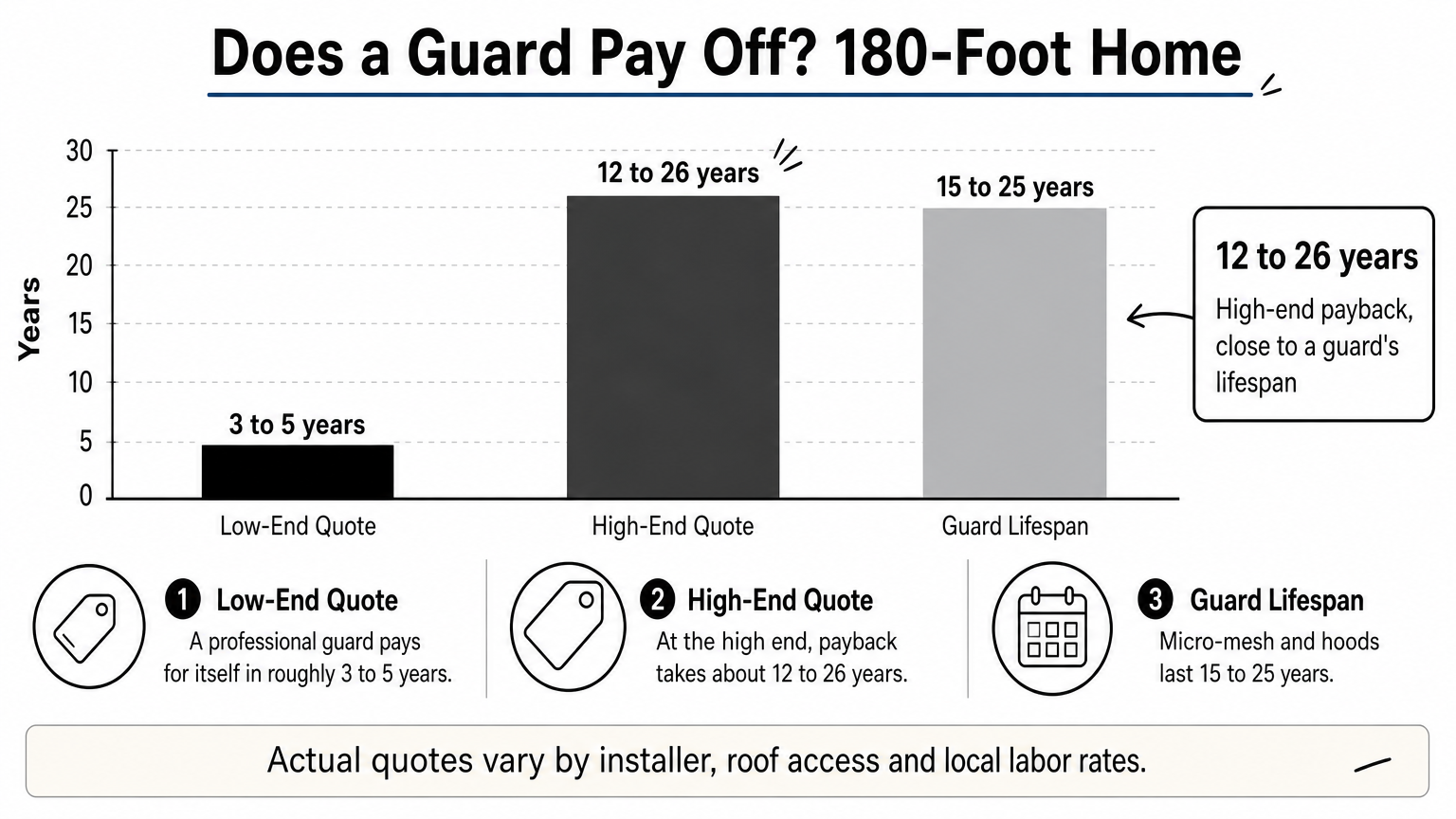
Take a typical 180-foot home, which is common for a two-story suburban house. Here is how the three paths compare.
| Option | Upfront cost | Ongoing cost |
|---|---|---|
| DIY screen or foam | $180 to $720 in materials | Your time, several clearings a year |
| Professional guard | $1,260 to $6,300 | A rinse once or twice a year |
| No guard | $0 | Two cleanings a year at $120 to $250 each, so $240 to $500 |
At the low end, a professional guard pays for itself against cleaning in roughly 3 to 5 years. At the high end it takes about 12 to 26 years, close to the guard’s lifespan. Actual quotes vary by installer, roof access and local labor rates, so treat these as national ranges.
Questions to ask before signing
Use this list when you compare quotes:
- What material is the mesh and the frame? Ask for stainless steel in writing.
- How does the guard mount, and does it keep the roof’s slope?
- Does the warranty cover the guard surface clogging, or only debris inside the gutter?
- Are the gutters and fascia sound before the guard goes on?
- How do I clean the top and reach the gutter later?
Beware any promise of zero maintenance under oaks. A tassel mat on mesh is normal, and a warranty that excludes it will not help you.
Ask what the warranty covers, because "no clogging" often means inside the gutter, not on top of the guard.
Which oak guard to pick
For a heavy oak canopy, choose stainless micro-mesh if you will rinse the top yearly, or a smooth reverse-curve hood if you want to rinse from the ground. Screens fit only light cover, and brush and foam do not belong under oaks. No type makes oak season maintenance-free, but the right one turns four cleanings into one rinse.
When you are ready to compare real prices, get a free gutter guard quote. You will see an estimated cost range first, and you can compare local installer quotes against it.
What should this cost you?
Answer four questions and get a fair price range for your home.