
Short answer: Should I repair or replace gutters? Repair them when the damage sits in one or two spots, the system is under about 15 years old, and the repair quote comes in well below half the price of new gutters. Replace them when the gutters are 18 years old or more, problems show up on several runs, or you keep paying for the same fix. Age, spread of damage, and cost decide it. Ready for quotes? Compare local pros →
In this guide
The choice is hard because a leaking seam looks the same whether it needs a tube of sealant or signals a system at the end of its life. Most homeowners buy gutters once or twice, so you have no baseline for a fair price. A quote can also lean either way depending on who writes it.
This guide walks through the decision in four steps. It comes from Guardian Gutter Guide, an independent resource that does not install gutters. Marcus Delaney, a former installer with 12 years in the trade, wrote it, and Dana Whitfield, a home inspector, reviewed it. By the end you will have a count of your problem spots and a side-by-side price comparison.
Why age, spread and cost decide the answer
The repair-or-replace question comes down to three tests, because each one answers something different. Age shows how much life is left, spread shows whether the problem is local, and cost shows whether a repair is still a good deal.
The decision rules at a glance
Use this table as your scorecard for gutter repair vs replacement. You will fill in each row over the next four steps.
| Test | Leans repair | Leans replace |
|---|---|---|
| Age | Under 15 years | 18 years or more |
| Spread | One or two spots, one side of the house | Three or more runs affected |
| Cost | Repair quote under 50% of replacement | Repair quote at or above 50% |
| History | First repair in years | Two or more repair visits in three years |
Ages between 15 and 18 years are a gray zone, so let the other three rows break the tie.
No single symptom decides it; the pattern across age, spread, and cost does.
Why patching fails on a worn-out system
Repairs treat symptoms. A new hanger or a dab of sealant works when the rest of the run is sound, but fatigued hangers, failing joints, and weakened metal show up everywhere at once as a system ages.
That is why repairs on old gutters turn into whack-a-mole. You fix the seam at the corner, and a different seam starts dripping next season. Each visit is cheap, but the total keeps climbing while the underlying problem stays put.
What should this cost you?
Answer four questions and get a fair price range for your home.
Step 1. Find the age and material of your gutters
Start with age, because it sets the odds before you look at any damage. Under 15 years leans repair, 18 years or more leans replace, and the years between depend on what the next three steps turn up.
Look up the age and material
Check your home inspection report, the roof replacement date, or the seller’s disclosure. If none exists, estimate from condition. Heavy rust, flaking paint, and brittle, chalky metal point to an old system.
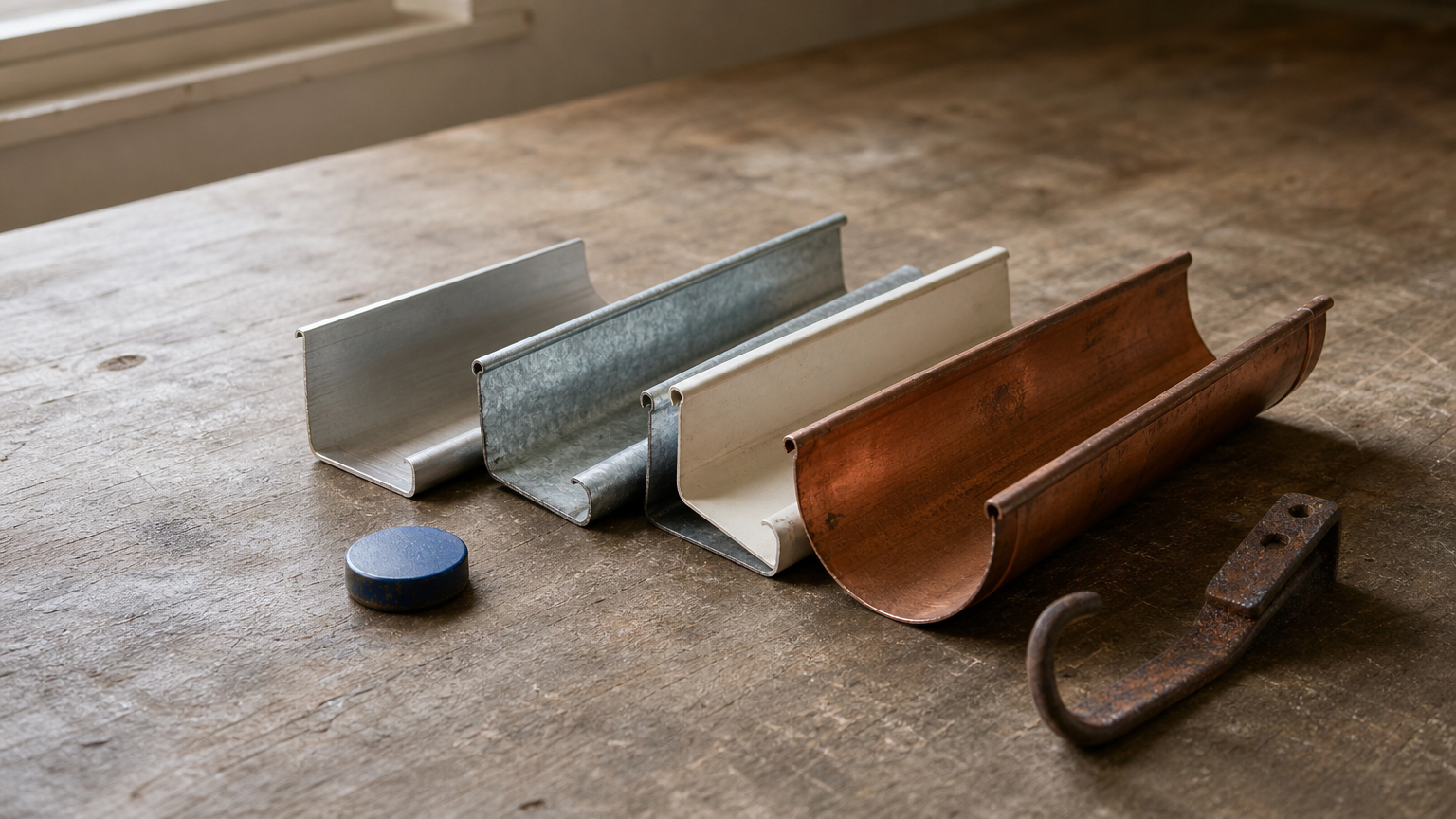
Then identify the material. A magnet sticks to steel but not to aluminum or copper. Vinyl is plastic and often cracks along the bottom edge.
| Material | Typical lifespan | What it means for your decision |
|---|---|---|
| Seamless aluminum | 20 to 30 years | Dents easily but does not rust, so repairs hold well |
| Galvanized steel | 15 to 25 years | Rusts at fasteners and seams as it ages |
| Vinyl | 10 to 20 years | Cracks and warps in sun and cold |
| Copper | 50+ years | Replacement is costly, so lean toward repair |
The older the system, the less a repair buys you.
Check whether the system is seamless or sectional
Seamless gutters are one continuous piece per run, with joints only at corners and downspouts. They are repair-friendly. Sectional gutters have a seam every few feet, and each one is a future leak.
If you have sectional gutters and they are past 15 years, replacement with seamless usually beats chasing leaks one joint at a time.
Step 2. Map the damage on every run
Walk the whole house and count problem spots. Three or more problems on different runs means the system is failing as a whole, while one or two spots in the same area means a local repair.
Walk each run in the rain or with a hose
Rain shows you exactly where water escapes. If it is dry, run a garden hose into the high end of each gutter and watch from the ground. Look for these:
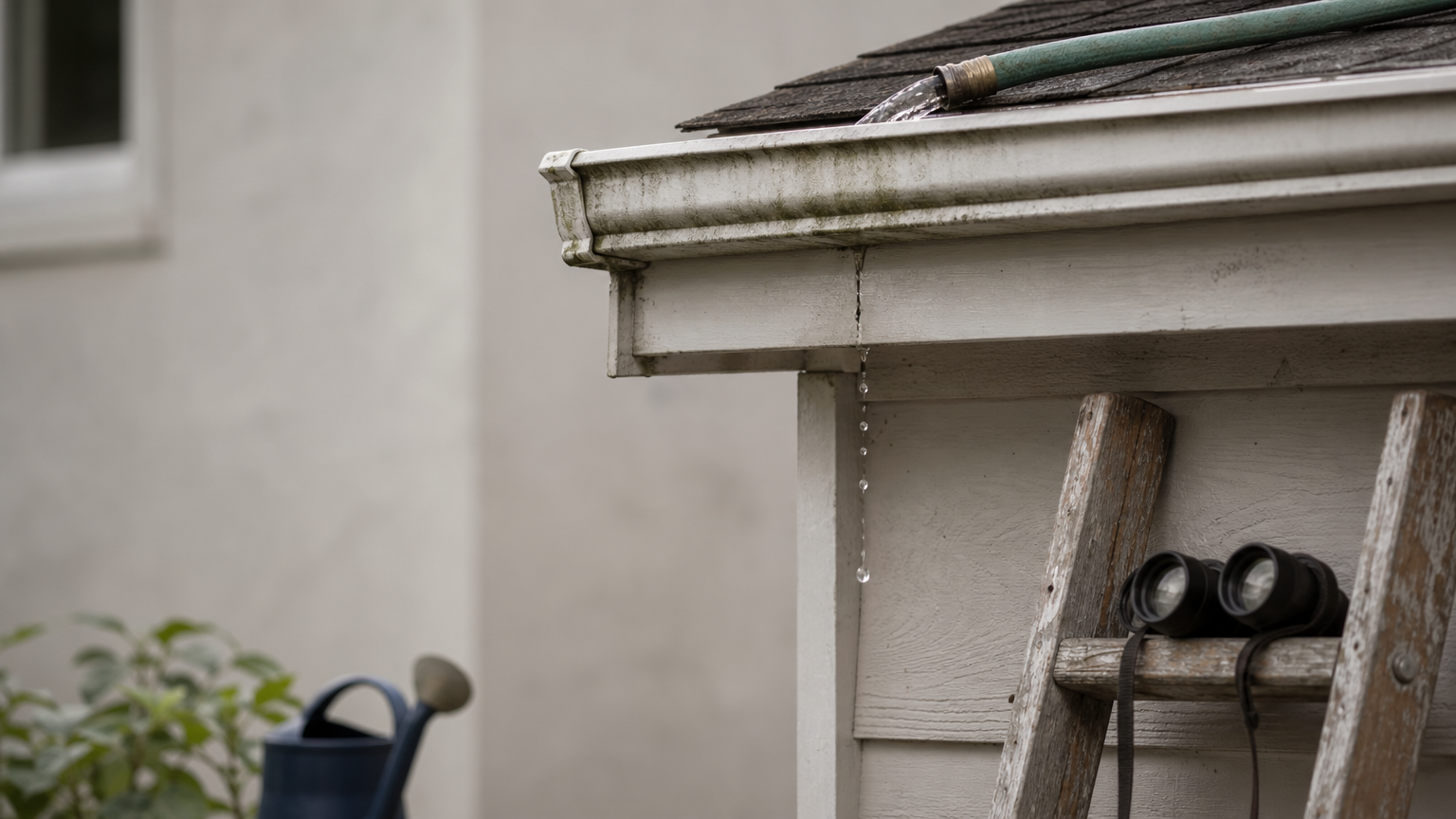
- Drips at seams, end caps, and corners.
- Water pooling or standing after the flow stops, which means the pitch is off.
- Overflow over the front edge when the gutter is clear.
- Stains on siding below the gutter.
- Gaps between the gutter and the fascia board.
Note each problem and which wall it is on. Do not climb a ladder if you are not comfortable. Binoculars work well.
Sort each problem into repair or replace
| What you see | Usually means |
|---|---|
| One leaking seam or end cap | Repair: clean, dry, and reseal with gutter sealant |
| Small hole or crack | Repair: patch with sealant or metal flashing |
| One or two loose hangers | Repair: re-screw into solid wood or add hangers |
| Sag in one spot, solid fascia | Repair: rehang and tighten |
| Sag in several spots | Replace |
| Rust holes or cracks across multiple runs | Replace |
| Soft or rotted fascia in several places | Replace |
| Peeling paint, stains below the gutter, mildew near the foundation | System is failing; lean replace |
If you see water in the basement, check the grading and downspout extensions too, since gutters are not the only cause.
Count the problem spots first; one or two is a repair, three or more is a pattern.
Step 3. Price both options with the same scope
Compare the two prices before you decide. A repair worth doing costs well under half of replacement. Past that point you are paying for time that new gutters would give you more cheaply.
Know the typical ranges
Repairs commonly run from about $100 to $625, depending on the fix. Full replacement commonly runs from about $1,500 to $6,000, driven by linear feet, number of stories, and material. As a working range for seamless aluminum, use $9 to $16 per linear foot installed. Those are national ranges, and actual quotes vary by installer, roof access, and local labor rates.
Apply the 50 percent rule
Take a 150-foot home. Replacement at $9 to $16 per foot comes to $1,350 to $2,400, so call it about $1,900 at the midpoint. A repair quote of $950 sits right at 50 percent.
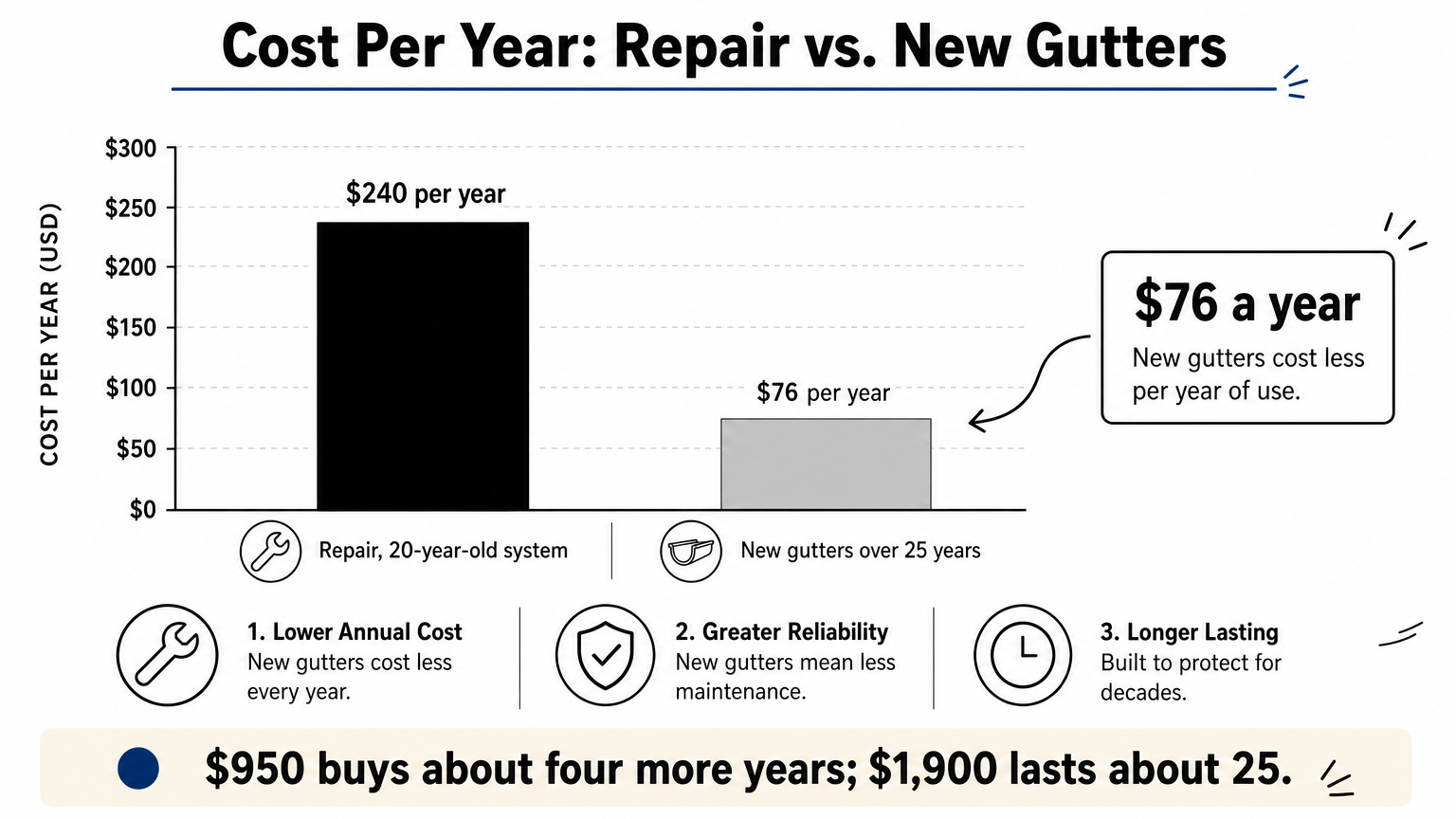
Age then breaks the tie. On an 8-year-old system, spend the $950, because the gutters have most of their life ahead. On a 20-year-old system, $950 might buy four more years, about $240 a year. New gutters at $1,900 over 25 years cost about $76 a year.
Rotted fascia changes the math too. Once you are paying for fascia work, the gap between rehanging old gutters and installing new ones shrinks fast.
A repair is only a bargain if the gutters it saves will outlast the money you spend.
Step 4. Make the call and get quotes
Add up your scorecard. Replace if two or more of the following are true, and repair if none or only one is.
Score your results
- The gutters are 18 years old or more (or 15 and sectional).
- Problems show up on three or more runs.
- The repair quote is at or above 50 percent of replacement.
- You have paid for two or more repair visits in the last three years.
- The fascia is rotted in more than one spot.
If you score one, make the repair and recheck in a year. If you score two or more, replacing is the cheaper path over time.
Get quotes that confirm it
Ask for written, itemized quotes for both repair and replacement, so you can run the 50 percent test with real numbers. A contractor should walk every run, inspect the fascia behind the gutters, and check downspout size and routing. Labor and materials should be listed separately.
Be wary of a replacement quote written without a look at the fascia. Ask what workmanship warranty comes with each option. Guardian Gutter Guide cannot diagnose gutters from a photo, so these quotes are your final check.
Make the call with numbers
Whether you should repair or replace gutters comes down to three checks: age, how many runs are damaged, and what a repair costs next to new gutters. A young system with one or two isolated problems is a repair. An old system with problems on several runs is a replacement.
Run your own count and the 50 percent test, then confirm with written quotes. When you are ready, request a free gutter repair estimate and ask for the replacement price alongside it, so you can compare the two directly.
What should this cost you?
Answer four questions and get a fair price range for your home.