
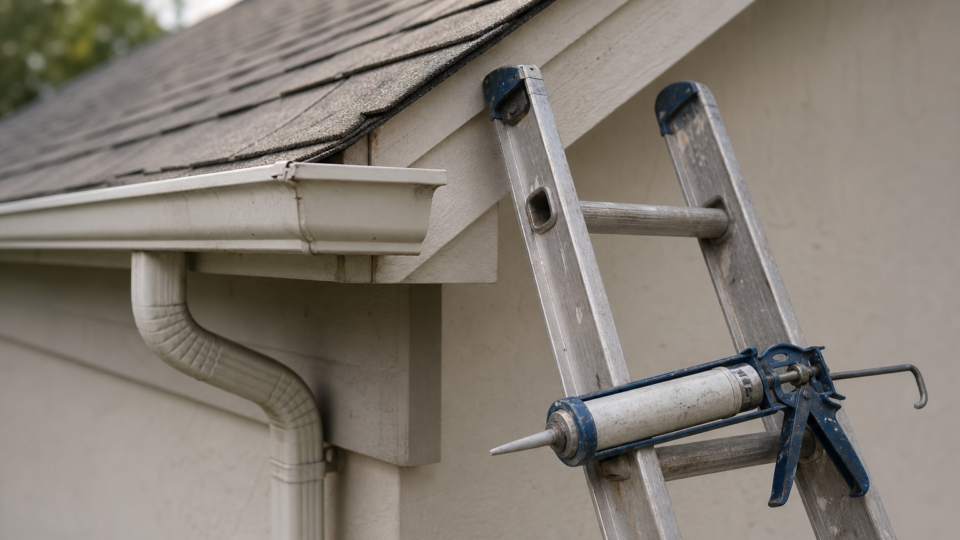
Short answer: You noticed water dripping behind your gutters, a sagging section pulling away from the fascia, or a downspout that won’t drain, and now you’re trying to figure out what a fair repair bill looks like before a contractor shows up. Gutter repair cost varies a lot depending on what’s actually wrong, and quotes can swing from under $100 to well over $1,000 for the same-sounding problem. Ready for quotes? Compare local pros →
In this guide
Most homeowners pay between $150 and $500 for a typical repair, with small fixes like resealing a seam running closer to $75 to $200, and bigger jobs like fascia replacement or a full section rehang landing at $500 or more. Per linear foot, expect to pay roughly $3 to $15 depending on material and labor rates in your area. Those numbers shift based on your gutter material, how much of the run is damaged, and whether your roof or fascia board needs work too.
Below, you’ll find a breakdown of costs by problem type, including sagging gutters, leaks, and downspout issues, plus how material choice and per-foot pricing affect your final bill. This guide draws on real installer pricing, not contractor marketing, so you can walk into any quote conversation knowing what’s reasonable.
Why gutter repair costs vary so much
Several factors stack on top of each other to produce that wide $150 to $500 range, and understanding them helps you spot a fair quote versus an inflated one. A cost for gutter repair depends less on a single price list and more on what a contractor finds once they’re actually up on the ladder looking at your fascia, your seams, and your downspout connections. Two homes with the same "my gutter is sagging" complaint can end up with bills $300 apart because one job is a quick bracket swap and the other involves rotted wood underneath.
Damage severity and type
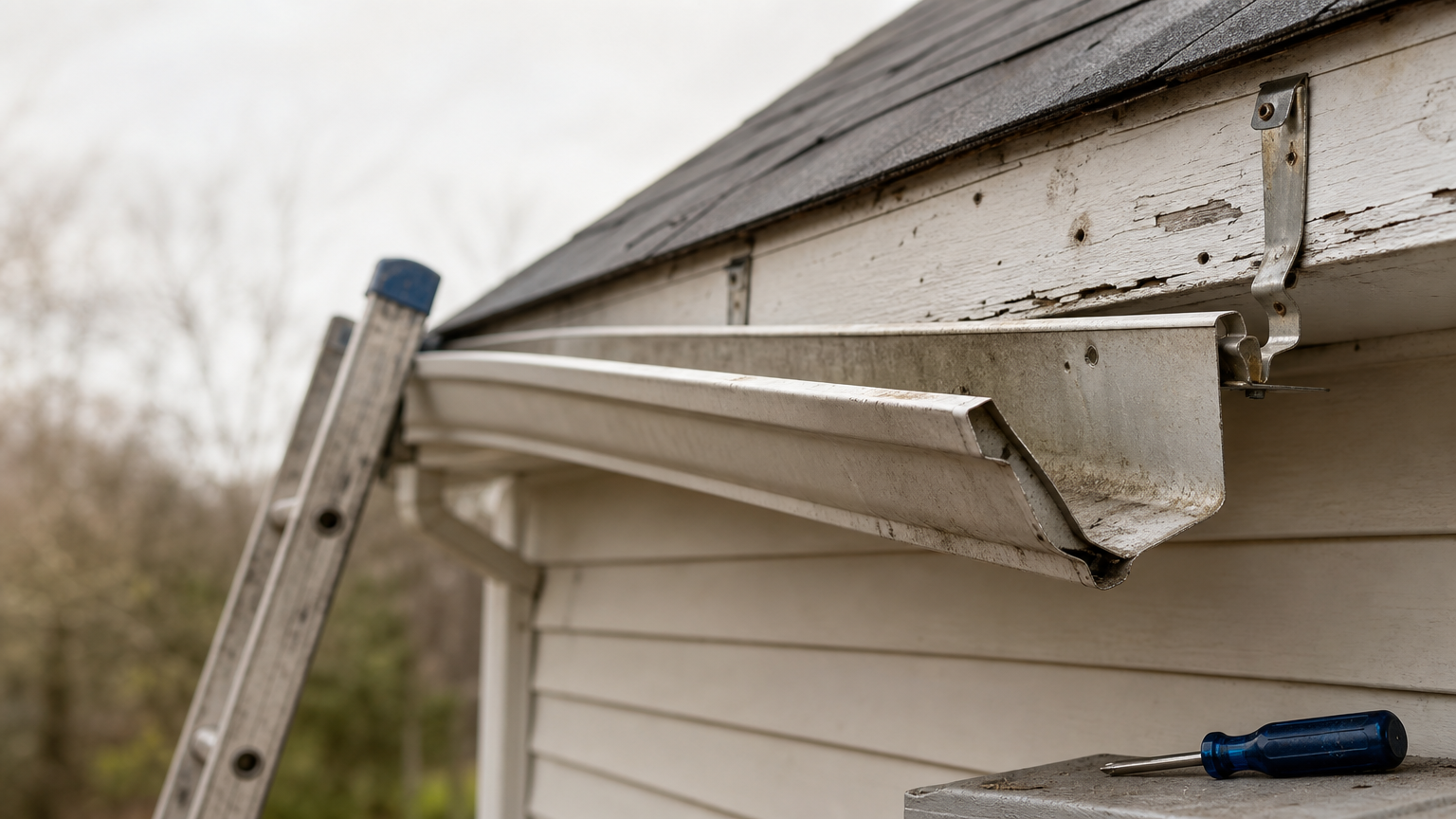
The single biggest driver of cost of gutter repair work is what’s actually broken. A loose hanger or a small seam leak is a 20-minute fix. A sagging gutter repair cost climbs fast when the sag has pulled fasteners out of the fascia, because now the contractor is drilling new anchor points or replacing sections of wood before they can even touch the gutter itself. Downspout problems follow the same pattern: a clogged elbow is cheap, but a gutter downspout repair cost rises sharply if the downspout has separated from the wall or if underground drainage extensions are crushed or buried.
The price of a gutter repair almost always tracks the damage underneath the gutter, not the gutter itself.
Material and age of your gutters
What your gutters are made of changes both the repair method and the price. Aluminum is the most common material and the cheapest to patch or replace in sections. Copper and galvanized steel cost more per foot because the material itself is pricier and fewer crews carry stock for it. Older seamless aluminum systems that have started to pit or corrode often need larger sections replaced rather than spot-patched, which pushes a small job toward the higher end of the range.
| Material | Typical repair difficulty | Relative cost impact |
|---|---|---|
| Aluminum | Easy, widely stocked | Baseline, lowest cost |
| Vinyl | Easy but brittle with age | Low, but cracks often need full section swap |
| Galvanized steel | Moderate, heavier to handle | 15-25% above aluminum |
| Copper | Specialized, fewer installers | 2-3x aluminum for the same repair |
Access, height, and roof complexity
Getting a ladder or lift safely positioned matters more than most homeowners expect. A single-story ranch with clear ground access costs less to work on than a two-story colonial with landscaping, a steep driveway, or a roof pitch that requires harnessing. Contractors price in the time it takes to set up staging, not just the time spent actually fixing the gutter, and that setup time doesn’t shrink for a small repair the way it does for a full replacement job where the labor gets spread across more linear feet.
Local labor rates and season
Where you live shifts the number too. A roof and gutter repair cost in a high cost-of-living metro area runs noticeably higher than the same job in a rural market, mostly because of labor rates rather than materials. Timing plays a role as well: booking a repair in the fall rush, right after the first big storm, often costs more than scheduling the same fix in early summer when crews have open calendars. If you want a number specific to your home before you start calling around, our gutter repair cost estimator factors in your region, home size, and damage type to give you a realistic range rather than a generic average.
What should this cost you?
Answer four questions and get a fair price range for your home.
How to estimate your gutter repair cost
Before you call anyone, you can get a reasonable ballpark yourself with a tape measure and a few honest observations about what’s wrong. Estimating how much does gutter repair cost for your specific house starts with measuring the linear footage of the damaged section, not your whole gutter run, since most contractors price repairs by the foot of affected gutter plus a flat fee for the visit.
Measure what’s actually damaged
Walk your gutter line and mark where the sag, leak, or separation starts and ends. Grab these basics before you estimate anything:
- Linear footage of the damaged section (not the whole house)
- Number of downspouts involved
- Whether fascia or soffit wood looks soft, discolored, or rotted
- Your gutter material (check for the telltale seams of aluminum vs. the heavier gauge of steel)
- How many stories the damaged section sits on
Apply a per-foot baseline
Once you have those numbers, a rough formula gets you close. Gutter repair cost per foot typically runs $3 to $15 depending on material and access, so a 10-foot damaged section at $8 per foot lands around $80 in materials and basic labor, before you add the service call fee most companies charge.
Estimated repair cost = (linear feet of damage x cost per foot) + service call fee
Example: (10 ft x $8/ft) + $75 = $155
Your estimate is only as good as your assumption about what’s hiding behind the gutter, so budget a cushion for surprises.
Add in the variables that push the number up
Access matters as much as materials. A two-story section needs ladder staging or a lift, which can tack on $50 to $150 just for setup, regardless of how small the actual fix is. If you spot soft or spongy fascia when you press on it, add another $200 to $400 for replacing the rotted wood behind the gutter, since almost no gutter repair estimate accounts for rotted structure until someone’s actually up there.
Running these numbers yourself won’t replace an in-person quote, but it does two things: it keeps you from panicking at a high first number, and it gives you a baseline to push back on if a quote comes in far outside what your math suggests. If you’d rather skip the manual math, our cost estimator tool plugs in your home size, material, and damage level to spit out a tighter range in under a minute.
Typical costs by repair type and material
Once you know roughly what’s wrong, you can compare your quote against real ranges instead of guessing. The average cost of gutter repair shifts based on the specific problem and the material you’re working with, and seeing both side by side makes it obvious why two "gutter repair" quotes can look nothing alike.
Common repair jobs and what they cost
Every repair category has a fairly predictable price band, assuming there’s no hidden rot behind it. Here’s what you should expect to pay for the most common jobs homeowners call about:
| Repair type | Typical cost range | Notes |
|---|---|---|
| Reseal a leaking seam | $75-$200 | Quick fix, often bundled with a service call |
| Reattach sagging section | $150-$400 | Cost jumps if fascia needs new anchor points |
| Replace damaged downspout | $100-$350 | Rises with length and underground extensions |
| Fascia board replacement | $300-$700 | Priced per linear foot of rotted wood |
| Full section rehang (10-20 ft) | $400-$900 | Includes new hangers and resealing |
| Downspout clog clearing | $75-$150 | No parts replaced, mostly labor |
A quote that ignores fascia condition is a quote that’s guessing, not measuring.
These numbers assume aluminum, the material most crews carry and price around. If your cost to fix gutters quote comes in noticeably above these ranges, ask specifically what’s driving the difference, whether it’s rot, access, or material.
How material changes the bill
Swapping in a different material shifts every one of those numbers, sometimes by a wide margin. Steel and copper repairs cost more not because the labor takes longer, but because the material itself is pricier and fewer local crews stock replacement parts for it, so they may need to special-order a matching section.
- Aluminum: cheapest to patch, widely available, matches easily to existing seamless runs
- Vinyl: inexpensive material, but brittle sections often need full replacement rather than a patch
- Galvanized steel: 15-25% above aluminum for the same job, heavier to handle on a ladder
- Copper: 2-3x aluminum pricing, often requires a specialist who solders rather than crimps seams
Knowing your gutter material before you call around answers the how much should gutter repair cost question more precisely than any general estimate, since material alone can double the bill for an identical-sounding fix.
Repair or replace: which makes more sense
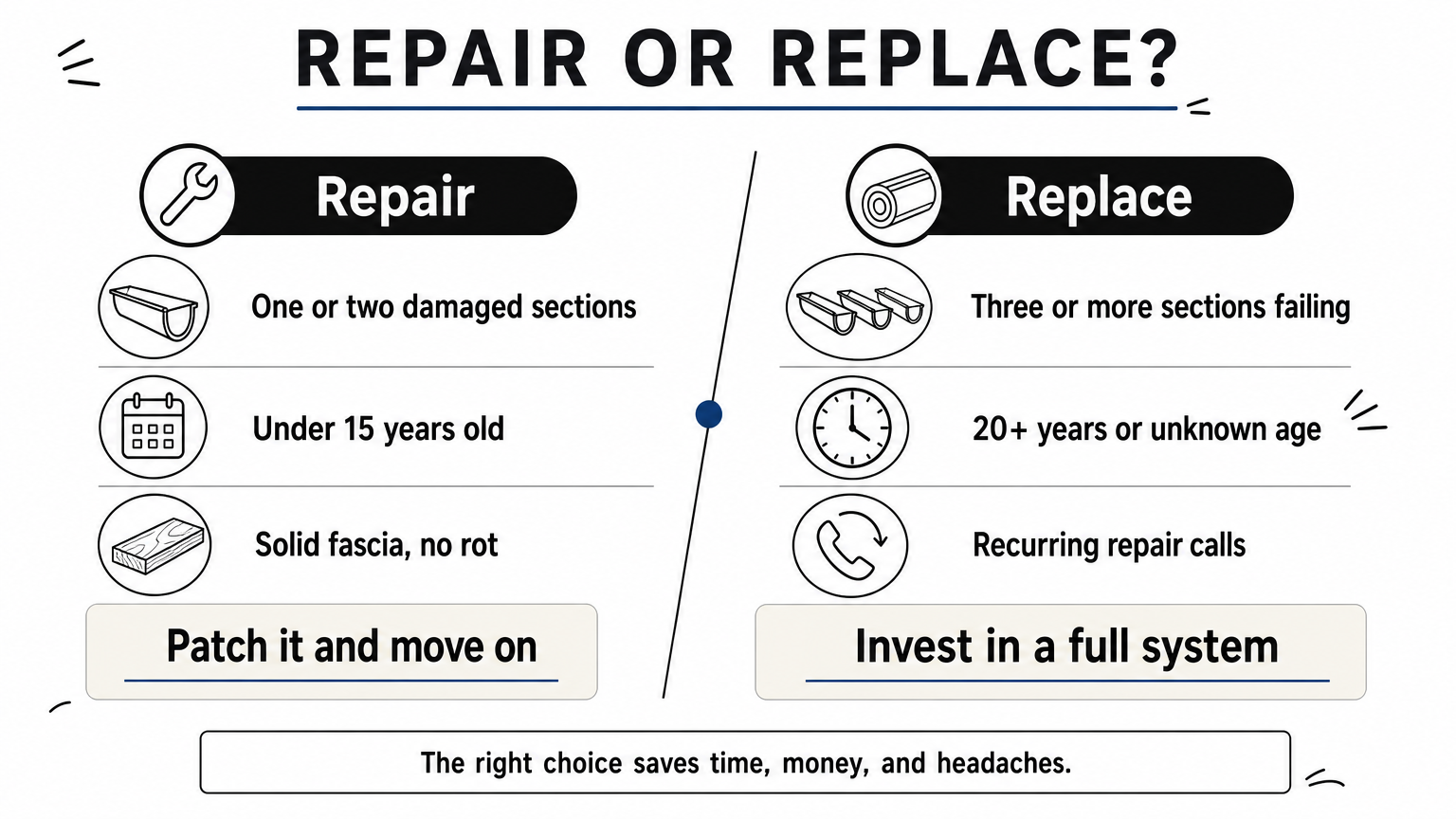
At some point, the math tips away from patching and toward tearing the whole system out. Deciding between a cost to repair gutter damage versus paying for full replacement usually comes down to how much of the run is affected and how old the existing gutters already are. A single bad section on an otherwise sound five-year-old aluminum system is an easy repair call. Three or four sagging sections on a 20-year-old run with visible corrosion is a different conversation entirely, even if each individual fix looks cheap on its own.
When repair still makes sense
Spot repairs earn their keep when the damage is contained and the rest of the system is holding up fine. Look for these signs before you commit to a patch job:
- Damage is limited to one or two sections, not spread across the whole house
- Gutters are less than 15 years old with no widespread pitting or rust
- Fascia and soffit wood behind the damaged area feels solid when pressed
- You’ve had no more than one or two repair calls in the past few years
When replacement wins on cost
Once you’re calling a contractor every season, the running total of small fixes starts to outpace what a new system would have cost upfront. A full aluminum gutter replacement typically runs $6 to $12 per linear foot installed, which means a house needing 150 feet of new gutter lands somewhere around $900 to $1,800, not far off from what three or four separate repair visits can add up to over a couple of years.
If you’ve paid for more than two repairs on the same section in three years, you’re financing a replacement in installments.
| Situation | Repair makes sense | Replacement makes sense |
|---|---|---|
| Age of gutters | Under 15 years | 20+ years or unknown history |
| Damage spread | One or two sections | Three or more sections, or whole-house sagging |
| Fascia condition | Solid, no rot | Soft or rotted in multiple spots |
| Repair history | First or second call | Recurring calls on same area |
Running both scenarios through a calculator before you commit either way helps you see the real numbers side by side instead of guessing. Our cost estimator tool lets you compare a targeted repair quote against a full replacement estimate for your home’s size and material, so you’re not deciding blind. Whichever way you go, get the comparison in writing before you sign anything, since a contractor who only offers replacement quotes may not be giving you the full picture.
How to keep your gutter repair costs down
Spending less on gutter repair usually comes down to catching problems early and doing a few cheap things twice a year rather than one expensive thing once every five. Most homeowners who ask how much does it cost to repair a gutter are really asking after the damage has already spread, and that’s the moment where prevention stops being an option and starts being a bill.
Catch small problems before they become big ones
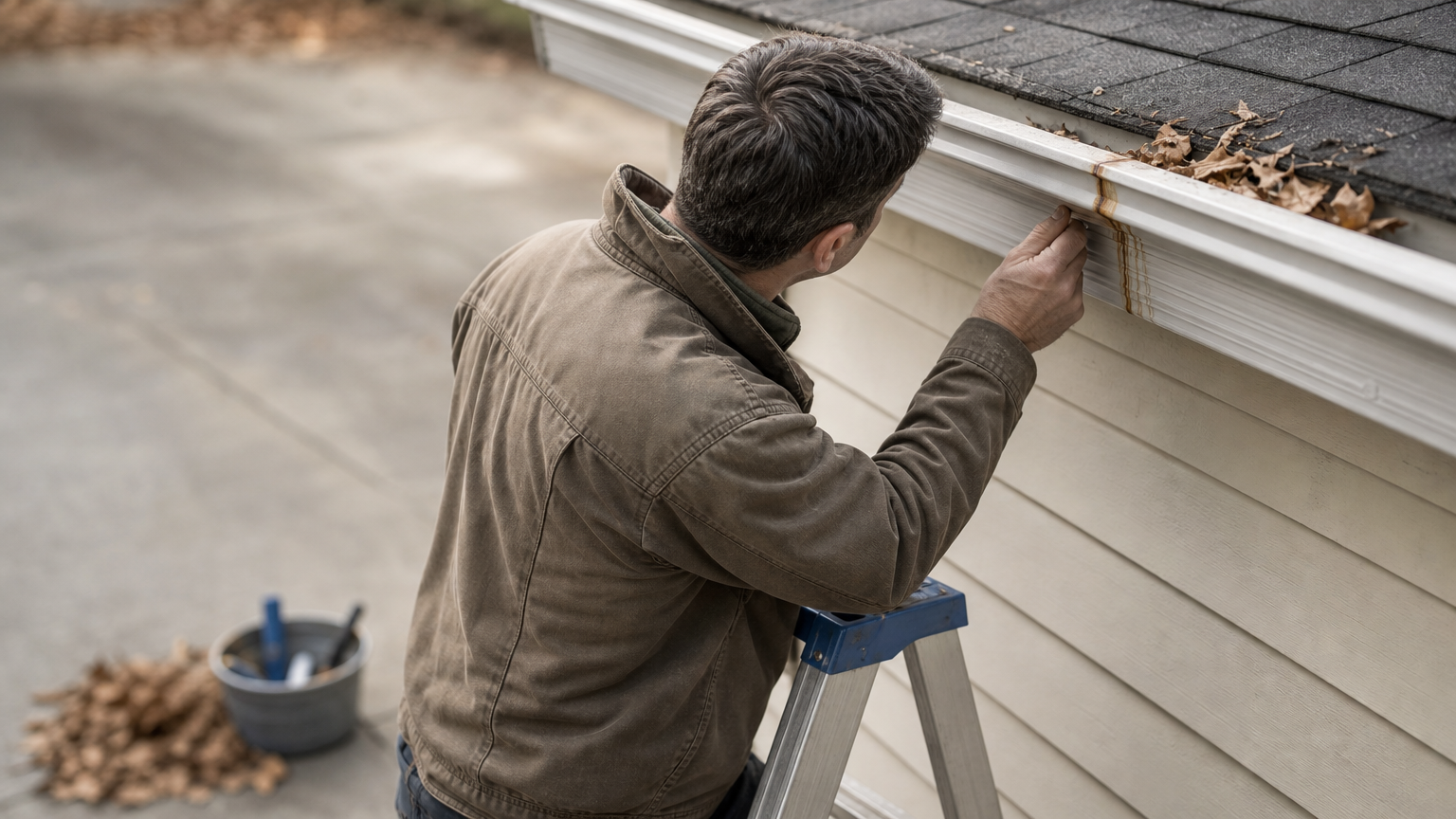
Gutters rarely fail all at once. A hairline seam leak left alone for two seasons turns into fascia rot, and fascia rot turns a $150 reseal into a $500 rebuild. Walk your gutter line twice a year, once in spring and once before the leaves drop, and look for these warning signs before they escalate:
- Small drip marks or rust streaks below a seam
- A section that looks slightly lower than the rest of the run
- Standing water in the trough after a dry day
- Downspout brackets that have pulled away from the wall
- Fascia paint that’s peeling or bubbling near the gutter line
Fixing a $75 leak this spring beats paying for a $400 fascia repair next fall.
Clean gutters regularly to prevent bigger damage
Debris is the quiet cause behind a lot of repair calls. Standing water from clogged leaves adds weight that stresses hangers, and it holds moisture against the fascia long enough to start rot. Twice-yearly cleaning, or gutter guards if you’re tired of the ladder trips (here’s what guards run by style and roof size), keeps that weight and moisture off your system and directly cuts down how often you’re calling anyone about how much does it cost to repair guttering in the first place.
Bundle repairs and compare multiple quotes
Once you do need a repair, timing and shopping around save real money. Scheduling non-urgent fixes together, rather than calling separately for a leak this month and a loose hanger next month, spreads the service call fee across more work instead of paying it twice. Getting two or three quotes matters too, since pricing on the same job can vary by $100 or more between contractors in the same town.
Handle simple fixes yourself
Not every repair needs a professional. Resealing a small seam with gutter sealant, tightening a loose hanger, or clearing a clogged downspout are jobs most homeowners can do safely from a stable ladder in under an hour, and skipping the service call fee on those alone can save $75 to $150 per visit.
Questions to ask before hiring a gutter pro
Getting a fair price isn’t just about knowing the numbers ahead of time, it’s about asking the right questions before a contractor ever touches your gutters. Every quote you get for a cost to repair gutter damage should hold up to a few basic questions, and a pro who bristles at answering them is telling you something too.
What to ask before you sign anything
Run through this list on the phone or during the in-person estimate, before you agree to a date or a deposit:
- Is the estimate itemized by material, labor, and any fascia or wood repair separately?
- Does the price include a full inspection of the fascia and hangers, or just the visible damage?
- What’s your license and insurance status, and can you provide proof?
- Is there a warranty on the repair, and how long does it last?
- What happens if you find rot or additional damage once you’re up there?
- Will the same crew that gives the quote do the actual work?
A contractor who can’t answer these six questions on the spot probably hasn’t done this job enough times to price it right.
Watch for vague or padded pricing
Quotes that lump everything into one flat number without breaking down materials, labor, and travel are harder to evaluate against your own math. Insist on a gutter repair cost per foot breakdown when the job involves more than a single quick fix, since that’s the only way to compare one bid against another apples-to-apples. If a quote comes back well above the ranges in the table earlier in this guide, ask what’s driving it: rot, height, or material cost. A straight answer builds trust; a shrug doesn’t.
Confirm what happens if the job grows
Rotted fascia hiding behind a gutter is the single most common reason a quoted repair turns into a bigger bill mid-job. Before work starts, get a clear answer on how the contractor handles surprises: do they call you with a revised price before proceeding, or just add it to the final invoice? Reputable crews pause and call. Ask this question specifically if you’re dealing with a sagging gutter repair cost estimate, since sag almost always means the fascia needs a look, and that’s exactly where surprise charges tend to show up.
Get it in writing
Verbal quotes are easy to forget and easy to inflate after the fact. Ask for a written estimate that includes scope, materials, timeline, and payment terms before any work begins, and keep a copy for your own records in case a dispute comes up later.
Budgeting for a gutter repair that lasts
Most gutter repairs land between $150 and $500, but the real number for your house depends on what’s damaged, what material you’re working with, and whether the fascia behind it is still solid. Knowing the per-foot ranges and repair categories from this guide puts you in a stronger position than most homeowners calling around blind, and it means you’ll recognize a fair quote the moment you hear it.
Remember the pattern that keeps showing up: small problems caught early stay cheap, and ignored ones turn into fascia work or a full replacement conversation. Sagging sections, recurring leaks, and repeat repair calls on the same stretch of gutter are your cue to stop patching and start comparing replacement numbers instead.
If you’re ready to see what a repair costs for your specific home, skip the guesswork and have a local pro put real numbers to your gutter repair, free.
What should this cost you?
Answer four questions and get a fair price range for your home.