
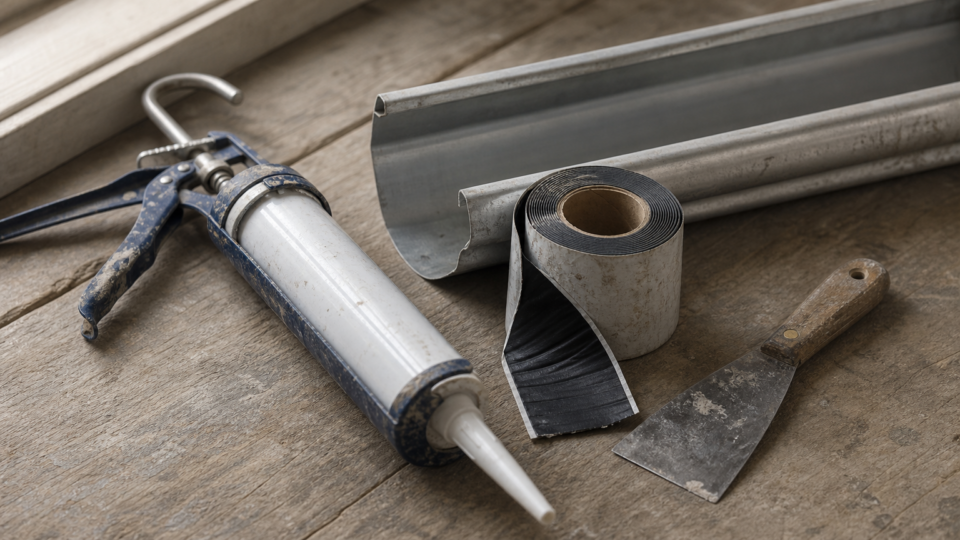
Short answer: What to use to seal leaking gutters depends on where the water escapes. For seams, corners and end caps, a tripolymer or metal-rated gutter sealant applied with a caulk gun gives the longest-lasting fix. For pinholes and rusty patches, liquid rubber or roofing cement works better. For a leak you need stopped today, waterproof tape holds in seconds. Choose by leak type and gutter material, not by brand name. Ready for quotes? Compare local pros →
In this guide
Most homeowners find the leak after a rainstorm, with a drip at a corner or a dark streak under a joint. Then they stand in a hardware aisle facing thirty tubes that all say "waterproof." Many of those tubes are the wrong chemistry for gutters. Acrylic caulk cracks, expanding foam fails, and any sealant applied over dirt peels within a season.
This guide covers seven products that work, who each one suits, how long it takes to cure and where it falls short. Then it shows how to match a product to your leak and apply it so it holds. Guardian Gutter Guide is not a contractor. Our repair guides are written by a former gutter installer and reviewed by a home inspector, so you also get a straight answer on when sealant is not the right fix.
1. Tripolymer gutter sealant
Where it works best
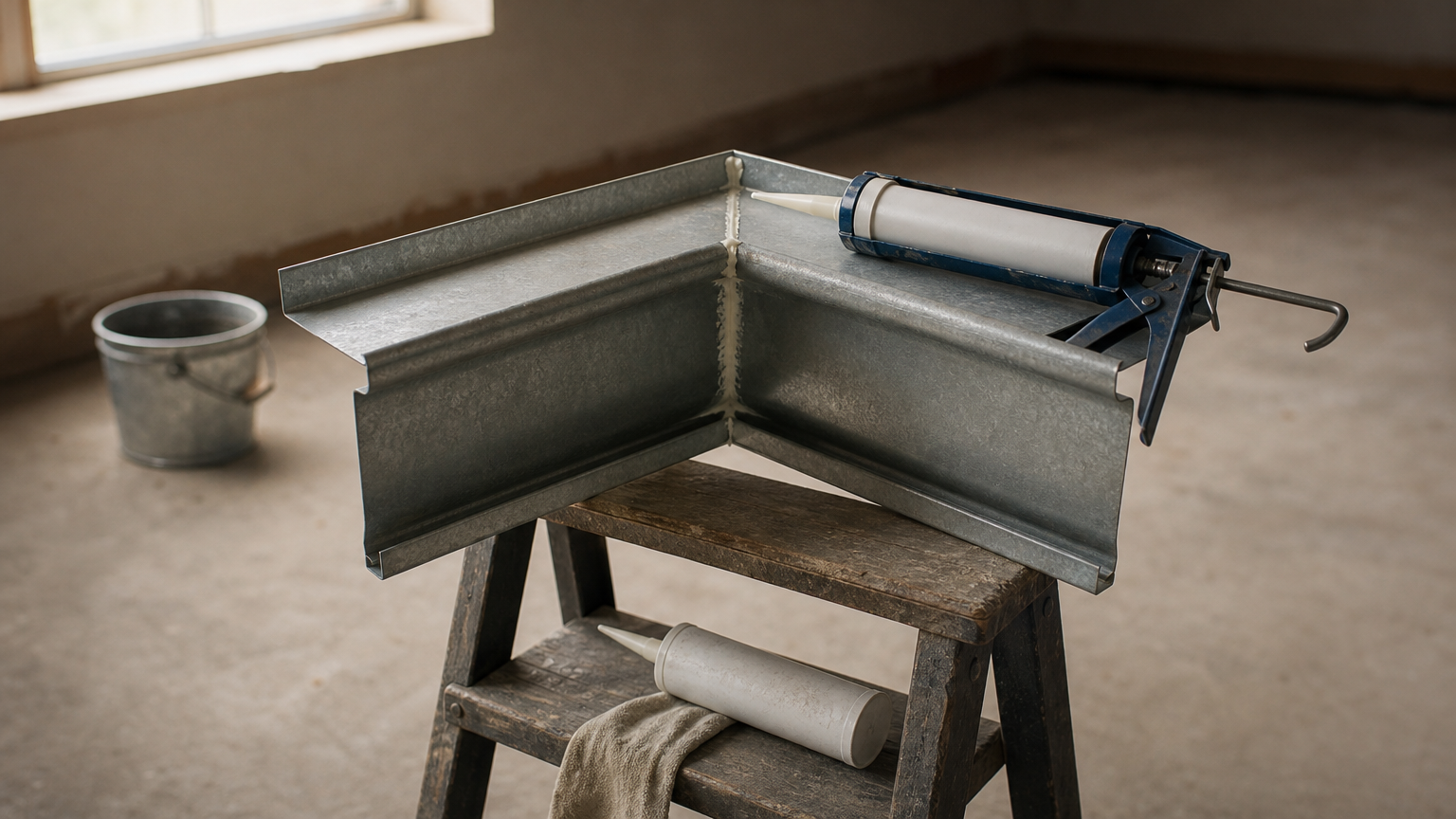
Tripolymer gutter sealant is the best all-round pick for leaking seams, corners, end caps and downspout outlets. It comes in a 10-ounce caulk tube, flows into the joint because it is self-leveling, and cures into a tough, rubbery bond that flexes with the metal. Geocel 2320 Tripolymer Gutter and Narrow Seam Sealant adheres to all common gutter types and fills gaps up to ¼ inch. Amerimax SeamerMate is a similar product that tests as one of the more affordable options, but it is made for metal-to-metal bonds, so read the label before using it on vinyl.
- Applied with: a standard caulk gun
- Gutter material: all types (Geocel), metal (SeamerMate)
- Coverage: one tube lays a ¼-inch bead about 28 feet (Geocel)
- Cure: surface skin in about an hour, full cure up to 5 days
For a leaking seam or corner, start with a tripolymer sealant and a caulk gun.
What to watch out for
Cure time is the main drawback. Both products take up to five days to cure fully, and Geocel stays soft for roughly a day, so apply it when no heavy rain is forecast. Expect a strong chemical odor while it cures, and wear gloves. Anything wider than ¼ inch means the joint has pulled apart, so refasten it before you seal it.
A tube goes further than you might expect. Say you seal 20 joints with about 6 inches of bead each. That uses 10 feet, well short of the 28 feet a tube lays. Use the rest on every other corner and end cap while the ladder is up, because the joints that look dry today are the same age as the one that leaks. Tubes such as SeamerMate cannot be resealed once opened, so plan to use the whole tube in one session.
What should this cost you?
Answer four questions and get a fair price range for your home.
2. Metal silicone sealant
Where it works best
Metal silicone is the right choice when you have aluminum, galvanized steel or copper gutters and want a fast, flexible seal. GE Metal Silicone 2 is formulated for those metals. It is waterproof in about 30 minutes and fully cured in 24 hours, which makes it the quicker option when weather is coming. It tolerates 25 percent joint movement and temperatures from -60°F to 400°F, so it suits gutters that expand and shrink through hot summers and freezing winters.
- Applied with: caulk gun
- Gutter material: aluminum, galvanized steel, copper
- Cure: waterproof in about 30 minutes, full cure in 24 hours
Silicone is also the product Home Depot’s repair guidance uses for a bead at downspout joints when you reassemble them.
If a storm is coming and your gutters are metal, silicone gets you watertight in half an hour.
What to watch out for
The finish is softer and the grip lower than with tripolymer sealants. That is fine for a well-prepped seam on clean metal, but it is a weaker choice for bonding end caps or filling gaps near the ¼-inch limit. Surface prep matters more with silicone because it has less adhesion to spare.
Silicone gives off an unpleasant vapor while you apply it. Wear a mask, gloves and eye protection. Also think about the future. Many sealants stick poorly over cured silicone, so you will need to scrape the spot back to bare metal before any later repair at that joint.
3. Liquid rubber coating
Where it works best
A water-based liquid rubber coating is the best product for pinholes, rusty spots and long hairline seam leaks, especially if you dislike fumes. Liquid Rubber Waterproof Sealant goes on with a brush or roller, bridges seams, gaps and small holes, and works on every gutter material. It is UV-stable, contains no solvents or VOCs and has very little odor. Once it is fully dry you can paint over it. Brush-on coatings also reach awkward spots where a caulk gun cannot.
- Applied with: brush, roller or piston sprayer
- Gutter material: all types
- Cure: 24 to 48 hours, often two coats
Liquid rubber is the low-odor choice for small holes and hairline cracks, not for gaps or end caps.
What to watch out for
Slow drying is the cost. Waiting a full 24 hours before the second coat is the safer call. Plan on two coats for most repairs and a few days before the gutter sees heavy rain.
For a seam that has opened slightly, embed seam tape or geotextile fabric in the wet first coat. The maker of Liquid Rubber pairs its coating with those materials for this job. Do not rely on a brushed coating to glue on an end cap. Coatings seal a surface, while a tripolymer sealant bonds two parts together.
4. Waterproof patch tape
Where it works best
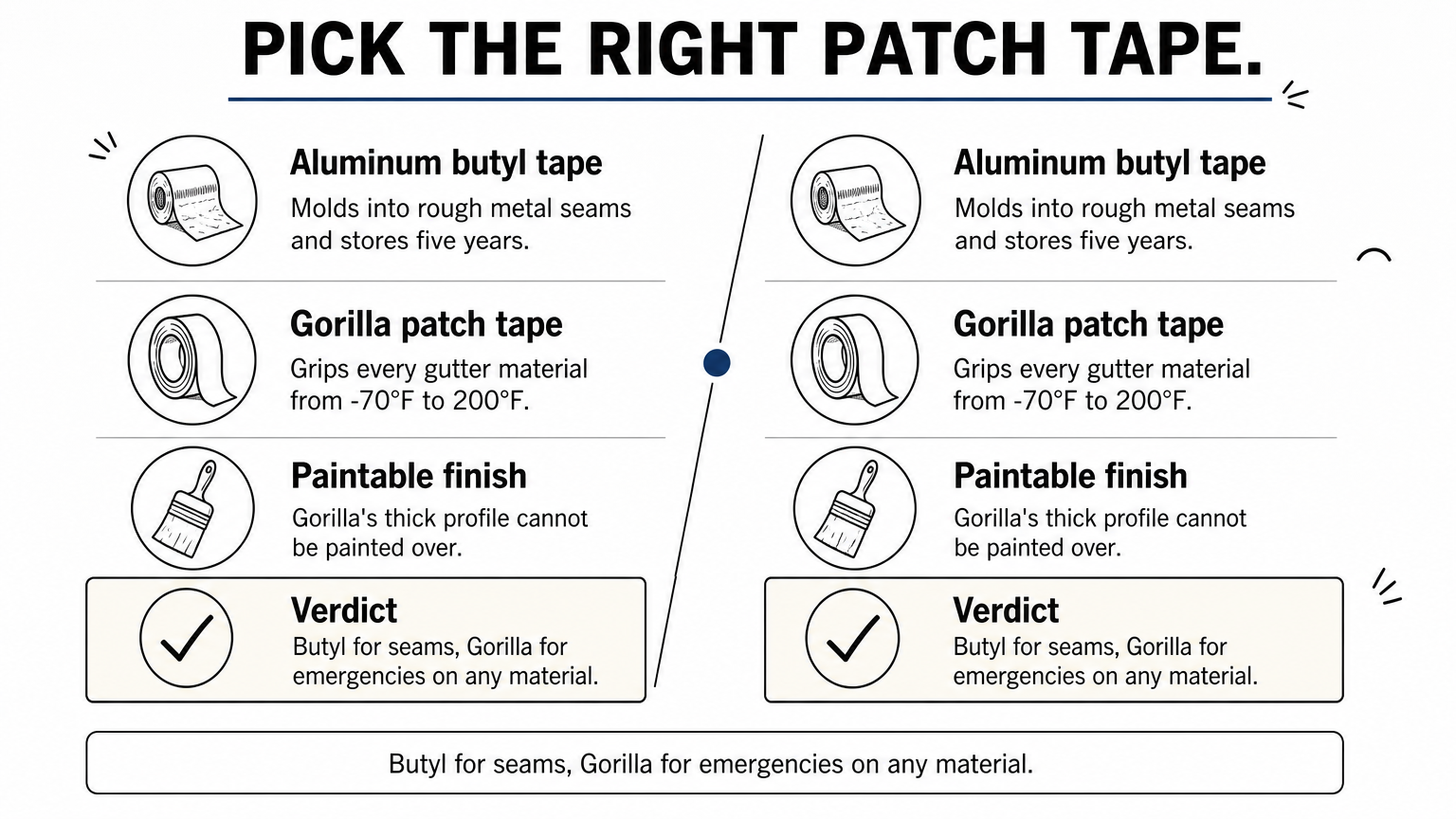
Waterproof tape is the fastest fix, because it needs no cure time at all. Two types are worth knowing. Aluminum butyl tape, such as XFasten, has a foil face and a thick butyl rubber adhesive that molds into rough surfaces. Gorilla Waterproof Patch & Seal Tape is a rubberized tape that grips all gutter materials and handles temperatures from -70°F to 200°F. Both are 4 inches wide, so they cover splits and seams in one piece. Butyl tape is the better pick for metal seams. Gorilla suits a quick emergency patch on any material.
- Applied with: hand, no tools
- Gutter material: all types
- Cure: none, the seal holds immediately
- Shelf life: XFasten lists 5 years in storage
Keep a roll of butyl tape in the garage, and a leak in the middle of a storm becomes a five-minute job.
What to watch out for
Both tapes demand a clean, dry, sound surface. Dust, flaking paint or slime makes them lift. Gorilla claims it sticks to wet surfaces, but it works best on dry ones. Positioning is unforgiving, since Gorilla is nearly impossible to reposition once it touches the gutter. Cut it to size with the backing still on, or it sticks to your scissors.
Looks are the other issue. Gorilla’s thick white profile is not paintable and stands out on an older gutter, so apply it on the inside where you can. Butyl adhesive gets very sticky in warm weather, and the cut edges of the roll gum up, which makes interior seams awkward. Treat tape as a quick repair or a seam reinforcement. Use a sealant when you want a clean, permanent finish.
5. Spray rubber sealant
Where it works best
Spray sealant is built for small pinholes and short hairline leaks that you can cover from a ladder in one pass. It goes on like spray paint. Rust-Oleum LeakSeal contains butyl rubber, dries to the touch in about 30 minutes, cures in 24 hours and comes in five colors, so it can match your gutter. It fills gaps up to ¼ inch, though wider ones take more than one coat. Flex Seal Spray-On Liquid Rubber dries in two to three hours.
If you are asking whether Flex Seal really works on gutters, the answer is yes, as a patch. It seals pinholes and small seam leaks well once cured. It is not a structural repair.
- Applied with: aerosol can
- Gutter material: all types
- Cure: about 24 hours (LeakSeal), 2 to 3 hours dry (Flex Seal)
Spray sealant stops pinhole drips quickly, but it patches the surface and does not rebuild a failed joint.
What to watch out for
Durability is where spray falls behind. Spray coatings rate lower for long-term wear than tripolymer sealants, and neither product is designed for newly installed seams or end caps. Flex Seal needs air temperatures of at least 65°F during application, which rules out a cold fall afternoon.
LeakSeal is highly flammable while you spray it, so keep it away from pilot lights, grills and sparks. Overspray travels, so shield your siding and fascia with cardboard. Spray is the most expensive way to cover a large area, so for more than a few spots, liquid rubber in a can is the smarter buy.
6. Fast-setting multisurface sealant
Where it works best
A fast-setting multisurface sealant is the pick when you need to paint or finish the repair quickly. OSI Quad Max is labeled mainly as a window, door and siding sealant, but it also performs well on gutters. It has a higher viscosity than most gutter sealants, so it sets up quickly. It is paintable within about an hour and can cure fully in as little as 24 hours, though other sources list up to 72 hours. It adheres to most building materials and resists UV, dirt and temperature swings, which helps where a gutter meets wood or masonry.
- Applied with: caulk gun
- Gutter material: all types
- Cure: paintable in about an hour, 24 to 72 hours to cure
Choose a fast-setting sealant when speed and a paintable finish matter more than the lowest price.
What to watch out for
This product is less forgiving than a self-leveling tripolymer. It is stiff in the caulk gun and does not flow into voids on its own, so any ridge in the bead stays after curing unless you smooth it right away. Work in short sections and tool each one.
It also costs more than several comparable gutter sealants, and cleanup has to happen promptly, before it skins over. If you want the most forgiving sealant for a first repair, choose tripolymer. Choose this one when time on the ladder or on the forecast is the constraint.
7. Roofing cement and metal patch
Where it works best
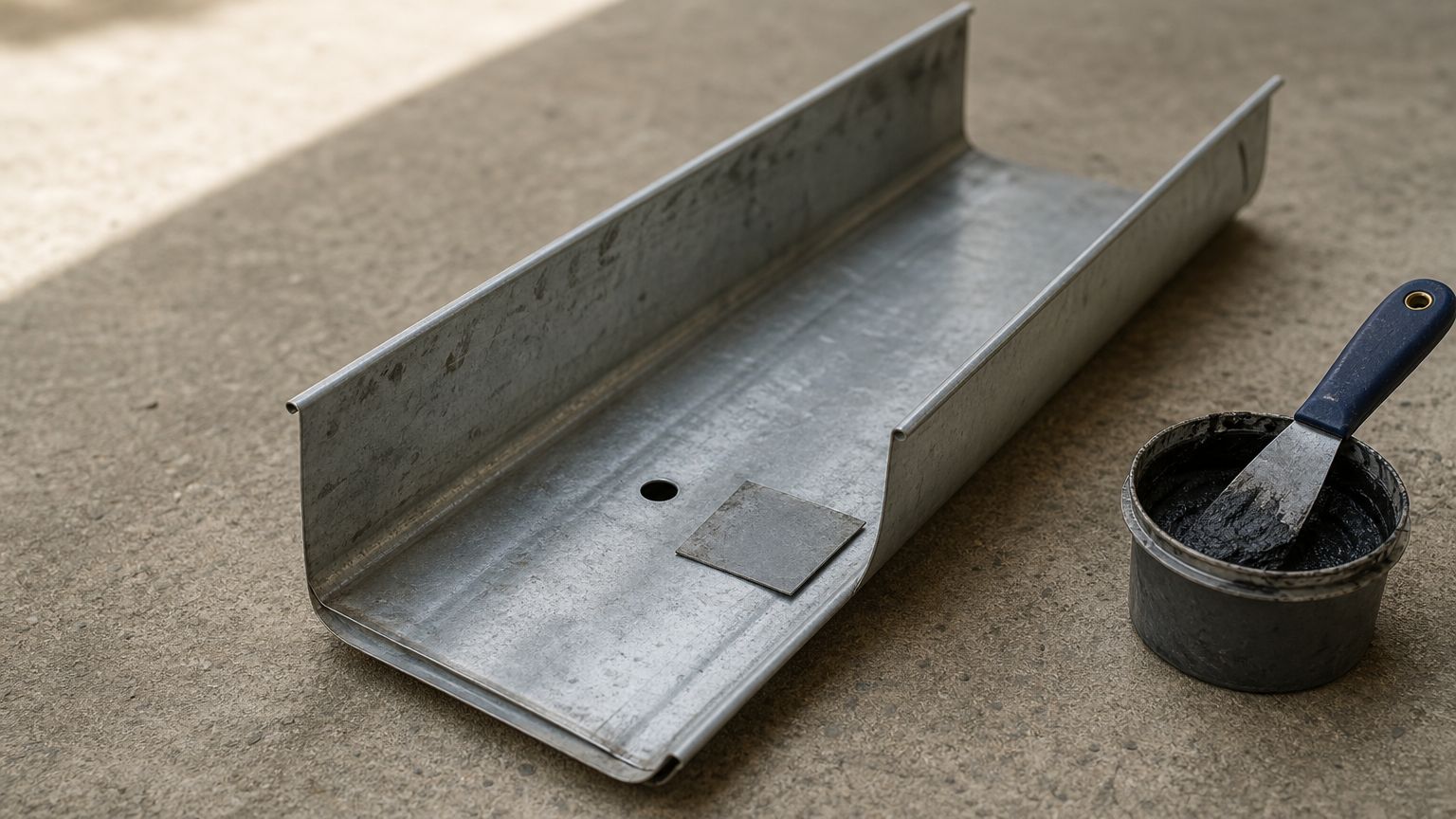
Plastic roofing cement is the right fix for holes and rust-throughs in metal gutters. For a small hole, press cement directly over it and fill it completely. For a hole bigger than a nail hole, cut a strip of flashing with tin snips, bed it into a layer of cement, then cover every edge with more cement. Use flashing of the same metal as the gutter, because mixing metals can cause corrosion where they touch. Feather the cement outward so the edge does not catch water or debris.
- Applied with: putty knife or trowel
- Gutter material: metal
- Cure: skins over, check the can for time before rain
Roofing cement plus a metal patch is the old-school, low-cost way to close a hole in a metal gutter.
What to watch out for
The patch is bulky and black, so it is a poor choice for a visible seam or a corner where a neat finish matters. It also fixes only the hole in front of you. If the metal around it is thin and flaking, the next hole opens a few inches away.
Clean the area with a wire brush and water, let it dry, then rough it with an abrasive pad. Cement bonds to texture, not polish. When you see rust across several feet of gutter, stop patching and read the next section on when to replace.
How to match the product to your leak
Pick by leak location
Start with where the water appears, because location predicts the product. Run a hose into the gutter section by section, starting at the high end, and watch for the drip. Then use this table.
| Where the leak is | Best product | Why |
|---|---|---|
| Seam, corner or end cap | Tripolymer (1) or metal silicone (2) | Fills gaps and flexes with the metal |
| Pinhole or rust spot | Liquid rubber (3), spray (5) or cement (7) | Covers small defects without a gun |
| Hole larger than a nail | Roofing cement and metal patch (7) | The flashing carries the repair |
| Hairline seam crack | Liquid rubber with seam tape (3) or tape (4) | Bridges the crack along its length |
| Leaking during rain | Butyl or patch tape (4) | Holds with no cure time |
| Repair you need to paint soon | Fast-setting sealant (6) | Paintable in about an hour |
Leaks at corners are the most common. If yours is a corner, the tripolymer or silicone route usually settles it.
Check your gutter material and skip the wrong caulk
Material limits your options. Aluminum, galvanized steel and copper all take metal silicone and tripolymer sealants. Vinyl gutters need a product whose label lists vinyl or "all gutter types", which includes Geocel, liquid rubber and the tapes above.
Caulking leaking gutters with ordinary acrylic latex caulk is the classic mistake. It is paintable but lacks flexibility, so it cracks as the gutter expands and contracts. Traditional expanding foam also fails in a gutter. If a "gutter joint repair kit" catches your eye, check which of the product types above it contains, since most pair one sealant with patches.
When sealing is the wrong fix
Sealant cannot fix a gutter that is the wrong shape or the wrong age. Stop sealing and look at the gutter itself in these cases:
- Sagging sections. A gutter should drop about ¼ inch per 10 feet toward the downspout. Sags hold water, and the joints in a sagging gutter leak again.
- Water running behind the gutter. This usually comes from overflow, a bad slope or a gap against the fascia, not a seam leak.
- Joints separated more than ¼ inch. They need refastening or a new section first.
- Rust across several feet. Aluminum gutters last up to 20 years with upkeep and vinyl 10 to 20, so widespread failure points to replacement.
- The same joint leaking again after resealing. Something is moving it, and sealant will keep losing.
Seal a leak that has a cause you can see, and replace or re-hang a gutter that is failing.
How to apply sealant so it lasts
Prep the surface
Surface prep decides whether the repair lasts a month or a decade. First, remove debris and old sealant from the joint. Use a putty knife, and a caulk remover or mineral spirits for stubborn residue. Scrub the area with a wire brush and water. Let it dry fully, then rough it with an abrasive pad so the new product has texture to grip. The gutter should be clean, dry and free of old product before you start.
Apply and cure
Follow the manufacturer’s directions first, since cure times and coat counts differ. For a tube sealant, the sequence is the same across brands:
- Cut the nozzle small enough to lay a bead of about ¼ inch.
- Push the bead into the seam so it penetrates the joint, instead of lying on the surface.
- Seal inside the gutter, where water flows, and add a bead on the outside joint if you can reach it.
- Smooth the bead with a gloved finger or a tool.
- Clamp or bind the joint if it will not stay together while the sealant cures.
- After the full cure time, run a hose and watch the joint. A stricter test is to fill the gutter and watch for 12 hours.
Weather and safety
Do not apply sealant in rain. Moisture prevents adhesion, and the safe window is usually 2 to 3 hours after the rain stops and the metal is dry. Check the label for minimum temperatures, since Flex Seal, for example, needs at least 65°F.
Wear gloves, eye protection and a mask for solvent-based products. Nitrile gloves are thin enough to work with. Set your ladder on firm, level ground and never reach past your shoulders. Finally, clean your gutters about every six months, because debris holds water against joints and shortens the life of every repair above.
Pick the fix, then watch it
For most leaks, the answer is simple. Use a tripolymer or metal silicone sealant on seams, corners and end caps. Use liquid rubber, spray or roofing cement for small holes, and keep waterproof tape for emergencies. Prep the surface, give the product its full cure time, and test with a hose before you call the job done.
If the same joint keeps leaking, the gutter sags, or water gets behind it, the problem is bigger than a seal. A quote costs nothing and tells you whether a repair or replacement makes sense. You can request a free gutter repair estimate when you are ready to compare your own fix against a pro’s price.
What should this cost you?
Answer four questions and get a fair price range for your home.