
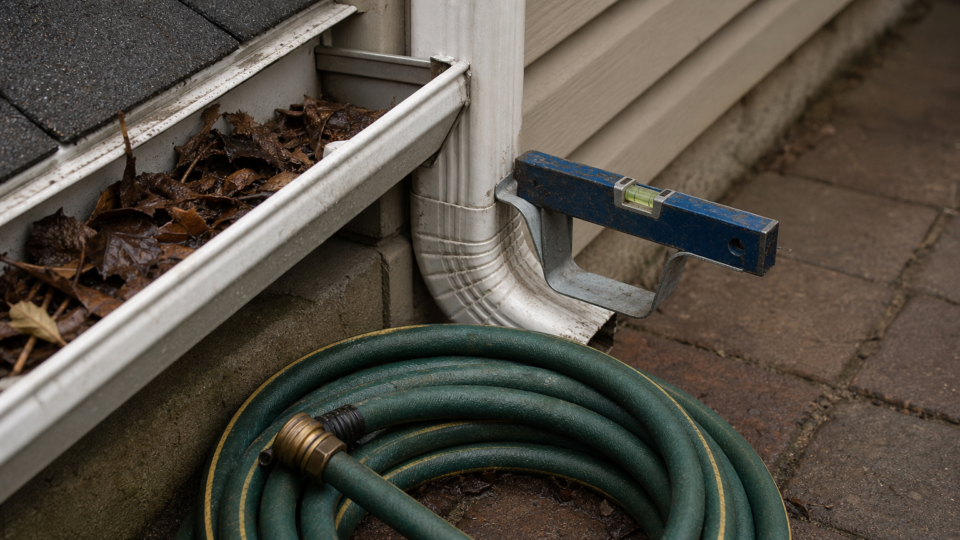
Short answer: Water pouring over the edge of your gutters during a storm is more than an annoyance. It can soak your siding, rot the fascia, and send runoff straight toward your foundation. If you are learning how to fix overflowing rain gutters, the good news is that most cases come down to a handful of causes you can find and fix yourself. Ready for quotes? Compare local pros →
In this guide
Here is the short answer. Clogged gutters or downspouts cause most overflow, but if yours are clean, look for poor slope, undersized gutters, or a blocked corner or elbow. Heavy rain from a large roof section can also overwhelm a gutter that is otherwise fine. Each cause has a different fix, so diagnosing first saves you time and money.
I spent years installing gutters, and the same few mistakes show up again and again. This guide walks you through checking for clogs, testing the pitch, fixing corners and loose hangers, and adding a downspout when the system is too small. You will also learn when a gutter guard helps and when it is time to call a pro.
Why gutters overflow, even clean ones
If you keep asking yourself why does my gutter overflow when there is not a leaf in sight, you are in good company. Clean gutters still spill because the problem is often water volume or geometry, not debris. Knowing which one you have is the first step in how to fix overflowing rain gutters without guessing.
Read the pattern first
Where the water spills, and when, tells you more than any tool will. Match what you see to the likely cause:
| What you see | Likely cause |
|---|---|
| Spills at one spot mid-run | Sag or low spot holding water |
| Spills at a corner | Blocked corner or slope pushing water into it |
| Spills only in heavy rain | Gutter or downspout too small for the roof area |
| Water runs down behind the gutter | Gutter pulled away from the fascia |
| Overflows near the downspout | Clogged elbow or too few downspouts |
Why it matters beyond the mess
Ignoring it lets gutters overflowing into house walls, soffits, and basement window wells turn a cheap fix into rot and water damage. Overflow that lands beside the foundation is the one I saw cause the most expensive repairs.
Capacity is the part most homeowners miss. Many installers default to 5-inch gutters with 2×3 downspouts, but a large or steep roof section often needs 6-inch gutters or a 3×4 downspout to handle a downpour. If you want to stop gutters overflowing in heavy rain, you have to match the system to the roof, not just clean it.
Clean gutters can still overflow, because slope and capacity matter as much as debris.
The next step is figuring out which of these causes is yours.
What should this cost you?
Answer four questions and get a fair price range for your home.
Step 1. Find the cause of the overflow
Diagnosing first is the fastest way to stop gutter overflow for good. A ten-minute check beats scooping out spotless gutters and still getting a waterfall at the next storm.
Run a hose test
Pick a dry day and bring a helper. A hose test shows how the gutter behaves under load and exposes low spots and slow drains that a visual check misses.
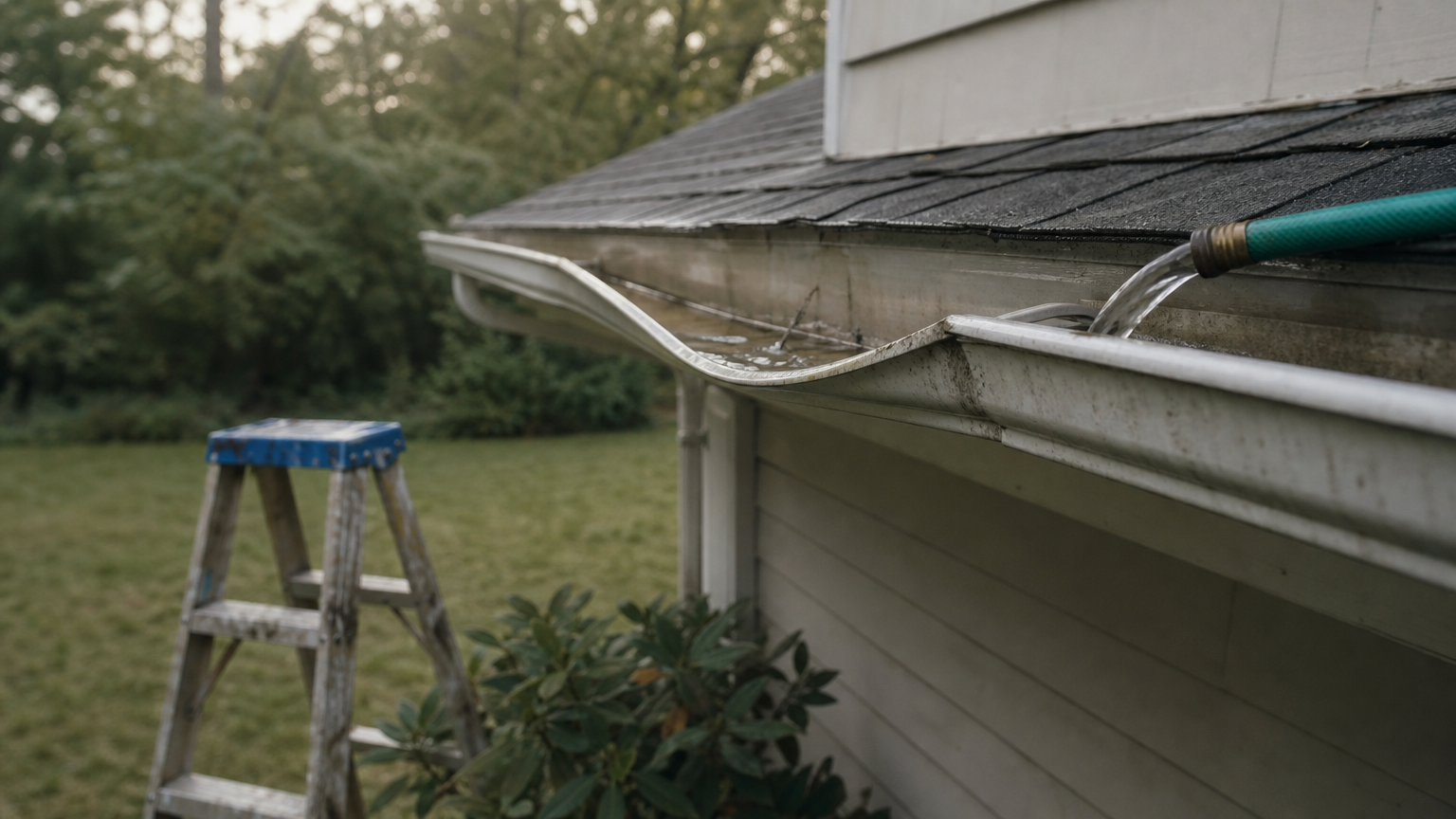
- Run the hose at the end farthest from the downspout for a full minute.
- Watch for water that pools or lingers after you shut it off. That marks a sag.
- Check the downspout outlet. A weak trickle means a clog in the elbow or pipe.
- Look behind the gutter for water running down the fascia, which means a gap.
Run water through the system before you touch a single bracket.
Check capacity
Count your downspouts too. A common rule of thumb is one for every 30 to 40 feet of gutter, so a long run with a single outlet is a likely culprit. If the hose test passes but the gutter still spills in storms, undersized capacity is your answer, and Step 4 covers it.
Step 2. Clear the gutters and downspouts
Scoop out the trough
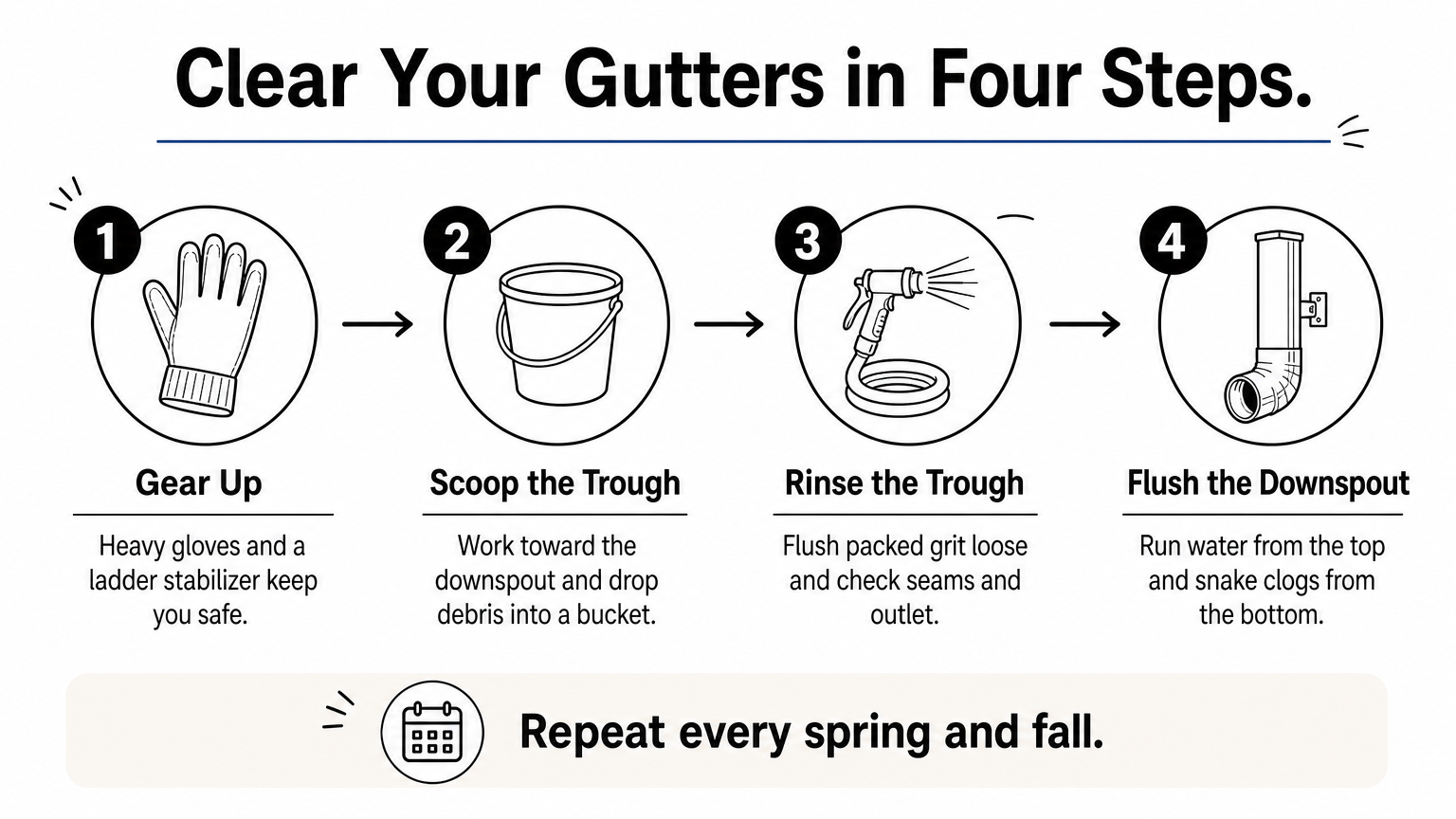
Clogs cause most overflow, so start by clearing the trough. Put on heavy gloves, set up a ladder stabilizer, and work toward the downspout with a gutter scoop or a plastic garden trowel.
- Scoop debris into a bucket, not onto the lawn.
- Rinse the trough with a hose to loosen packed grit.
- Check the seams and the outlet for sludge.
Flush the downspouts
Downspouts usually clog at the elbows. Run the hose down from the top. If water backs up, tap the pipe to find the clog, then push a plumber’s snake or the hose up from the bottom until the water flows freely.
A clean trough still overflows if the downspout is plugged.
Repeat this in spring and fall to keep gutters from overflowing season after season. If you have overhanging trees, add a third cleaning after the leaves drop, since wet leaves and shingle grit pack tight and block outlets quickly.
Step 3. Fix pitch, sagging, and corner problems
Check the pitch
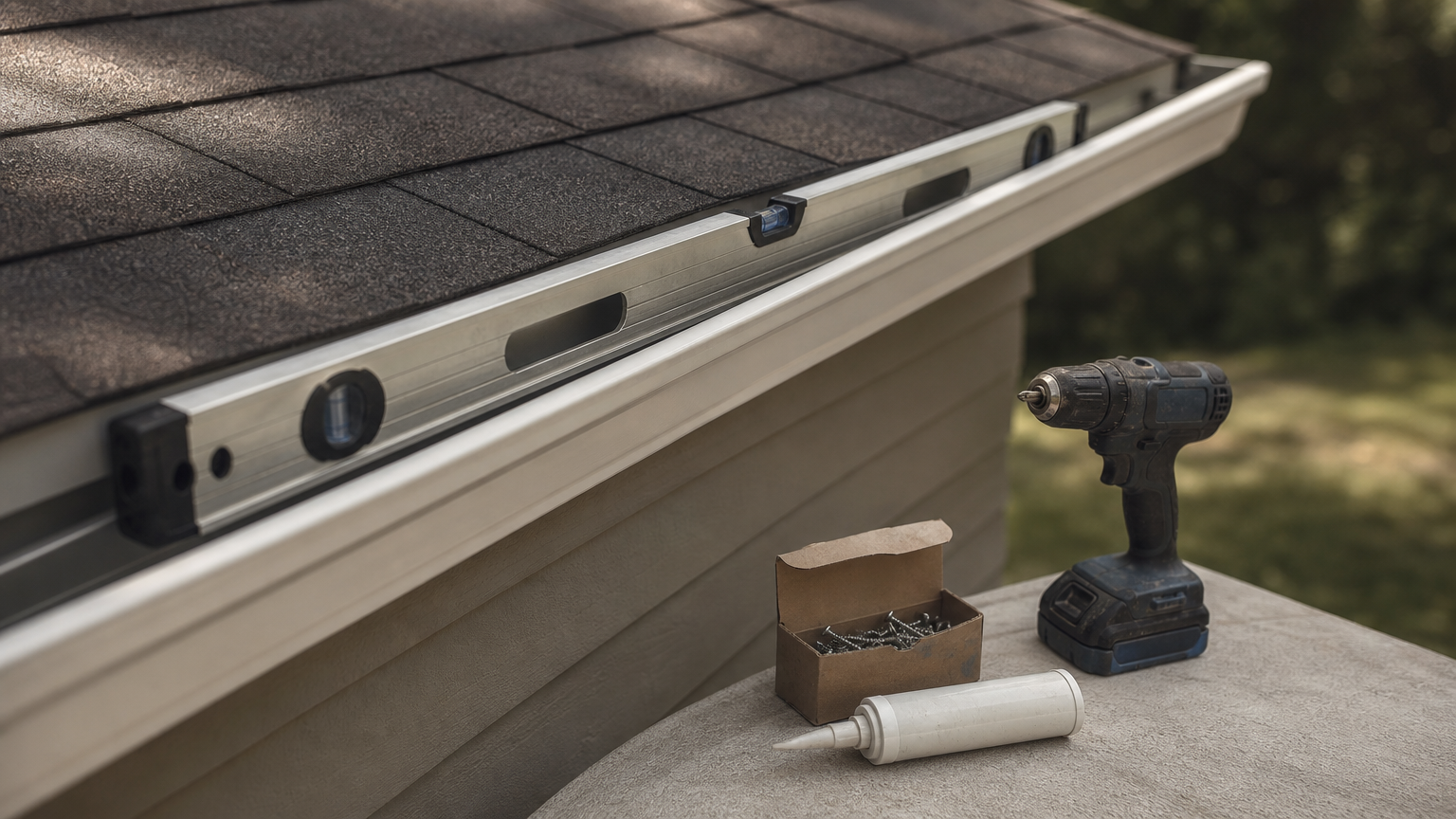
Gutters should drop about 1/4 inch for every 10 feet toward the downspout. Hold a 4-foot level against the trough or stretch a string line, and look for flat or backward sections. If you want to know how to stop my gutters overflowing at one spot, this is where you usually find the sag or low spot.
Water follows slope, so fix the pitch before you touch anything else.
Reset loose hangers
Loose hangers let the trough drop and pull away from the fascia. Reset them in this order:
- Lift the low section to the correct slope and mark the new line.
- Remove worn spikes and drive hanger screws into solid fascia or rafter tails.
- Space hidden hangers about 24 inches apart, closer if you get heavy snow.
Seal the corners
Corners spill when seams leak or debris packs the miter. Clear the corner, dry it, and reseal the inside seam with gutter sealant. If water still rushes in, add a downspout near the corner so it has somewhere to go.
Step 4. Handle heavy rain and prevent repeat overflow
Add capacity for heavy rain
When the hose test passes but storms still spill over the edge, you have a capacity problem. Add a downspout at the far end of the longest run, or swap a 2×3 for a 3×4 downspout, which carries about twice the water. On a large roof section, 6-inch gutters are the real fix for how to stop rain overflowing gutters.
Heavy-rain overflow is a capacity problem, so give the water more places to go.
Prevent repeat overflow
Once the system is sized right, a few habits prevent gutter overflow from coming back. Walk the house after each big storm and check these:
- Tuck drip edge under the shingles so water cannot slip behind the gutter.
- Run downspout extensions 4 to 6 feet away from the foundation.
- Trim branches that hang over the roof.
Gutter guards help, but choose carefully. Micro-mesh handles heavy flow best, while reverse-curve designs can shoot water past the edge in a downpour. Even with guards, plan on an annual check.
Keeping the water where it belongs
Overflow almost always traces back to one of three things: a clog, a pitch problem, or too little capacity. Diagnose first with a hose test, clear the trough and downspouts, fix slope and corners, then add a downspout or larger gutters if storms still win. That order is how to fix overflowing rain gutters without wasting a weekend on the wrong repair.
Most of this is a Saturday job with a ladder, a level, and a hose. Check the system after big storms and clean it each spring and fall, and the problem rarely comes back.
Some jobs are not worth doing alone. If your gutters are badly bent, pulling away from the fascia, or need resizing across the whole roof, a pro will finish faster and safer. In that case, you can get a free gutter repair estimate and see a real price range before you commit to anything.
What should this cost you?
Answer four questions and get a fair price range for your home.