

Short answer: Foam gutter guards are wedge-shaped pieces of porous foam that sit inside your gutter trough. Water soaks through, and leaves and sticks stay on top. The short answer in this foam gutter guards review is that they work for a while, in the right conditions, and they are among the cheapest guards you can buy. They are a short-term fix, not a permanent one. Expect about three to five years of life, and less with pine needles, seeds, or heavy downpours. Ready for quotes? Compare local pros →
In this guide
This article covers why opinions on foam are so split, the real pros and cons, how to choose, fit, and maintain foam inserts, how they compare with mesh and other guard types, and which homes should skip them. You will get concrete numbers, including what foam costs over 15 years on a typical house.
Guardian Gutter Guide is an independent homeowner resource, not a contractor. Marcus Delaney, a former gutter installer with 12 years of experience, writes our guides, and Dana Whitfield, a residential home inspector, reviews them. Contractors cannot pay to be recommended here, so you get a straight read on foam before you spend anything.
Why foam gutter guards divide homeowners
Foam gutter guards split opinion because they are cheap and easy to install, but their results depend heavily on your trees, your rainfall, and how long the foam has been in the gutter. A fair review has to weigh all three.
What the foam does inside your gutter
Foam inserts are usually made of polyether or open-cell polyurethane. They are commonly sold in 4-foot sections and in widths from about 4 to 6 inches. The wedge fills the trough, so leaves and twigs rest on top instead of settling in the bottom. Rain soaks into the foam, drips through, and runs out the downspout.

Most US homes have 5-inch or 6-inch K-style gutters. A gutter guard foam insert has to match that width to work. A loose fit lets debris slip around the edges, and an oversized piece can ride up and block roof runoff.
Why reviews of foam gutter guards disagree
A new insert under a maple tree in a mild climate often performs well. The same insert after three summers of sun, pollen, and shingle grit is a different product. Retailer reviews skew toward first-season impressions, while forum complaints come from people pulling out crumbling, clogged foam in year three. Both groups are telling the truth.
At around $2 per foot, foam is also a low-risk bet. That is why you see so many people trying it, and why you see so many people ripping it out.
Foam works best as a cheap, short-term filter, not a set-and-forget upgrade.
What should this cost you?
Answer four questions and get a fair price range for your home.
Foam gutter guards pros and cons in real use
Foam wins on price, ease of installation, and looks, and it loses on lifespan, fine debris, and heavy rain. Here is how each factor plays out once the inserts are in your gutters.
Pros and cons at a glance
| Factor | What to expect |
|---|---|
| Price | About $2 per foot for the insert |
| Installation | Cut to length and drop in, no fasteners |
| Looks | Mostly invisible from the ground |
| Large leaves and twigs | Sit on top and dry out |
| Pine needles, seeds, shingle grit | Lodge in the pores and hold moisture |
| Heavy rain | Foam soaks up water and can overflow once saturated |
| Lifespan | Roughly 3 to 5 years, less without UV protection |
| Upkeep | Rinse or wipe with algaecide once or twice a year |
| Freezing climates | Wet foam can freeze, so some owners pull it for winter |
What goes wrong over time
The most common failure is debris working into the pores. Small seeds and needles get lodged, stay damp, and sprout or grow mold. That layer adds weight and slows drainage. Sun also dries foam out. It becomes brittle, shrinks, and crumbles, which leaves pieces to clean out when you replace it.
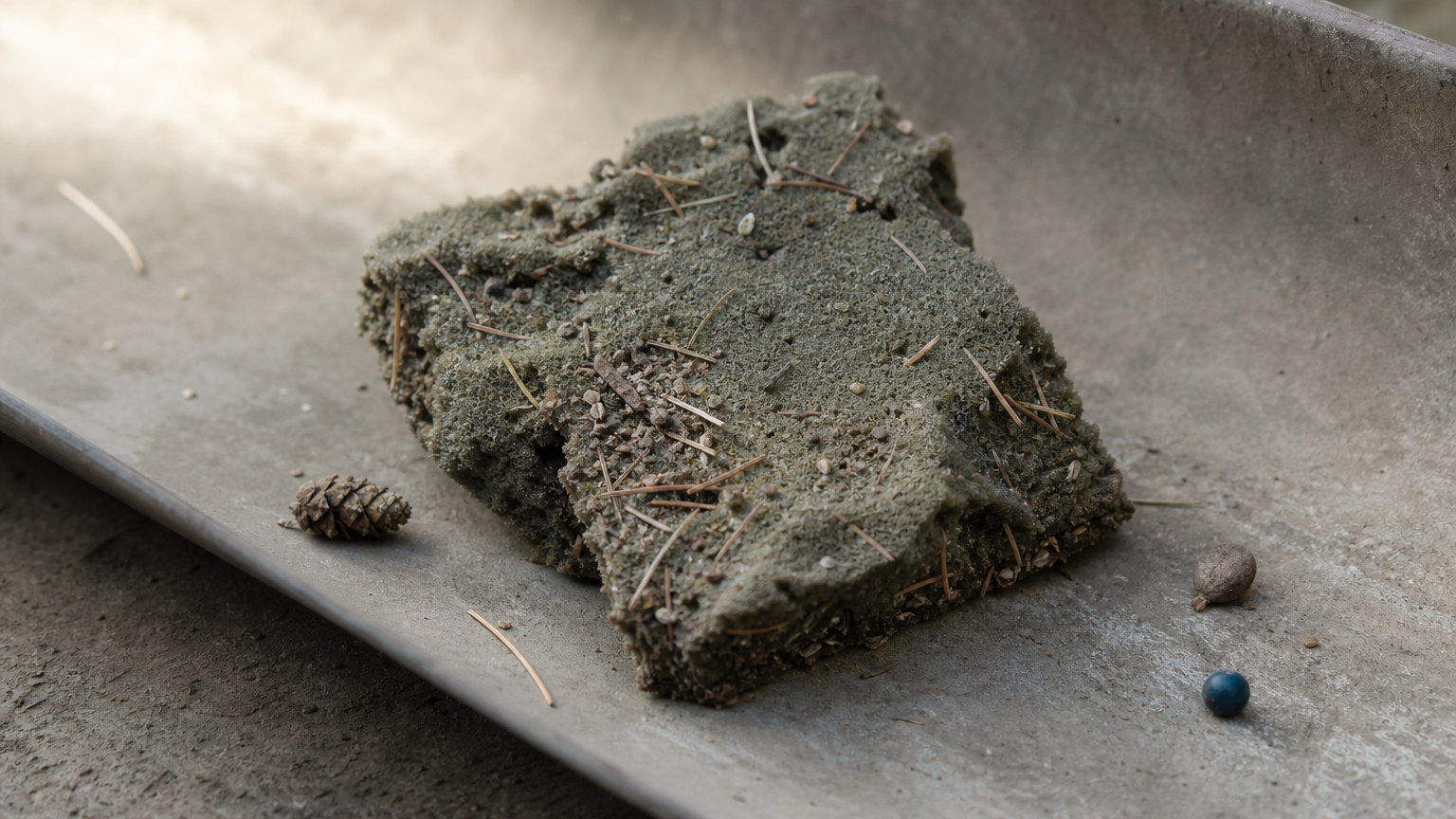
Heavy rain is the other weak spot. A saturated insert behaves like a full sponge, so water backs up and spills over the front edge of the gutter. If that happens near your foundation, you have traded a clogged gutter for a wet basement risk.
Foam handles big leaves well and fine debris badly, and that gap decides most reviews.
How to choose, install, and maintain foam inserts
Choosing a good insert, fitting it snugly, and cleaning it twice a year gets the most life from foam gutter guards. Skipping any of those steps shortens the three-to-five-year window.
What to look for before you buy
Check these points on the product label or listing:
- Width that matches your gutter. Measure across the top opening, not the downspout.
- UV resistance. Foam without it cracks and shrinks before the three-year mark.
- Fire-retardant treatment. Untreated foam is a hazard near a roofline.
- Algae and mold resistance. This helps in shaded, damp yards.
- Extra length. Buy 10 percent more than your measured run to cover corners and miscuts.
How to install foam gutter inserts
- Scoop out debris, then flush the gutters and downspouts with a hose.
- Measure each run in linear feet and note the gutter width.
- Cut the foam to length with scissors or a utility knife.
- Press each piece in so it fills the trough with no gaps at seams or corners.
- Keep the foam clear of downspout openings so water can exit.
- Run a hose over the roof edge and watch that water flows through and out the downspout.
Upkeep and replacement
Wipe or rinse the foam with algaecide once or twice a year, more often under heavy tree cover. Check it after big storms for sagging or sprouting. Plan to replace the foam every three to five years, and sooner if it is crumbling or sitting soggy after a dry spell.
A snug fit and two cleanings a year are what separate a three-year insert from a five-year one.
Foam vs mesh, screens, and other gutter guards
Foam is the cheapest and easiest option, while micro-mesh is the most effective and durable. If you are asking whether foam or mesh is better, mesh wins on performance and foam wins on upfront price.
How the guard types compare
| Guard type | Installation | Upfront cost | Fine debris | Main weakness |
|---|---|---|---|---|
| Foam | DIY, drop in | Lowest tier | Poor | Short life, holds moisture |
| Brush | DIY, drop in | Low | Poor | Collects debris, needs frequent cleaning |
| Metal or plastic screen | DIY or pro | Low | Moderate | Small debris can pass through or lodge |
| Micro-mesh | Usually pro | Higher | Best | Higher cost, still needs occasional cleaning |
| Reverse-curve | Usually pro | Higher | Fair | Visible from the street, pro install |
What foam costs over 15 years
Take a home with 150 linear feet of gutter. At about $2 per foot, the first set of foam is $300. Replace it every five years and you buy three sets in 15 years, or $900. Replace it every three years and you buy five sets, or $1,500. That is before your own labor and algaecide.
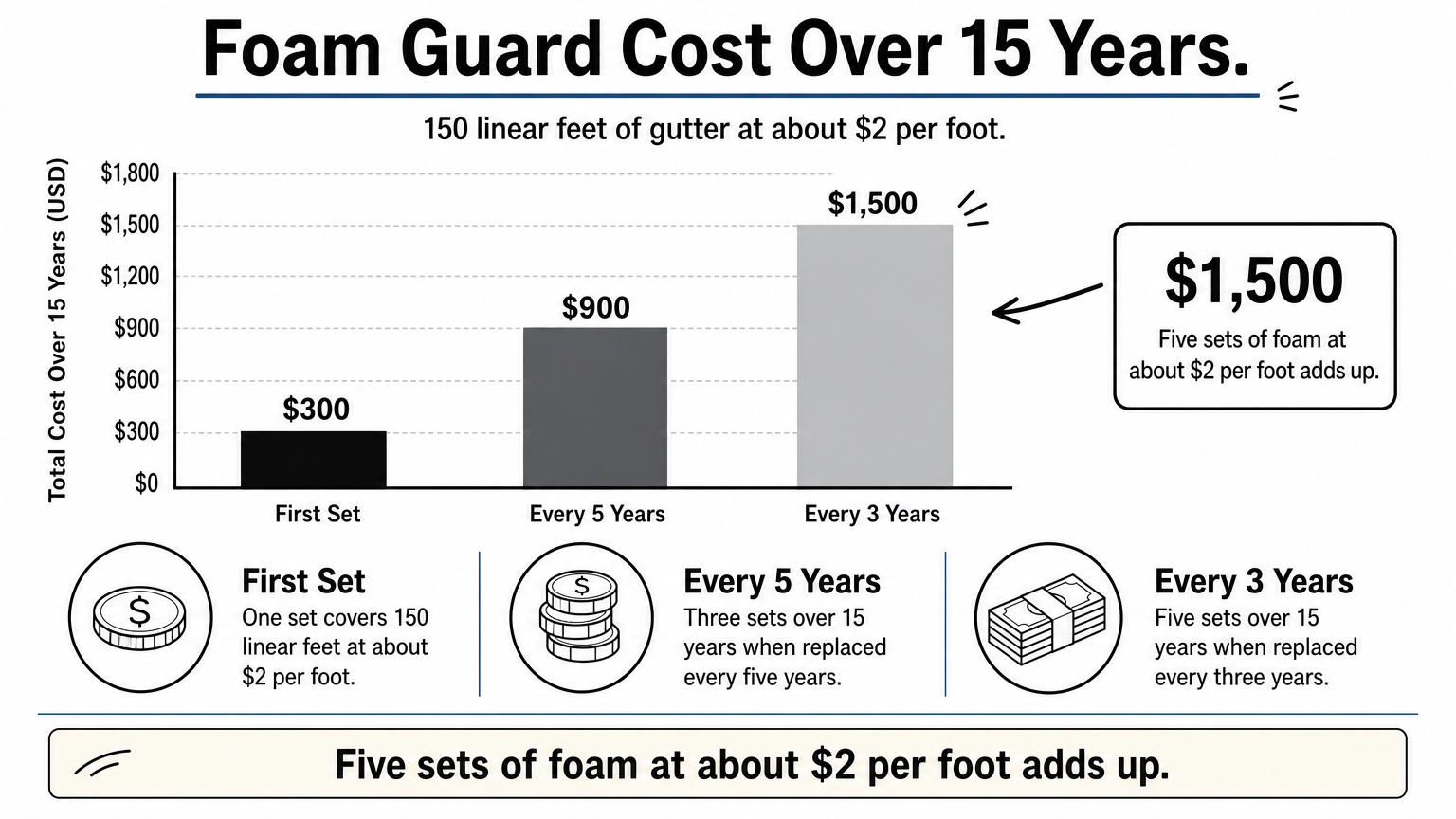
For comparison, installed gutter guards of all types commonly run about $650 to $2,000 as a one-time job. Foam can look cheap on day one, but over 15 years it often costs as much as a more durable guard that you install once. Your own price depends on brand, home size, and region.
Foam is cheapest on day one and often not cheapest by year fifteen.
Who should use foam gutter guards, and who shouldn’t
Foam suits small budgets, moderate leaf fall, and homeowners who will do the upkeep. It is a poor choice under pine trees, in heavy rain regions, or anywhere you want to install once and forget it.
Match foam to your situation
| Your situation | Foam verdict |
|---|---|
| Tight budget, large leaves from a few trees | Reasonable |
| Short-term fix before selling or replacing gutters | Reasonable |
| Comfortable with a ladder and twice-yearly upkeep | Reasonable |
| Pine needles, seeds, or lots of shingle grit | Skip |
| Heavy, frequent downpours | Skip |
| Freezing winters and no plan to pull the foam | Skip |
| Want a one-time install that lasts a decade | Skip |
A fair final verdict
So, are foam gutter guards any good? They are good at one narrow job, which is keeping big leaves out cheaply for a few seasons. They fall short as a long-term answer, and foam sits at the low end for durability and fine-debris filtering, with micro-mesh at the top.
If your gutters keep overflowing even with foam in them, the guard may not be the problem. Pitch, clogged downspouts, and sagging runs also cause overflow. Fix those first, or no guard will perform well.
Buy foam knowing it is a budget filter with an expiration date, and it will not disappoint you.
Bottom line on foam gutter guards
Foam inserts keep large debris out, cost about $2 per foot, and go in without tools. They also clog with fine debris, struggle in heavy rain, and need replacing every three to five years. If your situation fits the "reasonable" rows above, they are a fair stopgap. If not, plan on a sturdier guard.
If you want to compare foam against longer-lasting options for your own house, see what installers in your area would charge. You can get a free gutter guard installation quote with an estimated cost range shown first, and no pressure to book.
What should this cost you?
Answer four questions and get a fair price range for your home.