
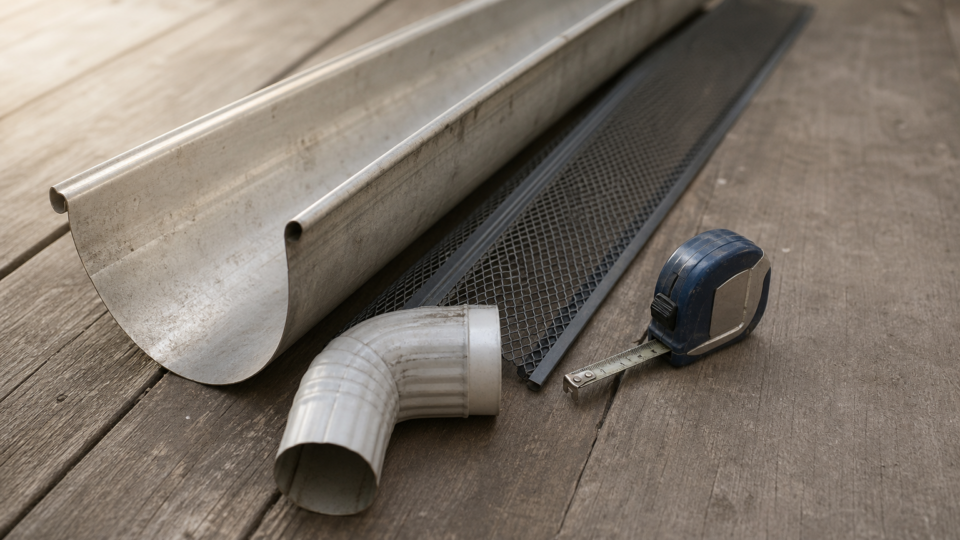
Short answer: The cost of new gutters with guards is typically $15 to $38 per linear foot installed. That works out to roughly $1,800 to $4,600 for a small one-story home and $3,750 to $9,500 for a large two-story house. The number combines two jobs: hanging a new gutter system and covering it with a debris-blocking guard. When one crew does both, you pay for one set of ladders and one visit instead of two. Ready for quotes? Compare local pros →
In this guide
Those ranges are wide because the guard type, gutter material, roof height, and your region all change the per-foot rate. A $1,800 quote and a $9,000 quote can both be fair for different houses. What you need is a way to tell which one is fair for yours.
Guardian Gutter Guide is an independent resource written by a former gutter installer and reviewed by a home inspector. This guide explains what the combined price includes, how to estimate your own total, which choices drive the cost, and whether the guards earn back their price.
Why the combined price matters before you request quotes
The cost of new gutters with guards matters as a single number because contractors often price the two parts separately, and the way they are bundled changes your total and your warranty. If you know the combined range first, you can spot a quote that is padded or suspiciously thin.
What the price should include
A complete quote covers more than a gutter and a screen. Ask that each item below appears as a line item or is clearly stated as included, because missing items are where surprise charges come from.
- Gutter sections, corners, end caps, and hangers
- Downspouts, elbows, and extensions
- The guard, with the brand or type named
- Removal and disposal of the old gutters
- Sealant, flashing, or drip edge where needed
- Labor and any lift or scaffolding rental
Why bundling usually saves money
Installing both at once usually costs less than doing them in two steps. The crew is already on the ladder, the gutters are clean and level, and the guard is cut to fit a brand-new trough. Guards added later to old gutters often require the installer to straighten, re-pitch, or reseal sections first, and that work shows up on your bill.
Fit matters too. Most guards are made for a specific gutter size, commonly 5-inch or 6-inch K-style. Buying both together keeps the sizing matched, and one company stands behind the whole system if water spills over the edge.
Guards belong on sound gutters, so the cheapest time to add them is the day the new gutters go up.
When guards on old gutters waste money
If your current gutters sag, rust through, or pull away from the fascia, a guard only protects a failing system. A decent rule is to replace the gutters and add guards together when the gutters are past 15 to 20 years old or have needed repeated fixes. If only one section is damaged, a repair may be enough, and you can add guards to the sound gutters later.
What should this cost you?
Answer four questions and get a fair price range for your home.
How to estimate your cost with simple math
Multiply your linear feet of gutter by a combined rate of $15 to $38 per foot, then add anything the quote leaves out. The hard part is measuring linear feet correctly, because square footage is a poor guide to how much gutter your house needs.
Measure your linear feet
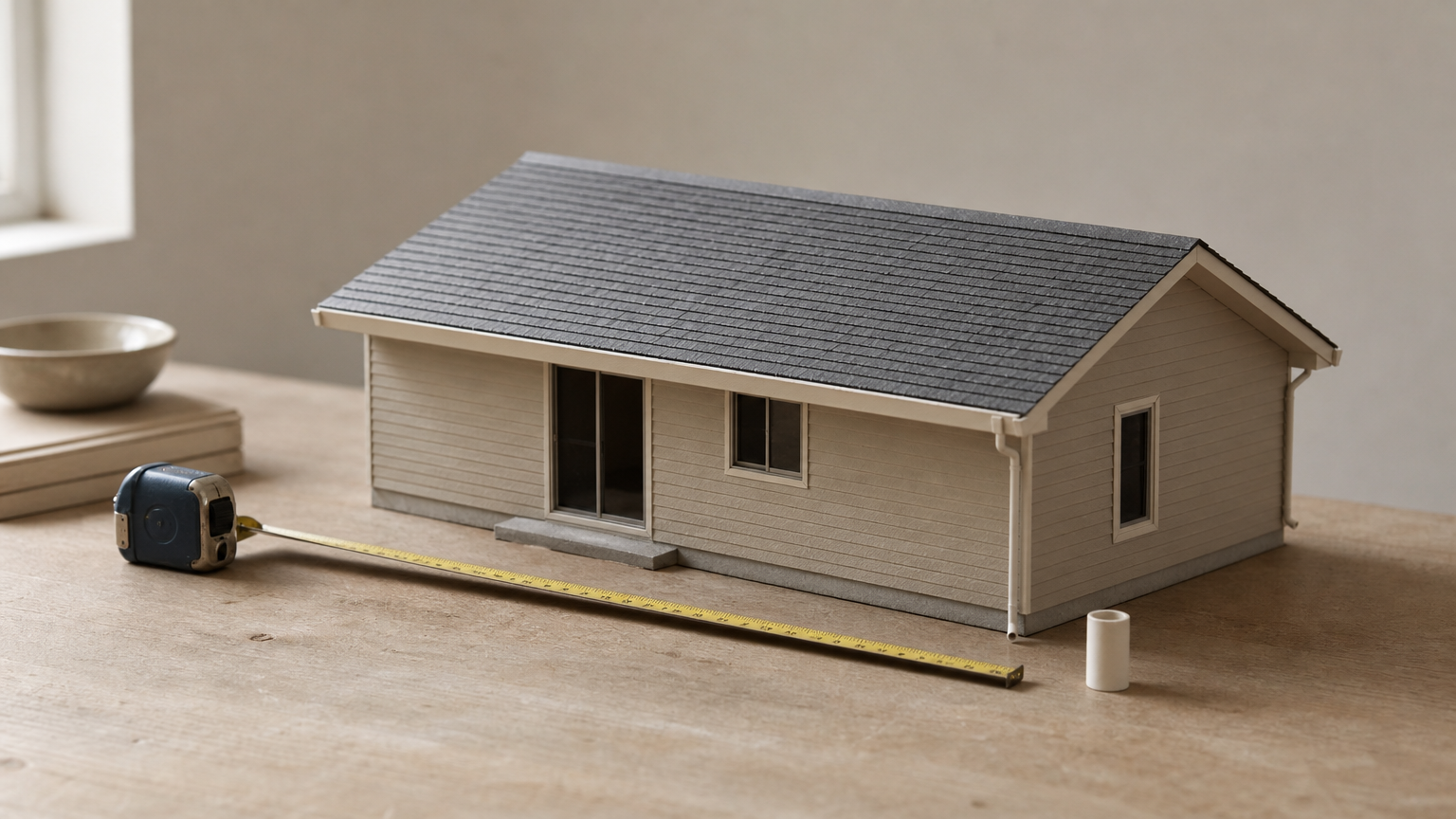
Gutters run along the roof edges that shed water, so you need the perimeter of those edges, not your floor area. A simple 40 by 30 foot ranch has about 140 feet of eaves. A two-story house with a 1,000 square foot footprint has less gutter than a 2,000 square foot ranch, but each foot costs more to install because of the height.
Downspouts are usually priced per foot too. Plan on about one downspout for every 30 to 40 feet of gutter, and add the vertical run from the eave to the ground for each one.
Typical totals by house size
The table below uses estimated linear footage and a combined rate of $15 to $38 per foot. The low end assumes aluminum gutters with a budget-friendly guard. The high end assumes aluminum with a premium micro-mesh guard.
| House size | Typical linear feet | Gutters only | Guards only | Combined total |
|---|---|---|---|---|
| 1,000 sq ft, one story | 120 | $960 to $2,160 | $840 to $2,400 | $1,800 to $4,600 |
| 1,500 sq ft, one story | 150 | $1,200 to $2,700 | $1,050 to $3,000 | $2,250 to $5,700 |
| 2,000 sq ft, one story | 180 | $1,440 to $3,240 | $1,260 to $3,600 | $2,700 to $6,800 |
| 3,000 sq ft, two story | 250 | $2,000 to $4,500 | $1,750 to $5,000 | $3,750 to $9,500 |
Published national averages for gutters alone run about $2,000 to $6,000 for an average home, which fits these figures. Treat the table as a budgeting tool, not a quote.
Measure the eaves, not the floor plan, and your estimate will land much closer to the real bid.
A worked example
Take that 40 by 30 foot ranch with 140 feet of eaves. At $15 per foot the project costs about $2,100, and at $38 it costs about $5,320. A midrange pairing of seamless aluminum and a reverse-curve or fine-screen guard at roughly $25 per foot lands near $3,500. Add a few hundred dollars if the old gutters need hauling away or the fascia needs repair.
Gutter material and guard type: where the per-foot rate comes from
Your per-foot rate is the gutter material plus the guard type, and most homes land at $15 to $30 per foot with seamless aluminum and a midrange guard. Material sets the floor of the price, and the guard decides how far above that floor you go.
What each gutter material costs
The combined range in this article assumes seamless aluminum, the most common choice. Vinyl pulls the total down, while steel and copper push it up.
| Gutter material | Typical installed cost per foot | Typical lifespan |
|---|---|---|
| Vinyl | $3 to $7 | 10 to 20 years |
| Seamless aluminum | $8 to $18 | About 20 years |
| Galvanized steel | $10 to $25 | 20 to 30 years |
| Copper | $25 to $50 | 50 years or more |
Vinyl is cheap but gets brittle in cold climates, so it pairs poorly with a premium guard. Aluminum offers the best balance for most budgets. Copper is mostly an aesthetic choice, and adding a guard to it rarely makes financial sense.
What each guard type costs
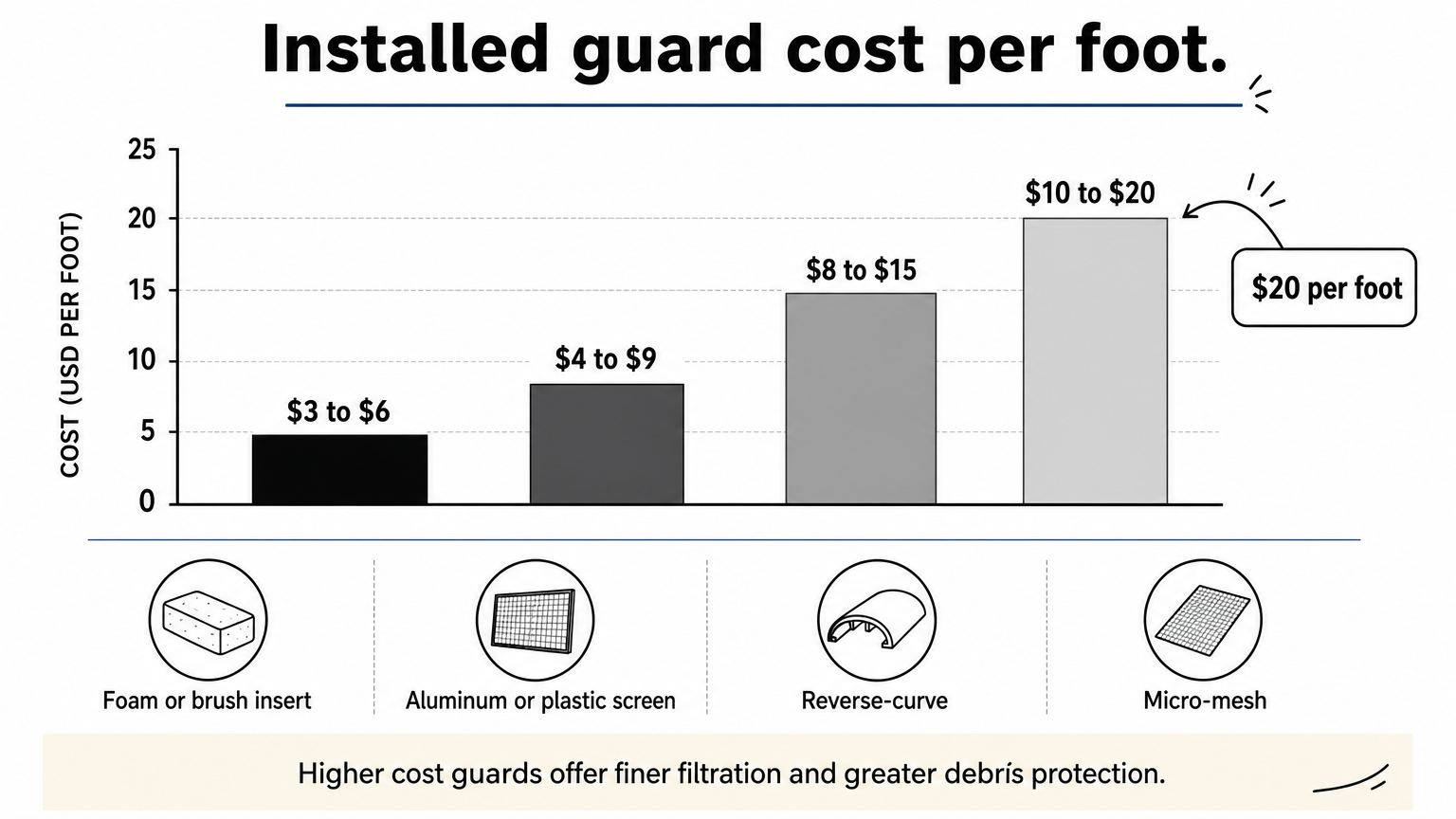
Guard prices vary more than gutter prices. Foam and brush inserts are the cheapest, and micro-mesh sits at the top because the fine stainless mesh and aluminum frame cost more to build and fit.
| Guard type | Typical installed cost per foot | Main trade-off |
|---|---|---|
| Foam or brush insert | $3 to $6 | Cheap, but clogs and breaks down |
| Aluminum or plastic screen | $4 to $9 | Blocks leaves, lets small debris through |
| Reverse-curve | $8 to $15 | Strong on leaves, can overshoot in heavy rain |
| Micro-mesh | $10 to $20 | Blocks the most debris, costs the most |
Professionally installed systems mostly fall between $7 and $20 per foot. Store-bought screens can run $1 to $10 per foot in materials, but you take on the labor and usually lose the performance warranty.
The guard is the biggest swing in your budget, so decide on its type before you compare quotes.
What pushes your quote up or down
Height, roof complexity, rotted wood, old-gutter removal, and your region cause most of the gap between two quotes on similar houses. Understanding these drivers keeps the cost of new gutters with guards from surprising you after the estimate.
House and roof factors
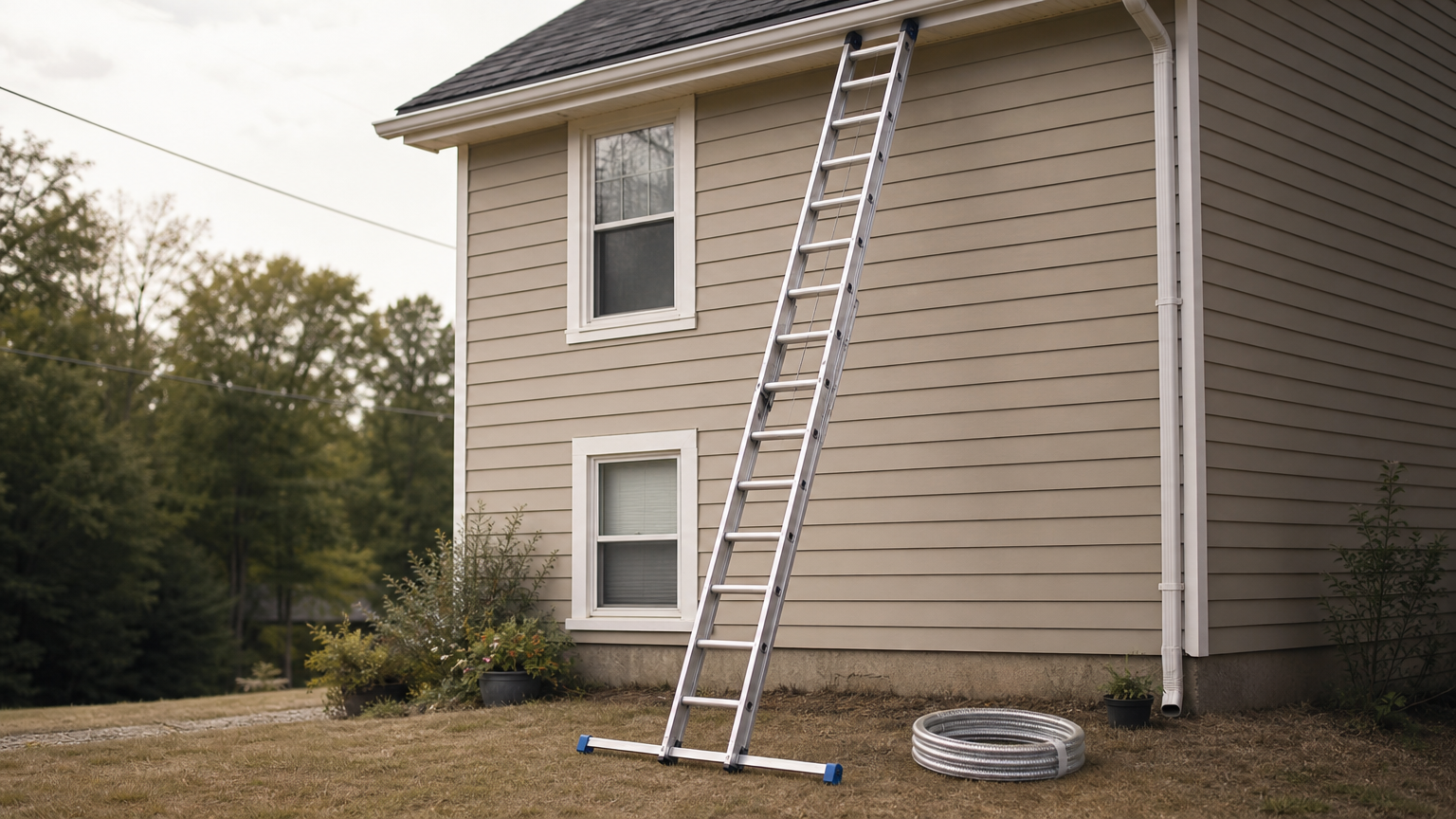
A second story brings extra labor and safety gear. Crews may need ladders with stabilizers, lifts, or scaffolding, and the per-foot rate rises accordingly. Complex rooflines add corners, valleys, and extra downspouts, which cost more than straight runs of gutter.
Steep roofs also slow the work. Guards on steep pitches may need extra fasteners or special brackets, so expect a higher rate there.
Prep work and add-ons
Rotted fascia or soffit boards must be repaired before new gutters go up, since hangers need solid wood. If you already see damage, have the contractor price it separately. Removal and disposal of the old system usually add a modest per-foot fee or a haul-away charge. Extras like downspout extensions, flashing, and drip edge can add a few hundred dollars each, depending on the house.
Region and quote red flags
Labor rates differ by region and between metro and rural areas, so national averages only get you started. Gather at least three written quotes and compare them line by line. Ask each contractor these questions:
- What is the price per linear foot for gutters and for guards separately?
- What gutter gauge and size are you using (aluminum gutters commonly come in .027 and .032 inch thicknesses)?
- Which guard brand or type, and who manufactures it?
- Is the warranty on materials, performance, or both, and does it transfer if I sell?
- Does the price include removal, disposal, and repair of damaged fascia?
The lowest quote is only the cheapest if it includes the same gutter, the same guard, and the same prep work.
Are gutter guards worth the added cost?
Guards are worth it if your house sits under heavy tree cover, has two stories, or is hard to reach, and they are a closer call on a single-story home with few trees. Count the cost of new gutters with guards against the cleanings you would otherwise pay for or do yourself.
The payback math
On a 150-foot house, guards add roughly $1,050 to $3,000. Professional gutter cleaning often runs $100 to $250 per visit on a single-story home and more for taller ones. Two visits a year is $200 to $500. Divide the guard cost by your yearly cleaning spend and the payback lands somewhere between two and fifteen years. Heavy debris and a tall house push it toward the short end.
There is a safety value too. Ladder falls are a real risk for DIY cleaners, and removing that chore has value beyond the dollar figure.
The honest downsides
No guard is maintenance-free. Micro-mesh still collects pollen, shingle grit, and pine needles on top, and it needs an occasional brushing or rinse. Cheap screens can bend, sag, or let seeds through and sprout. Reverse-curve designs can shoot water past the gutter in a heavy downpour. Poorly fitted guards can also hide a clog or a leak until it becomes expensive.
A simple decision rule
Add guards when most of these apply to you:
- Large trees hang over or near the roof
- Your gutters clog more than twice a year
- The house has two or more stories
- You plan to stay for at least five to ten years
- You would otherwise pay for cleaning or climb the ladder yourself
If only one or two apply, a sturdy gutter alone may serve you better. Spend the savings on fascia repair or better downspout drainage instead.
Guards pay off for homes with heavy debris, and they are optional for homes without it.
Budget first, then get real quotes
Plan on $15 to $38 per foot for new gutters with guards, which is about $1,800 to $9,500 for most homes depending on size, material, and guard type. Measure your eaves, match your gutter and guard choices to your trees and your stories, and compare written quotes line by line. Guards earn their price on shaded, tall, hard-to-reach homes, and they are optional on low-debris houses.
When your numbers are ready, request a free gutter guard installation quote and you will see an estimated cost range first, then get matched with local contractors who can price your exact home.
What should this cost you?
Answer four questions and get a fair price range for your home.