
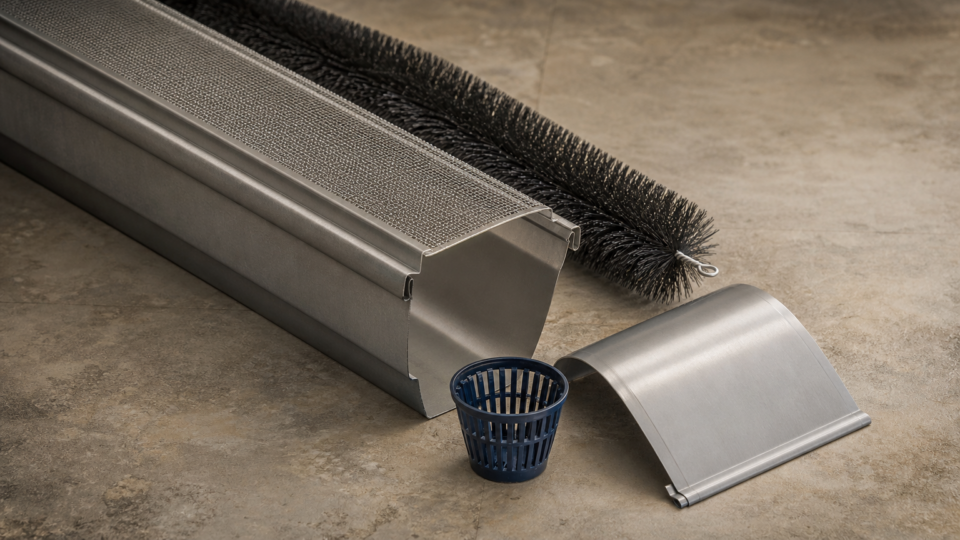
Short answer: The best gutter guards for heavy rain are stainless steel micro-mesh systems with a built-in pitch, because they pass a lot of water while blocking fine debris. If you hire a pro, that is the pick for most homes. If you install it yourself, DIY micro-mesh panels come closest. If money is tight, a perforated aluminum screen is the best inexpensive choice, as long as your gutters are sized for the roof. Ready for quotes? Compare local pros →
In this guide
The most common complaint after a guard goes on is overflow during a downpour. The guard is rarely the only cause. Undersized gutters, weak pitch, and clogged downspouts do as much damage, and most brand roundups skip them. This guide ranks six options by how they handle fast water. It also shows what to check for 5-inch, 6-inch, and 3-inch gutters and for downspouts.
Marcus Delaney, a former gutter installer with 12 years in the trade, wrote this guide. Dana Whitfield, a residential home inspector, reviewed it. Guardian Gutter Guide does not sell or install guards, so the ranking does not depend on who pays.
What makes gutter guards handle heavy rain
A gutter guard handles heavy rain when it lets water in as fast as your roof sends it down and keeps debris from slowing that flow. Three things decide that: the guard design, the capacity of your gutters and downspouts, and the pitch of the guard and the gutter underneath.
Why gutters overflow in a downpour
Overflow is a volume problem first. One inch of rain on 1,000 square feet of roof is about 620 gallons. At a hard 3 inches per hour, that is roughly 31 gallons per minute arriving from just that 1,000 square feet. A guard that slows entry, or a downspout that cannot carry the flow, sends the excess over the edge.
Debris makes it worse. A partly clogged guard shrinks the opening that water has to pass through, so a storm that a clean guard handles will overflow a dirty one. That is why fine mesh that stays clear often beats coarse mesh that fills up, even though coarse mesh has bigger holes on paper.
Gutter size and downspout capacity
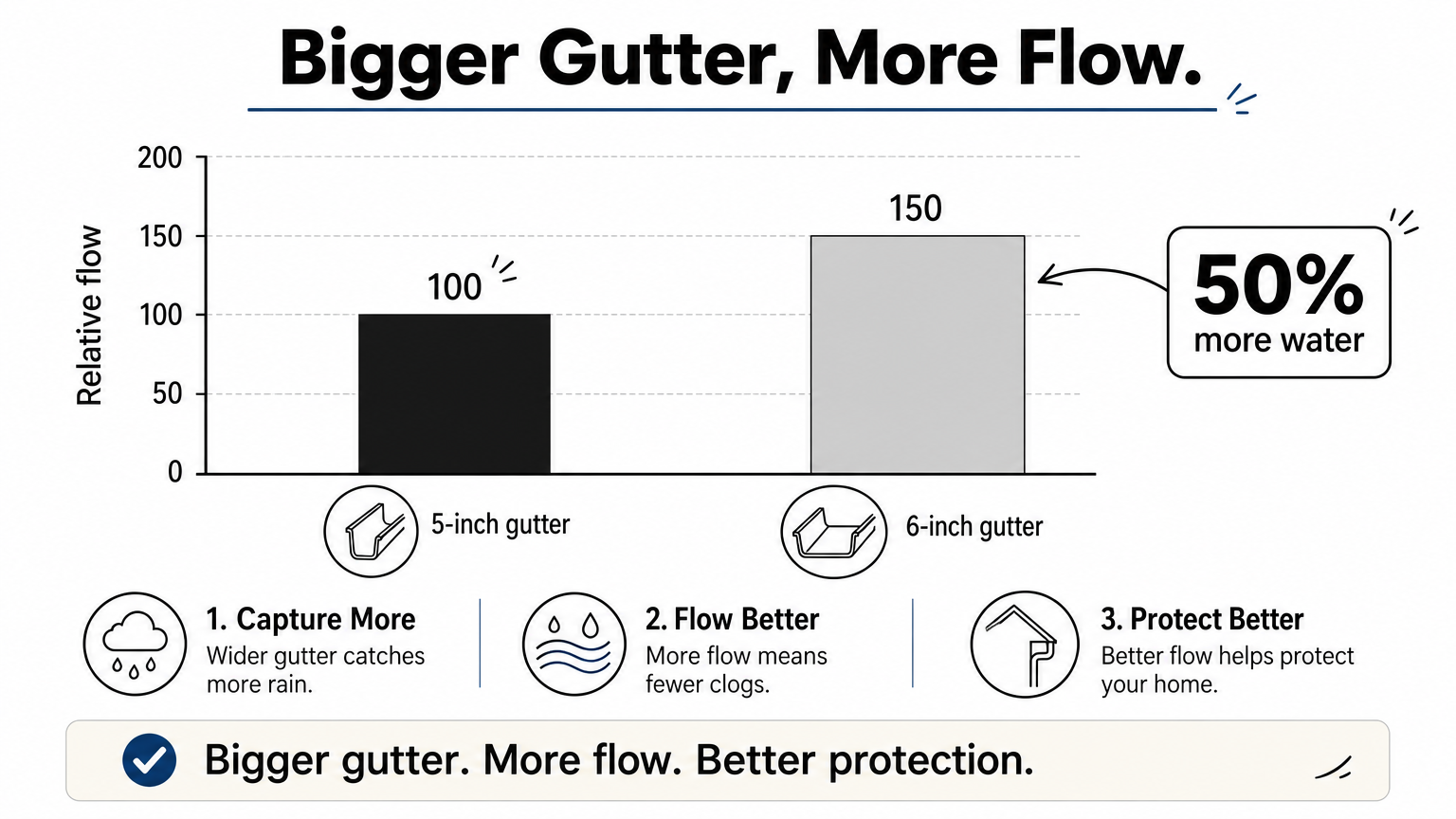
Gutter and downspout size set a ceiling that no guard can raise. A 6-inch gutter is commonly cited as carrying about 50% more water than a 5-inch gutter. That is why 6-inch is the safer choice on large roofs, valleys, and steep pitches. A common rule of thumb is one square inch of downspout opening for every 100 square feet of roof draining to it.
| Downspout size | Opening area | Roof area it handles |
|---|---|---|
| 2×3 inch | 6 sq in | About 600 sq ft |
| 3×4 inch | 12 sq in | About 1,200 sq ft |
A guard cannot add capacity, so fix undersized gutters and downspouts before you choose one.
Match the guard to the gutter width as well. Many DIY kits cover only 5-inch and smaller gutters, so look for 6-inch fit in the listing. Gutters of 3 inches are uncommon on main roofs. You mostly see them on porches, sheds, and small additions, and few guards are made for them. A brush guard or a cut-to-fit screen usually works there. If that run carries real roof runoff, replacing it with a 5-inch gutter is the better fix.
How the six picks are ranked
Each pick was judged on five points, in this order of weight:
- Water entry: how much water the guard admits per minute when clean.
- Debris blocking: whether fine grit, needles, and seeds stay out or lodge in the openings.
- Self-cleaning: whether pitch and surface let debris shed in rain and wind.
- Space used: whether the guard sits on top or eats into the gutter’s capacity.
- Fit and difficulty: which gutter sizes it covers and how hard it is to install correctly.
Foam insert guards are left off the list on purpose. They fill the gutter, trap seeds, and cut capacity, which is the opposite of what a downpour demands.
What should this cost you?
Answer four questions and get a fair price range for your home.
1. Professionally installed stainless micro-mesh
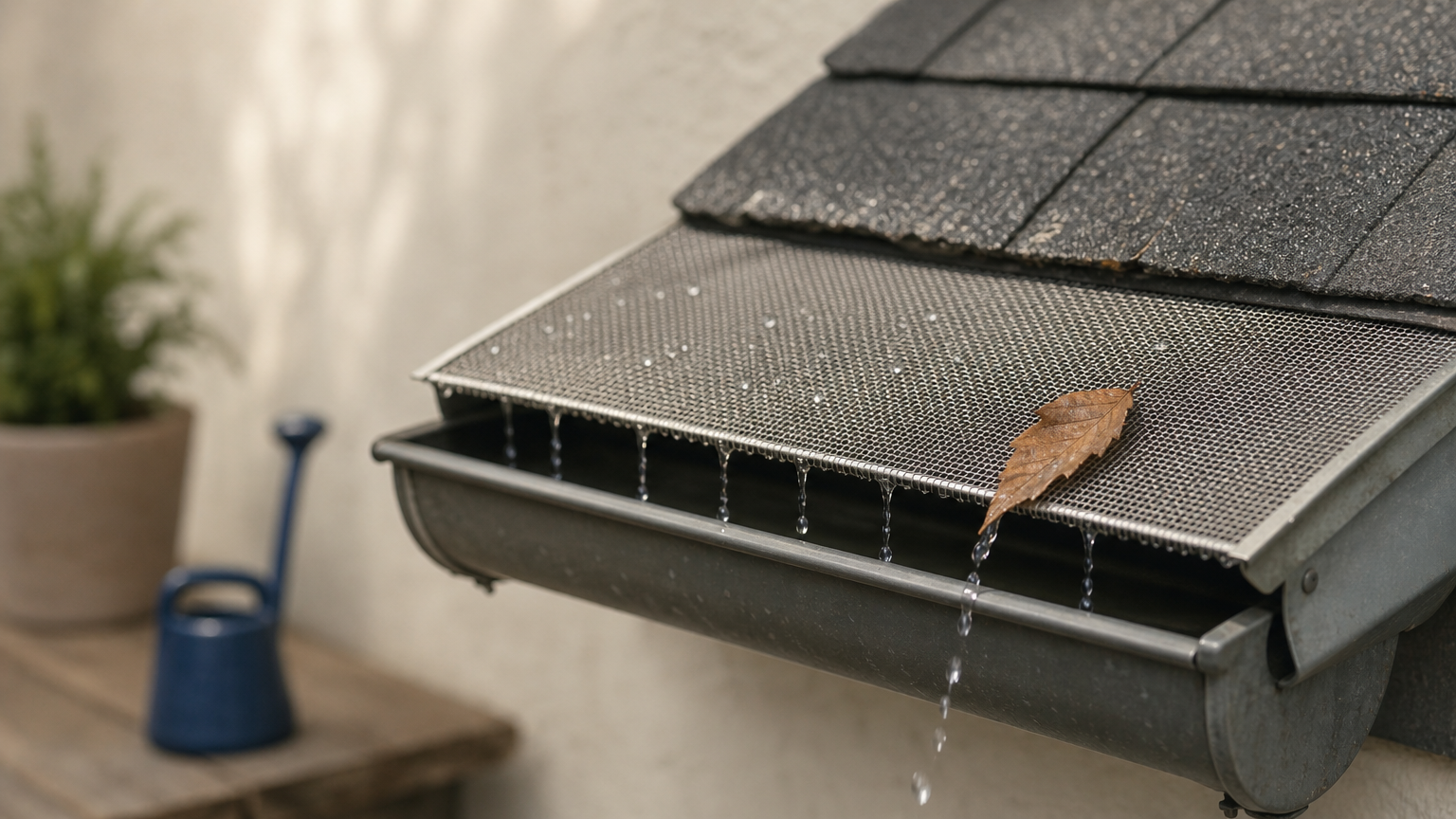
This is the best overall pick for heavy rain. A fine stainless steel screen on a pitched frame admits water quickly and keeps shingle grit and pollen out. Brands such as LeafFilter, HomeCraft, and Gutter Guards America sell versions of it.
How it handles heavy rain
Water clings to the mesh and drops through thousands of tiny openings, while leaves and sticks slide off the pitched surface. Because fine debris stays out, the gutter below keeps its full capacity during a storm.
The weak point is fine film. Pollen, dust, and grit can cake on a flat or poorly pitched screen and slow water entry, so the installed pitch matters as much as the mesh. No mesh fixes a 5-inch gutter on a roof that needs 6-inch.
A micro-mesh guard with the right pitch over right-sized gutters is the safest bet for heavy rain.
Who it suits
Choose this if you have a two-story home, a steep roof, or heavy tree cover with pine needles and seed pods. It also suits owners who want to stay off ladders and value a warranty. Most professional systems carry a limited lifetime warranty, but terms differ, so read what the clog coverage includes. Some installers tuck the guard under the first row of shingles, so ask whether that affects your shingle manufacturer’s warranty.
Cost and installation
Homeowner survey data puts professionally installed gutter guards at roughly $32 to $47 per linear foot, with micro-mesh near $40 per foot. For 150 linear feet, that is about $6,000, or $4,800 to $7,050 across the range. A good installer checks the gutters, slope, and downspouts before quoting. Get at least three written quotes, and expect repairs such as fascia fixes to add to the total. Actual quotes vary by installer, roof access, and local labor rates.
2. Self-install micro-mesh panels
DIY micro-mesh panels are the best self-installed gutter guards for heavy rain. They use the same fine-mesh principle as the pro systems, and you pay for material only. Raptor is a well-known example, but check the gutter size on any kit.
How it handles heavy rain
Water flow is close to a pro system when the panels are level, tight, and pitched like the roof. Quality varies with the frame. Flexible frames can sag between brackets, and gaps where panels meet let debris in.
Fit is the biggest trap. Many DIY kits are made for 5-inch gutters and smaller, so on 6-inch gutters you need a kit listed for that width. A narrow guard on a wide gutter leaves an open strip along the edge.
Buy the kit rated for your exact gutter width, because a near fit lets debris in and water over.
Who it suits
This suits handy owners with a single-story home or a low roofline, and anyone comfortable on a ladder. It is the best self install option when you want micro-mesh performance without a $6,000 quote. It is a poor fit for tall homes. A fall from a second-story ladder costs far more than a professional install.
Cost and installation
Installation steps for most panels:
- Clean the gutters and flush the downspouts.
- Fix sagging sections so the gutter drops about 1/4 inch per 10 feet toward the downspout.
- Measure each run and cut panels with aviation snips.
- Slide or fasten the panels so the guard follows the roof slope.
- Overlap or butt the seams tightly, then check for gaps.
- Run a hose at the roof edge for several minutes and watch for overshoot.
Material costs run well below the $40 per foot pro figure, since you skip labor. Use a ladder stabilizer, and never lean off the side.
3. Perforated aluminum screen
A perforated aluminum screen is the best inexpensive guard that still moves heavy-rain volume. Its larger openings pass water readily, and the price drops sharply when you install it yourself. Expect to give up some fine-debris protection.
How it handles heavy rain
Water passes through easily, and a screen sitting on a 6-inch gutter has plenty of capacity below it. In a downpour, it often keeps up with micro-mesh. The trade-off is what gets through. Shingle grit, seeds, and pine needles can drop into the gutter, settle, and slowly build up into a blockage.
Big leaves can also lie flat across the holes and cover them. On a roof under maples or oaks, that can slow entry until wind or rain clears the leaf.
A screen moves water well but lets fines through, so it needs periodic raking where trees are close.
Who it suits
This fits homeowners with few overhanging trees, mostly larger leaves, and a tight budget. It also suits a single-story house where cleaning once or twice a year is not a burden. If pines or seed-heavy trees sit near the roof, move up to micro-mesh. Fine debris is exactly what a screen cannot stop.
Cost and installation
Professionally installed screen guards average around $38 per linear foot in survey data, which is about $5,700 for 150 feet. The savings come from DIY. Most snap-in or slide-in screens install with snips and a drill, and cost a fraction of the pro figure. Check that the product is listed for 6-inch gutters if you have them, and fasten it so the front edge cannot lift in wind.
4. Downspout strainers and outlet guards
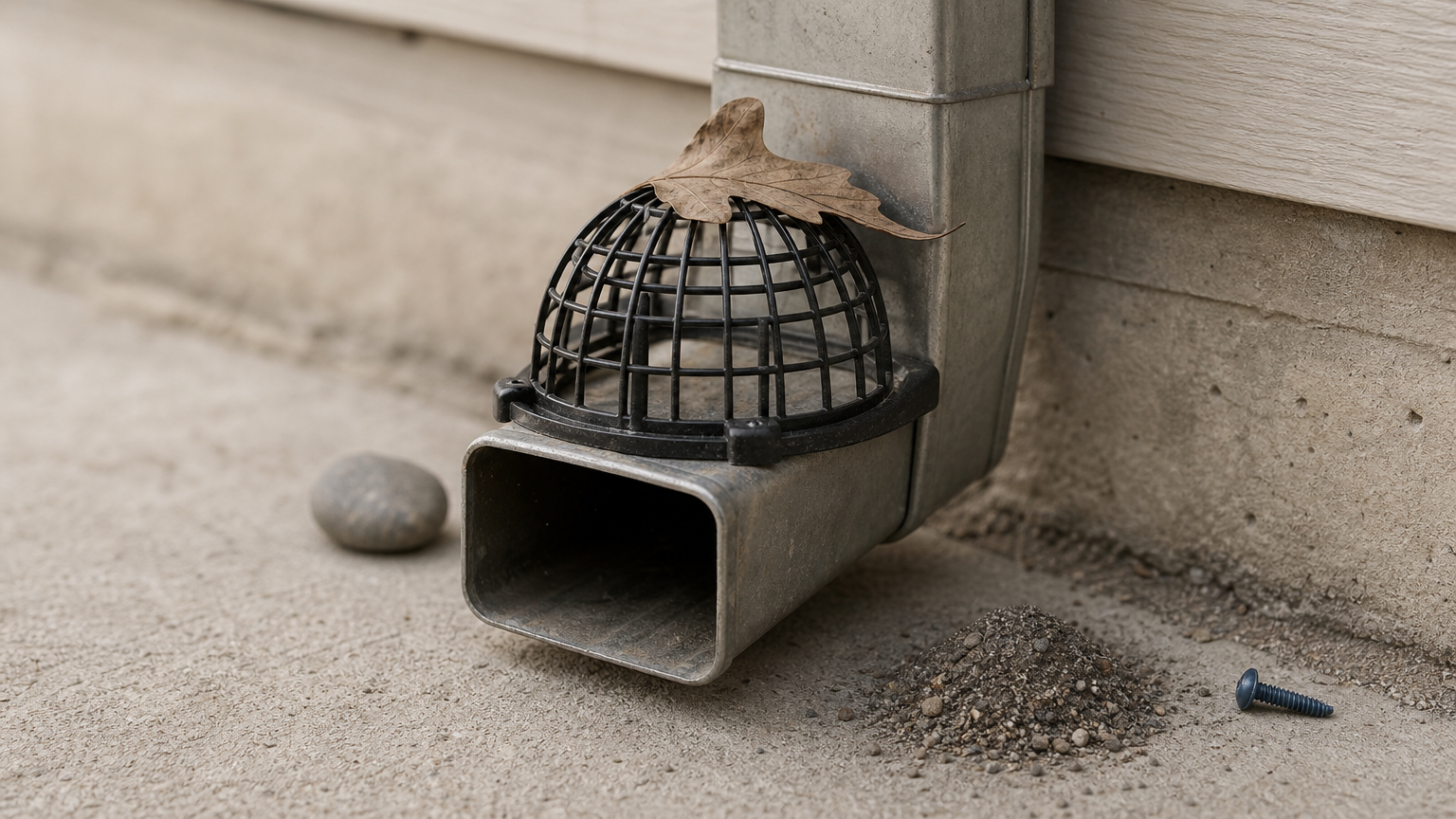
Downspout strainers are the best downspout guards, and they are cheap insurance for any guard type. The downspout is where heavy-rain overflow often starts, so a strainer protects the narrowest point in the system.
How it handles heavy rain
Most blockages form at the outlet or the first elbow, where leaves and grit pile up. A cage-style strainer that sits above the outlet catches larger debris and lets water bypass if the cage fills. Avoid tight basket plugs that sit deep in the tube. They clog themselves and turn a clog at the elbow into a clog at the top.
Strainers matter most with screen or brush guards, which let more debris into the gutter. They also protect underground drain lines, which are costly to clear.
Keep the downspout open, because a gutter guard is only as good as the pipe it drains into.
Who it suits
Anyone with a downspout that has clogged before, and anyone whose guard lets fines through, should add one. It also helps homes where downspouts connect to a buried drain. Measure the opening first. Downspouts come as 2×3 inch, 3×4 inch, and 3-inch or 4-inch round, and the strainer must match.
Cost and installation
Strainers cost far less than a gutter guard and install in minutes with a screwdriver. Set one in each outlet, then check it after the first big leaf drop. It is not a replacement for a guard. Treat it as the add-on that keeps the guard you chose from being the reason water backs up.
5. Brush guards
Brush guards are the cheapest and fastest gutter guards to self install, and they suit a short-term or odd-size fix. They are a weak choice for heavy rain because they sit inside the gutter and use up capacity.
How it handles heavy rain
Water flows between the bristles, which hold large debris above the gutter floor. In a downpour, they work until debris tangles in the bristles. Then the brush becomes a dam inside the gutter, and water spills over the front edge. Because the brush fills the channel, the gutter also holds less water than an open gutter.
Cleaning is simple but regular. Lift the brush out, shake or hose it off, and set it back.
A brush is a budget stopgap that needs regular cleaning, not a set-and-forget answer to heavy rain.
Who it suits
Brush guards fit tight budgets, rental properties, and short runs. They are also the type most often sold in several diameters, so they are the likelier fit on odd sizes such as 3-inch gutters. Check the listed diameter against your gutter depth. They are a poor match for steep roofs and heavy rain regions. The bristles also stick out above the gutter lip, which some owners dislike.
Cost and installation
Survey data puts brush guards near $19 per foot when professionally installed, which is about $2,850 for 150 feet. Most people install them by hand. You cut sections to length and lay them in, with no tools needed for the basic job. The low price comes with a cost. Budget time to pull and rinse them once or twice a year.
6. Reverse-curve covers
Reverse-curve covers rank last for heavy rain. They shed leaves well, but in a hard downpour water can shoot past the curve and onto the ground. They fit regions with moderate rain and heavy leaf drop.
How it handles heavy rain
The solid top sends water around a curved nose and into the gutter by surface tension. In light to moderate rain, that works well, and leaves blow off. In an intense downpour, fast water can overshoot the nose, especially from steep roofs and valleys where runoff concentrates. Larger gutters give the system more room, but the overshoot problem stays.
If your area gets frequent cloudbursts, a reverse-curve cover is the type most likely to disappoint.
Who it suits
This fits homes in regions with moderate rainfall and heavy leaf or blossom drop. It also works on low-pitch roofs where water moves slower. Ask any installer how the cover handles your roof’s valleys and pitch. If they cannot explain it, choose micro-mesh instead.
Cost and installation
Survey data puts reverse-curve covers near $41 per linear foot installed, about $6,150 for 150 feet. That is the highest price on this list for the weakest heavy-rain performance. Installation is generally a professional job, because the cover must sit at the right angle against the roof edge and the gutter. Compare quotes against micro-mesh before you commit.
Choosing the right guard for your gutters and budget
Pick by your biggest constraint. If you want the best gutter guards for heavy rain and will hire a pro, choose micro-mesh. If you will install it yourself, choose DIY micro-mesh. If budget rules, choose screen. Then confirm your gutter size and downspouts.
Quick picks by need
| Your need | Best pick | Why |
|---|---|---|
| Heavy rain, hiring a pro | 1. Pro-installed micro-mesh | Highest flow with fine-debris blocking |
| Self-install | 2. DIY micro-mesh panels | Same design, no labor cost |
| Inexpensive | 3. Perforated aluminum screen | Strong flow, low DIY cost |
| 6-inch gutters | 1 or 2, sized for 6-inch | Confirm the listed gutter width |
| 3-inch gutters | 5. Brush or cut-to-fit screen | Most flexible on small sizes |
| Downspouts | 4. Cage-style strainers | Protects the narrowest point |
What 150 feet costs by type
These are installed averages from homeowner survey data, rounded to the dollar per foot. DIY removes the labor part of each figure.
| Type | Per linear foot | 150 linear feet |
|---|---|---|
| Brush | $19 | $2,850 |
| Foam insert | $22 | $3,300 |
| Screen | $38 | $5,700 |
| Micro-mesh | $40 | $6,000 |
| Reverse-curve | $41 | $6,150 |
Checks before you buy
Run through this list before you spend money:
- Measure the gutter width, and confirm the guard is listed for it.
- Compare downspout size and count against the roof area they drain.
- Check the gutter slope, about 1/4 inch of drop per 10 feet.
- Ask about your shingle warranty if the guard slides under the shingles.
- Get three written quotes if you hire out.
Guardian Gutter Guide may earn a referral fee when you request quotes through a link on the site. Fees do not change the rankings or the prices shown, and contractors cannot pay to be recommended.
Pick the guard after you check the gutters
For heavy rain, choose stainless micro-mesh, installed by a pro or by you. Use a perforated screen if the budget is tight. Add a downspout strainer to any setup, and treat brush guards and reverse-curve covers as situational picks. None of them will rescue gutters that are too small or poorly sloped, so check size, pitch, and downspouts first.
If you are ready to price a professional install, get free guard install quotes with a cost range first. You will see what a fair number looks like before a contractor calls.
What should this cost you?
Answer four questions and get a fair price range for your home.