
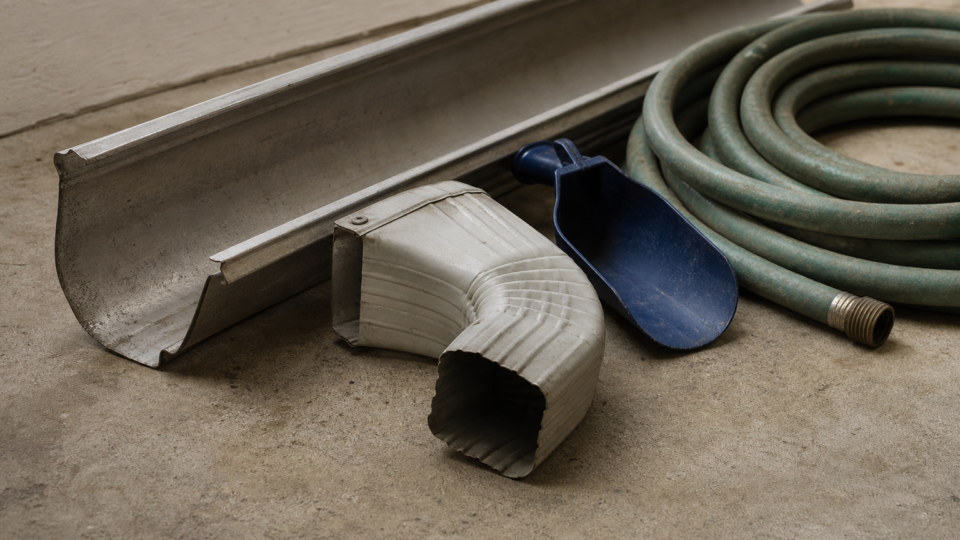
Short answer: The best gutter overflow solutions match the cause of the spill, so you fix the real problem once. Clear clogs first, then correct the slope, add downspout capacity, deflect water at valleys and corners, protect against debris, and upsize only when clean gutters still can’t keep up. If you own a ladder and have an hour, items 1 to 3 cost little or nothing. If one corner is the problem, item 4 is your answer. If trees keep refilling your gutters, look at item 5. If clean gutters overflow in every hard rain, item 6 is the permanent fix. Ready for quotes? Compare local pros →
In this guide
Overflow rarely announces its cause. Water pours over the lip, stains the fascia, and digs a trench beside the foundation, and the usual advice is "clean your gutters." That works only when a clog is the culprit. Otherwise you clean, wait for the next storm, and watch the same spot spill again.
This guide is written by a former gutter installer and reviewed by a home inspector. It starts with a quick way to diagnose your overflow, then gives six fixes in order from cheapest to most involved. Each one covers what it solves, how to do it, and what it costs.
How to find out why your gutters overflow
Gutters overflow for one of four reasons: a blockage, poor slope, too little drainage, or more water than the gutter can carry. Where and when the water spills tells you which one you have, and that tells you which of the six fixes below to start with.
Read the pattern of the overflow
Stand outside during a rainstorm, or look at the stains and erosion afterward. The pattern of the spill points to the cause. Use this table as a shortcut.
| What you see | Likely cause | Start with |
|---|---|---|
| Spills along the whole run, even in light rain | Clogged gutter or downspout | Fix 1 |
| Standing water in the trough after rain stops | Sagging or flat gutter | Fix 2 |
| Gutter fills to the brim near one downspout, or the downspout barely flows | Blocked or too few downspouts | Fix 3 |
| A waterfall at one valley or inside corner | Concentrated roof flow | Fix 4 |
| Debris is back within weeks of cleaning | Heavy tree cover | Fix 5 |
| Clean, level gutters spill only in the hardest downpours | Undersized system | Fixes 3 and 6 |
Many homeowners ask whether it is normal for gutters to overflow in heavy rain. An occasional spill in a rare downpour is not a failure, because every system has a design limit. Regular overflow in ordinary storms is not normal, and it almost always has a fixable cause.
Run a hose test before you buy anything
Clean the gutters first, then test them. Put a hose in the high end of each run and let it flow for a few minutes while you watch from the ground. Look for three things:
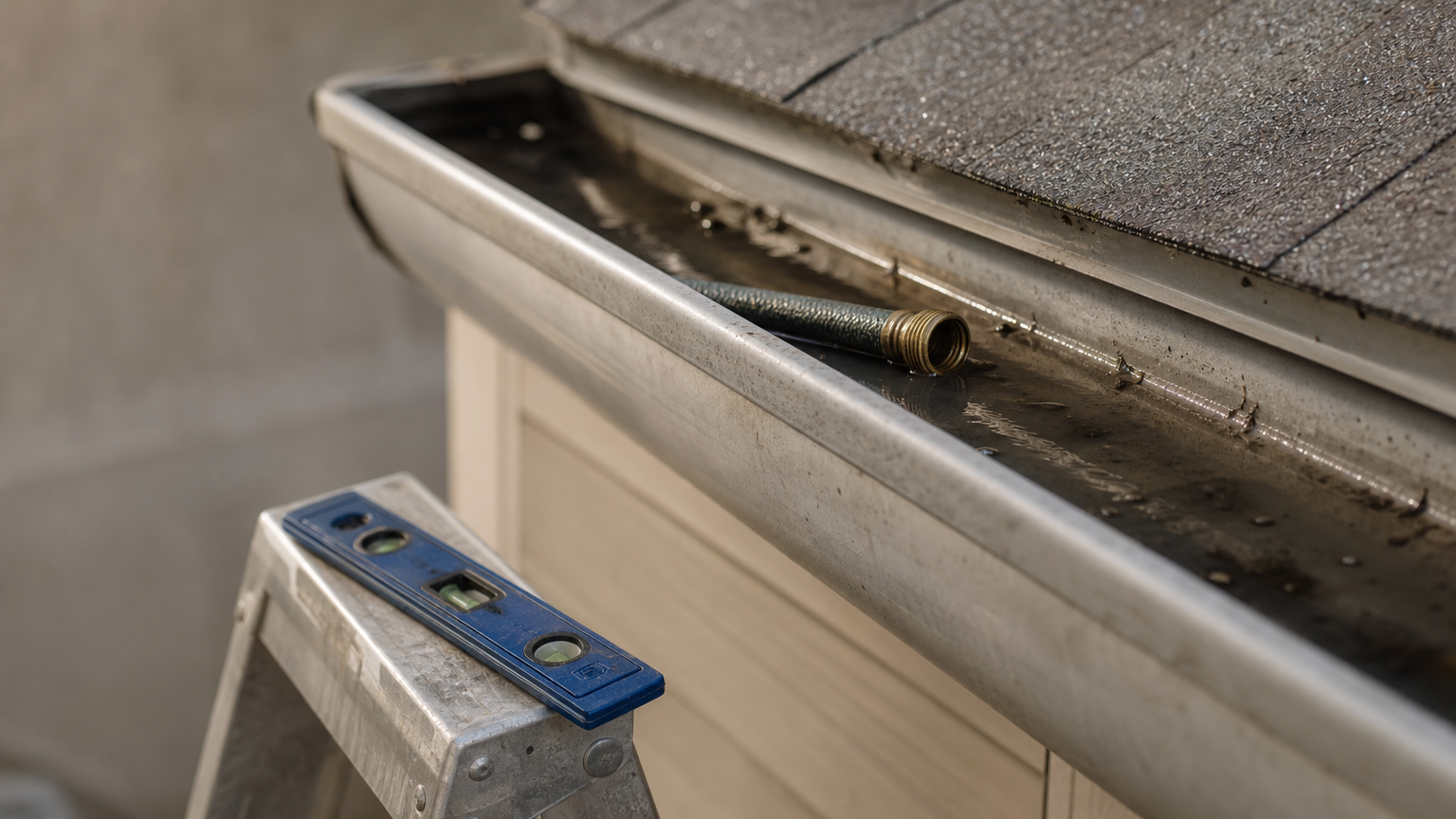
- Water pooling in the middle of a run, which means a pitch problem.
- Water that backs up at a downspout and drains slowly, which means a blockage below.
- Water that leaps over the lip at one spot, which means a valley, corner, or flow concentration.
This test is also the answer to "why are my gutters overflowing when they aren’t clogged?" Clean gutters spill because of slope, downspouts, or size.
The pattern of the spill tells you the cause, and the cause tells you which fix is worth paying for.
What should this cost you?
Answer four questions and get a fair price range for your home.
1. Clear the gutters and downspouts
Clearing debris from the trough and the downspouts is the first of the gutter overflow solutions to try, because a clog is the most common cause. It costs nothing if you do it yourself and fixes most whole-run overflow.
What it fixes
Leaves, shingle grit, seed pods, and twigs pack the trough until water has nowhere to sit. The downspout opening is the usual choke point. A small clump there acts like a dam, so the gutter fills from the bottom up and spills even though it looks mostly clear.
A second trouble spot is the downspout itself. Debris that washes in can lodge in an elbow and block the pipe from below.
A gutter that looks clean can still be dammed at the downspout outlet.
How to do it
Work from a ladder on firm, level ground, and keep your hips between the rails. Never lean out to reach farther.
- Scoop out debris with a gloved hand or gutter scoop and drop it in a bucket.
- Flush the trough with a hose, starting at the end farthest from the downspout.
- If water backs up at the outlet, push the hose up the downspout from the bottom, or feed a plumber’s snake down from the top.
- Run water again and confirm it drains freely with no pooling.
Cost and difficulty
Twice a year is the usual rhythm, and more often if trees overhang the roof. Here is what to expect:
- DIY cost: free if you own a ladder and a hose.
- Time: one to two hours for a typical one-story house.
- Professional cleaning: roughly $100 to $250 for an average one-story home, and more for two stories.
- Skip DIY if your gutters are high, the roof is steep, or you are not steady on a ladder.
2. Fix the pitch and tighten the hangers
Correcting the slope of a gutter run, and replacing the hangers that let it sag, solves overflow that comes with standing water. It is a moderate DIY job that needs a level and a helper.
What it fixes
Gutters should slope gently toward the downspout, roughly a quarter to a half inch for every 10 feet. A flat or sagging section holds water, collects silt, and spills over the front lip long before it should. Too steep a slope is a different problem, because fast water can overshoot a corner or outlet.
Here is a worked example. A 40-foot run draining to one end should drop about 1 inch from high end to low end, and it shouldn’t drop much more than 2 inches. Standing water after rain tells you the run has dipped below that line.
How to do it
Old spikes and ferrules work loose over time, and heavy debris or ice pulls hangers away from the fascia. Fix it in this order:
- Snap a chalk line from the high end to the low end at the right drop.
- Loosen the hangers in the sagging section and lift the gutter to the line.
- Replace worn spikes with screw-in hidden hangers, spaced roughly every 2 to 3 feet.
- Hose-test the run and check that no water stays in the trough.
If the fascia board is soft or rotted, repair it first. New hangers will not hold in bad wood.
A gutter that holds water after the rain stops has a slope problem, and no amount of cleaning will fix it.
Cost and difficulty
Hangers are cheap. A 40-foot run with hangers every 2 feet needs about 20 of them, which usually costs under $50 in parts. A pro re-hanging a run typically charges a few hundred dollars, and quotes vary by roof access and local labor rates. Plan on a helper, because holding the gutter at the line while you screw it off is awkward alone.
3. Add or extend downspouts
Adding a downspout, or moving water farther from the house, fixes overflow where the gutter fills faster than it drains. It is among the gutter overflow solutions that cost the least relative to their effect.
What it fixes
A gutter can only move as much water as its outlets let out. Too few downspouts means the trough fills during a heavy burst, and the water goes over the edge. A common rule of thumb is no more than about 40 feet of gutter per downspout, and less on large or steep roofs.
Take a 60-foot run with one downspout at the far end. Adding a second outlet near the other end cuts each outlet’s job to about 30 feet of gutter. If your overflow is worst at a valley, put the new outlet close to it.
A gutter overflows when it fills faster than it drains, so more outlets often beat a bigger trough.
How to do it
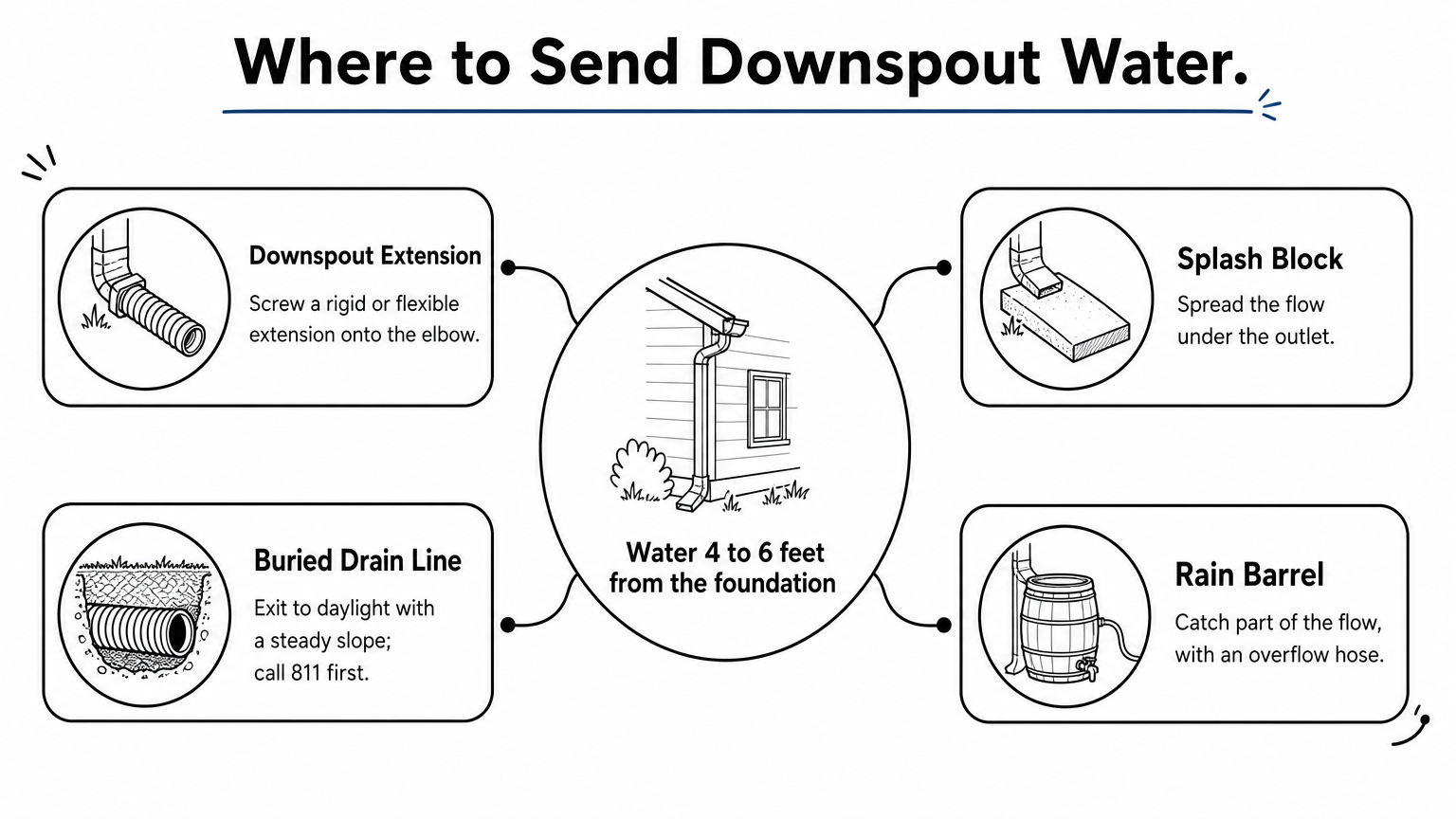
If you are asking how to disperse water from a downspout, the goal is simple. Send it at least 4 to 6 feet from the foundation and downhill from the house. These are the common options:
- A rigid or flexible extension screwed onto the elbow.
- A splash block under the outlet to spread the flow.
- A buried drain line that exits to daylight with a steady slope. Call 811 before you dig.
- A rain barrel, with an overflow hose, for part of the flow.
Adding a new outlet to the gutter itself means cutting the trough, fitting an outlet, and sealing it. Professional installation is the safer route unless you are comfortable with sheet-metal work.
Cost and difficulty
An extension or splash block usually costs $10 to $25 and takes minutes. A new downspout installed by a pro commonly runs $150 to $300 per outlet. A hose test afterward confirms the new outlet drains the whole run and the water leaves the area.
4. Add splash guards or diverters at valleys and corners
Splash guards, diverters, and custom corner work fix overflow that happens in one spot. They are the right fix when the rest of your gutter handles rain fine.
What it fixes
A valley is where two roof planes meet, and it funnels the runoff of both into one narrow stream. That stream hits the gutter fast, and the water shoots over the front lip instead of dropping in. Inside corners behave the same way, and the corner seam is often where debris collects too.
If your overflow is always at the same corner, you do not need new gutters everywhere. You need to slow or redirect the water at that point. Steeper roofs make the effect worse.
When water overflows in one spot only, fix that spot instead of replacing the whole run.
How to do it
Work from the cheapest option up, and stop when the hose test passes:
- Splash guard: an aluminum deflector that fixes inside the gutter at the valley outlet and turns the stream back into the trough.
- Valley diverter: a metal or rubber piece on the roof that splits the stream into a wider, slower flow. It requires roof work, so hire it out if the roof is steep or high.
- Extreme miter or custom flared section: a pro fabricates a wider section at the discharge point to catch more water.
- Extra downspout nearby: see item 3.
Cost and difficulty
Parts are cheap at the low end. A splash guard is roughly $15, a diverter about $20 to $50, and a pro-built extreme miter commonly $200 to $400. A splash guard is an easy ladder job, while a diverter or custom miter is not. If a splash guard fails after a season, the problem is likely volume, so move on to items 3 and 6.
5. Add gutter guards that match your debris load
Gutter guards keep clogs from forming, which stops the overflow that returns after every cleaning. They do not add capacity, so they are the right fix only when debris is your problem.
What it fixes
If you clear the gutters and they are full again in a month, trees are the cause. Guards cover the trough so leaves and needles stay out while water gets in. They cannot fix a bad slope or too few downspouts. On an undersized gutter, some guard styles can even make a heavy surge worse, because water can skip past them.
Guards stop clogs, not volume, so add them to a gutter that already drains well.
How to do it
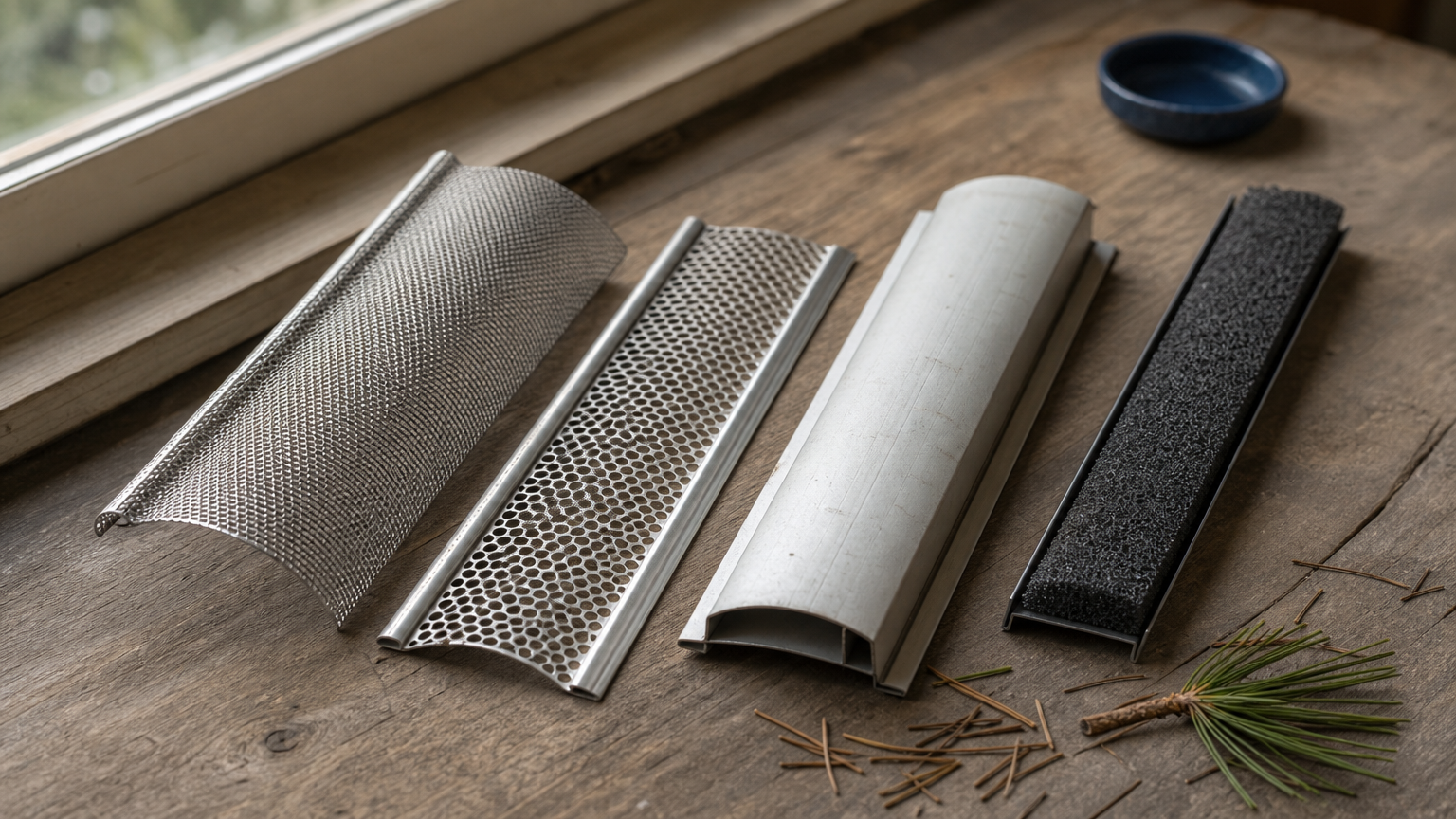
Pick the type for your trees and roof pitch, then have it installed or snap it in yourself. Check your roof warranty before sliding any guard under shingles.
| Type | Best for | Watch out for |
|---|---|---|
| Micro-mesh | Pine needles, shingle grit, fine debris | Higher price, and a poor install lets debris collect |
| Aluminum screen | Leaves and larger debris on a budget | Small debris slips through |
| Reverse-curve | Light to moderate leaf fall | Water can overshoot in heavy rain, especially on steep roofs |
| Foam or brush insert | Quick, low-cost DIY | Fine debris builds up and needs cleaning or replacing |
Cost and difficulty
Prices run from a few dollars per foot or less for DIY screens and foam, to several times that for professionally installed micro-mesh. Cost scales with linear feet, so measure your gutters before you shop. This site’s cost estimator gives a range by guard type, linear feet, and region. You still need an occasional check, since even good guards let fine debris build up over time.
6. Upgrade to larger gutters and downspouts
Moving to larger gutters and downspouts is the permanent fix when clean, well-pitched gutters with enough outlets still spill in hard rain. It is the costliest option and usually a job for a pro.
What it fixes
Some roofs simply deliver more water than the gutters were built for. Large roof areas, steep pitches, and multiple valleys all raise the flow. Most homes have 5-inch K-style gutters. A 6-inch gutter carries about 40% more water, according to one manufacturer’s comparison, and larger downspouts, commonly 3 by 4 inches instead of 2 by 3, drain it faster.
Seamless gutters have fewer joints to leak, but seamless alone does not add capacity. Sizing is what stops capacity overflow.
If clean, level gutters still spill in hard rain, they are too small for the roof.
How to do it
Replacing gutters is not a weekend project. The work is in getting the sizing right, so this is your checklist for quotes:
- Get at least three written quotes.
- Ask how each contractor chose the size, including roof area, pitch, valleys, and local rain intensity.
- Ask for 6-inch gutters, larger downspouts, and hidden hangers if your roof needs them.
- Ask whether the fascia needs repair before installation.
- Compare the quotes line by line, not just by total.
Cost and difficulty
A whole-house upgrade typically lands in the low thousands, with small homes at the low end and complex rooflines at the high end. Quotes vary by installer, roof access, and local labor rates. If only one side of the house overflows, ask about replacing just that section. If your gutters are old and rusting, upsizing at replacement time costs less than doing both jobs separately.
Match the fix to the cause
Start with the free steps: clean the gutters and downspouts, then run the hose test. If water pools, fix the pitch. If the trough fills faster than it drains, add or extend downspouts. If one corner or valley spills, deflect it there. Add guards only when debris is the repeat offender, and upsize only when everything else checks out. Buying guards or new gutters before you know the cause is the most common way to pay twice.
If the hose test points to something you would rather not do from a ladder, you can get a free gutter repair estimate and compare quotes at your own pace. Guardian Gutter Guide is not a contractor, and it may earn a referral fee if you connect with a pro through that link. That fee does not change the advice in this guide.
What should this cost you?
Answer four questions and get a fair price range for your home.