
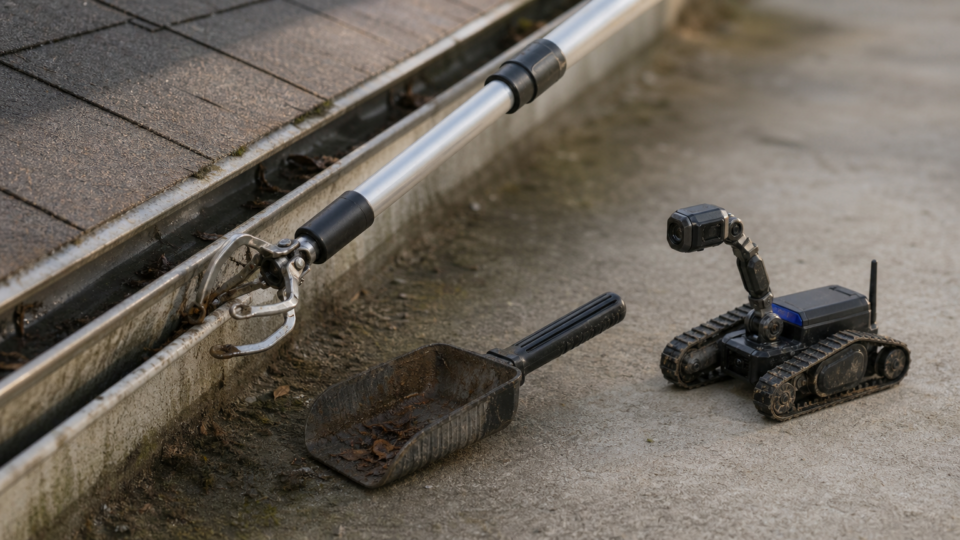
Short answer: Climbing a ladder to scoop wet leaves out of a gutter is how a lot of homeowners end up in the emergency room, not the hardware store. Every year, thousands of ladder falls happen during routine home maintenance, and gutter cleaning is one of the biggest culprits. If you’re searching for gutter cleaning from the ground tools, you already know there’s a smarter way to handle this chore. Ready for quotes? Compare local pros →
In this guide
The good news: you don’t need to risk a fall to keep your gutters clear. A handful of well-designed tools now let you flush, scrape, and vacuum debris while both feet stay planted on solid ground. From telescoping wand attachments that hook to your garden hose to cordless gutter vacuums built for two-story homes, the right pick depends on your gutter length, debris type, and how often you need to clean.
This list breaks down nine tools worth buying, what each one does best, and roughly what you’ll pay. We wrote it from a former gutter installer’s perspective, so you’re getting practical picks, not just a sales page. If DIY isn’t for you after reading this, we’ll also point you toward what pros charge to clean gutters and when to DIY and getting quotes from local pros.
1. Telescoping garden hose gutter cleaning wand
This is the tool most homeowners reach for first, and for good reason. A telescoping gutter wand attaches to any standard garden hose and lets you flush leaves and grit out of your gutters while standing on the lawn. It’s the simplest entry point if you’re just starting to look into gutter cleaning from the ground tools and don’t want to buy anything complicated.

How it works
The wand is a rigid or semi-rigid pole with a curved, angled tip that sprays water upward and sideways into the gutter channel. You extend the pole to your roofline, aim the nozzle into the trough, and walk the length of your house while water pressure pushes leaves, seeds, and grit toward the downspouts. Most models have a trigger or shutoff valve near the handle so you control flow without walking back to the spigot. A few premium versions add a small brush head to loosen packed debris before the spray hits it.
A telescoping wand turns a two-hour ladder chore into a fifteen-minute walk around the yard.
Best for
This tool suits homeowners dealing with light to moderate debris, mostly loose leaves, seed pods, and dust rather than compacted muck or standing sludge. It’s also the best starting point if you’ve never tried cleaning your gutters without a ladder and want a low-cost way to test the concept. Single-story and most two-story homes are well within its working range, and it pairs naturally with a seasonal rinse-out after the leaves drop.
Reach from the ground
Most telescoping wands extend between 13 and 25 feet, which covers gutters at 15 to 20 feet high once you account for the angle you’re spraying from. Manufacturers list a maximum extension, but real-world reach is usually 2 to 3 feet shorter once you factor in the curve needed to clear the gutter’s front lip. If your home has 25-foot-plus rooflines or steep dormers that block a straight sightline, you may need to reposition several times to cover every section.
What it costs
Expect to pay somewhere between $25 and $70 for most consumer models, with premium brands with brush attachments and telescoping locks running slightly higher.
| Feature | Budget wand | Premium wand |
|---|---|---|
| Extension length | 13-18 ft | 20-25 ft |
| Price range | $25-$40 | $45-$70 |
| Brush attachment | Rarely | Often included |
| Shutoff valve | Basic twist | Trigger-style |
Since it connects to a hose you already own, this is one of the cheapest tools needed for gutter cleaning on this list, and a reasonable first purchase before investing in anything more specialized.
What should this cost you?
Answer four questions and get a fair price range for your home.
2. Extendable gutter cleaning claw
When leaves have matted down into a wet, compacted layer, water alone won’t budge them. That’s where an extendable gutter claw earns its spot in your toolkit. It’s a mechanical grabber on a long pole that lets you pull debris out by hand, from the ground, without ever touching a rung.
How it works
The claw sits at the end of a telescoping aluminum or fiberglass pole, usually controlled by a trigger or squeeze handle near your grip. Squeezing the handle closes two or three curved jaws that scoop and pinch debris, then you lower the tool and release the load into a bucket or tarp. Some models add a rotating head so you can angle the jaws to match the gutter’s pitch without repositioning the whole pole.
A gutter claw handles the wet, compacted debris that a hose wand just pushes around.
Best for
This tool is built for compacted, wet debris, think matted leaves, pine needles fused with dirt, or the sludge that forms after a wet autumn sits untouched for weeks. It’s a strong pick if you’re comparing gutter cleaning tools without a ladder and your gutters tend to clog with heavier organic buildup rather than light, dry leaves. Homeowners near pine or oak trees get the most use out of one of these.
Reach from the ground
Most claws extend from 8 to 18 feet, shorter than hose wands because you need enough leverage and control to grip and lift debris rather than just spray it. That reach comfortably covers single-story homes and many two-story ranches, but taller homes may need a step stool or a longer pole add-on to reach the gutter lip cleanly.
What it costs
Basic claws run $20 to $35, while sturdier models with rotating heads and reinforced jaws climb to $50 or so. It’s a low-cost complement to a hose wand rather than a replacement, since most homeowners end up using both depending on the season and debris type.
3. Leaf blower gutter cleaning attachment
Dry debris calls for a different approach than water or claws, and a leaf blower gutter attachment fills that gap. It’s a curved extension tube that clips onto the end of your existing leaf blower, redirecting the airflow up and into the gutter channel so you can clear dry leaves and dust without climbing anything.
How it works
The attachment is a rigid, angled tube, often 4 to 8 feet long, that fits over the nozzle of a gas or battery leaf blower. You raise the tube to the gutter’s edge and let the blower’s airflow push loose debris out and over the far side, working section by section along the roofline. Because there’s no water or moving parts inside the tube, setup takes seconds, and you can switch back to blowing your yard the moment you’re done.
A blower attachment is the fastest tool on this list for dry debris, but it does nothing for wet, packed leaves.
Best for
This tool shines with dry, loose debris like fallen leaves, pine needles, and seed pods that haven’t had a chance to get soggy. It’s a smart pick for homeowners doing DIY gutter cleaning in early fall, before the first real rain compacts everything into a paste. Skip it if your gutters already hold standing water or matted sludge, since blowing air at wet debris just splatters it around.
Reach from the ground
Most attachments add 4 to 8 feet to your blower’s existing reach, which combined with your arm length and the blower’s own length, typically gets you to gutters 12 to 16 feet high. That covers most single-story and many two-story homes, though taller rooflines may need you to work from an upstairs window or a short ladder for the last few feet.
What it costs
Attachments themselves run $20 to $45, cheap since you’re reusing a blower you likely already own. If you need to buy a blower too, budget another $60 to $150 for a decent cordless model, making this one of the more affordable tools needed for gutter cleaning when debris stays dry.
4. Wet/dry vacuum gutter cleaning kit
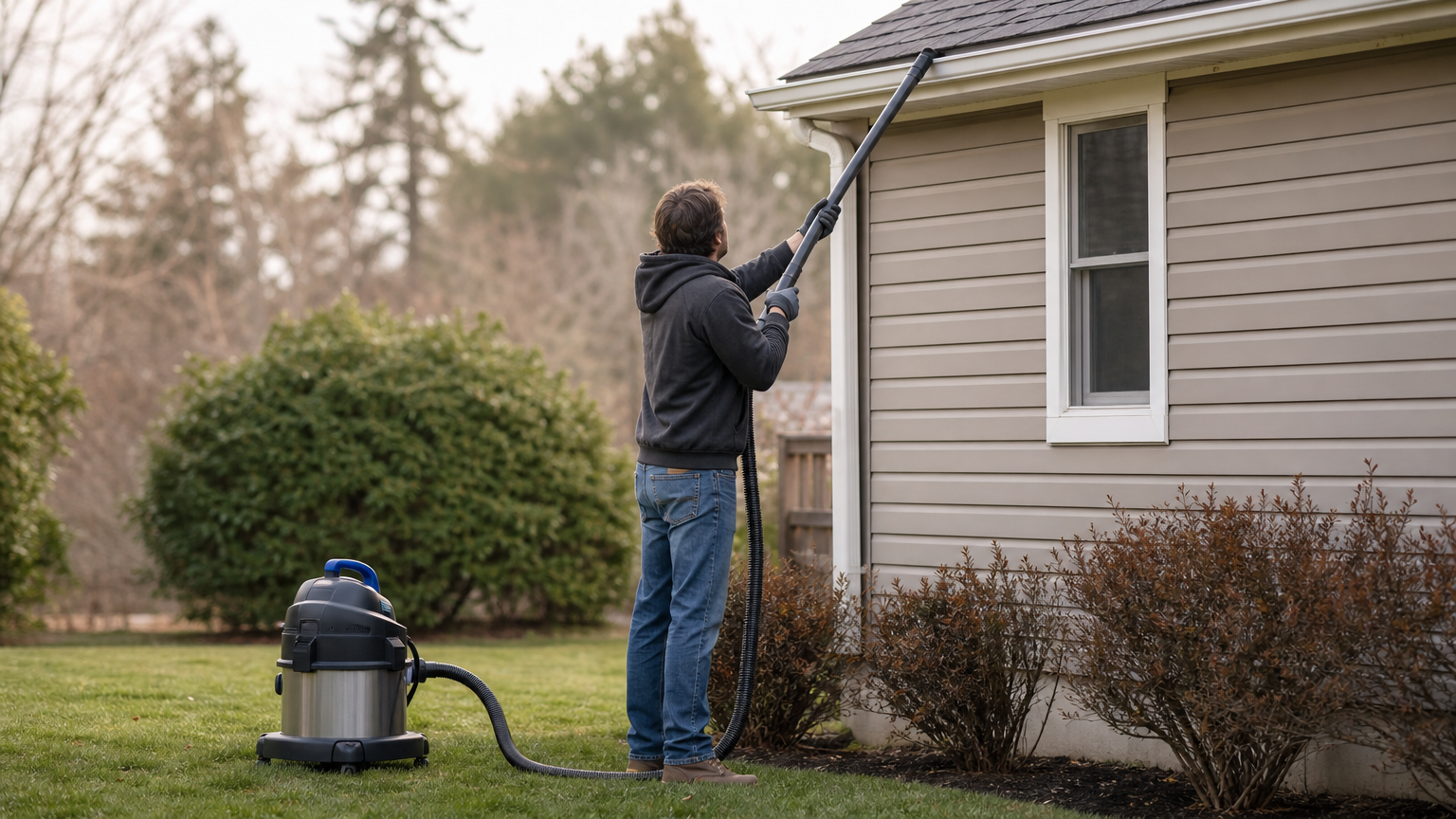
Sludge and standing water are where blowers and claws both struggle, and that’s the gap a wet/dry vacuum gutter kit fills. This setup pairs a shop vac with a set of lightweight extension tubes and a curved nozzle, letting you suck leaves, grit, and water straight out of the trough instead of pushing debris around.
How it works
Rigid or telescoping plastic tubes connect to your shop vac’s hose, ending in a curved nozzle shaped to slide along the gutter floor. You raise the tube to the roofline, work it along the channel, and the vacuum’s suction pulls loose leaves, seed pods, and wet muck down through the tube into the canister below. Because a wet/dry vac is built to handle liquid, you don’t need to dry anything out first, unlike a standard leaf blower setup.
A wet/dry vacuum is the one tool on this list that handles standing water and sludge without splattering it back at you.
Best for
This kit suits homeowners dealing with a mix of wet debris and standing water, especially after a storm or a long stretch without cleaning. It’s also a solid pick if you already own a shop vac for garage or workshop use, since the gutter attachment kit is a cheap add-on rather than a whole new purchase. Skip it if your gutters only ever collect dry, light leaves, since a blower attachment will clear those faster with less cleanup.
Reach from the ground
Most kits extend 12 to 24 feet depending on how many tube sections you buy, which covers single-story and most two-story homes. Reach depends heavily on your vacuum’s suction power holding up over that distance, and cheaper household shop vacs lose noticeable pull past 18 feet or so.
What it costs
Attachment kits alone run $30 to $60, though you’ll need a wet/dry vacuum to pair with them if you don’t already own one, adding another $70 to $150 for a mid-size shop vac. Compared to other gutter cleaning tools from the ground, this option costs more upfront but earns it back by handling debris types that trip up cheaper tools.
5. Pressure washer gutter cleaning wand
For gutters caked with dried mud, algae, or years of grime that a garden hose can’t touch, a pressure washer gutter wand brings real force to the job. It’s a rigid extension pole that connects to your pressure washer instead of a hose, turning that machine’s high-pressure stream into a precise tool you aim from the lawn.
How it works
The wand threads onto your pressure washer’s spray gun or hose fitting, extending your reach with a curved tip built to angle water into the gutter channel. You walk the wand along the roofline while the pressurized stream blasts caked dirt, algae, and stuck-on debris loose, often clearing sections a standard hose wand would just splash. Because the pressure is adjustable on most machines, you can dial it back for aluminum gutters to avoid denting soft metal.
A pressure washer wand clears years of caked grime that a garden hose simply can’t budge.
Best for
This tool is built for stubborn, dried-on buildup, think algae streaks, hardened mud, or gutters that haven’t seen a real cleaning in a couple of seasons. It’s a strong choice if you already own a pressure washer for the driveway or siding, since the wand attachment is a cheap add-on rather than a new machine. Skip it on older or thin-gauge aluminum gutters, where too much pressure can warp seams or pop loose brackets.
Reach from the ground
Most wands extend 12 to 20 feet, similar to hose wands, though the added weight of a pressure washer hose makes the top of that range harder to control steadily. Two-story homes are usually within reach, but you’ll want a helper managing the pressure washer’s trigger and hose slack while you focus on aiming.
What it costs
Wand attachments run $25 to $50, but you’ll need a pressure washer to power one, adding $100 to $250 for an electric model or more for gas-powered units. Among gutter cleaning tools from the ground, this is the most powerful option for grime, but the least beginner-friendly given the setup and control it demands.
6. Cordless power gutter cleaning kit
Battery technology has caught up with gutter maintenance, and a cordless power gutter cleaning kit is proof. These kits pair a rotating brush or spinning nozzle head with a battery-powered motor and an extension pole, giving you mechanical scrubbing power without a single cord to trip over or an outlet to hunt down.
How it works
A compact motor sits at the base of a telescoping pole, spinning a brush head or flexible whip at the top that knocks debris loose as you sweep it along the gutter channel. Some kits add a small water line fed from a garden hose so the spinning action combines with a rinse, which helps on packed leaves that a dry brush alone won’t budge. Battery packs typically run 20 to 40 minutes per charge, enough for most single cleaning sessions on an average home.
A cordless kit gives you scrubbing power on par with hand-cleaning, minus the ladder and the cord.
Best for
This kit suits homeowners who want a middle ground between spraying and scrubbing, especially on gutters with a mix of dry leaves, dust, and lightly packed debris. It’s also a smart pick if your property lacks a nearby outlet or your hose bib sits far from the roofline, since the tool runs on battery alone. Consider it one of the better best gutter cleaning tools from the ground if you want power without the weight of a pressure washer hose.
Reach from the ground
Most kits extend 10 to 16 feet, shorter than hose or vacuum setups because the motor and brush head add weight the pole has to support. That range covers single-story homes comfortably and reaches the lower half of many two-story gutters, though taller rooflines may need a add-on extension sold separately.
What it costs
Complete kits, motor, pole, and brush head included, run $60 to $130, putting this squarely in the middle of the pack for gutter cleaning DIY tools on this list. Replacement brush heads add another $10 to $20 as they wear out.
7. Telescopic gutter cleaning scoop
Sometimes the simplest tool wins, and a telescopic gutter scoop is about as basic as this list gets. It’s a pole with a curved, cupped end shaped like a small trowel, built to lift debris out by hand rather than blast or vacuum it away. If you want the cheapest of the gutter cleaning tools from the ground without batteries, hoses, or motors, this is it.
How it works
Unlike the claw, this scoop has no moving jaws or trigger mechanism. You extend the pole, angle the cupped head into the gutter, and drag it along the channel so the curved edge scrapes debris up and out in one motion. Some models flex slightly at the head to match the gutter’s slope, which helps you clear the last inch of muck sitting against the fascia. Because there’s nothing to squeeze or release, the learning curve is close to zero.
A telescopic scoop trades mechanical grip for pure simplicity, no batteries, no triggers, just a pole and a scrape.
Best for
This tool works best on loose to moderately packed debris, dry leaves, twigs, and light dirt that scoop out easily without much resistance. It suits homeowners who want the lowest-cost option among gutter cleaning tools without a ladder and don’t mind a bit more manual effort per pass. Skip it if your gutters regularly hold heavy, waterlogged sludge, since a claw or vacuum kit will clear that faster with less strain on your arms.
Reach from the ground
Most scoops extend 10 to 16 feet, a bit shorter than claws or wands since the rigid design needs enough stiffness to hold debris without bending. That reach handles single-story homes easily and covers the lower run of many two-story gutters, though steep rooflines may leave a few feet uncleared near the peak.
What it costs
Expect to pay $15 to $30 for most models, making this the cheapest entry point on the entire list. It’s a smart backup tool even if you buy something more advanced, since it costs little and never runs out of charge.
8. Robotic gutter cleaner
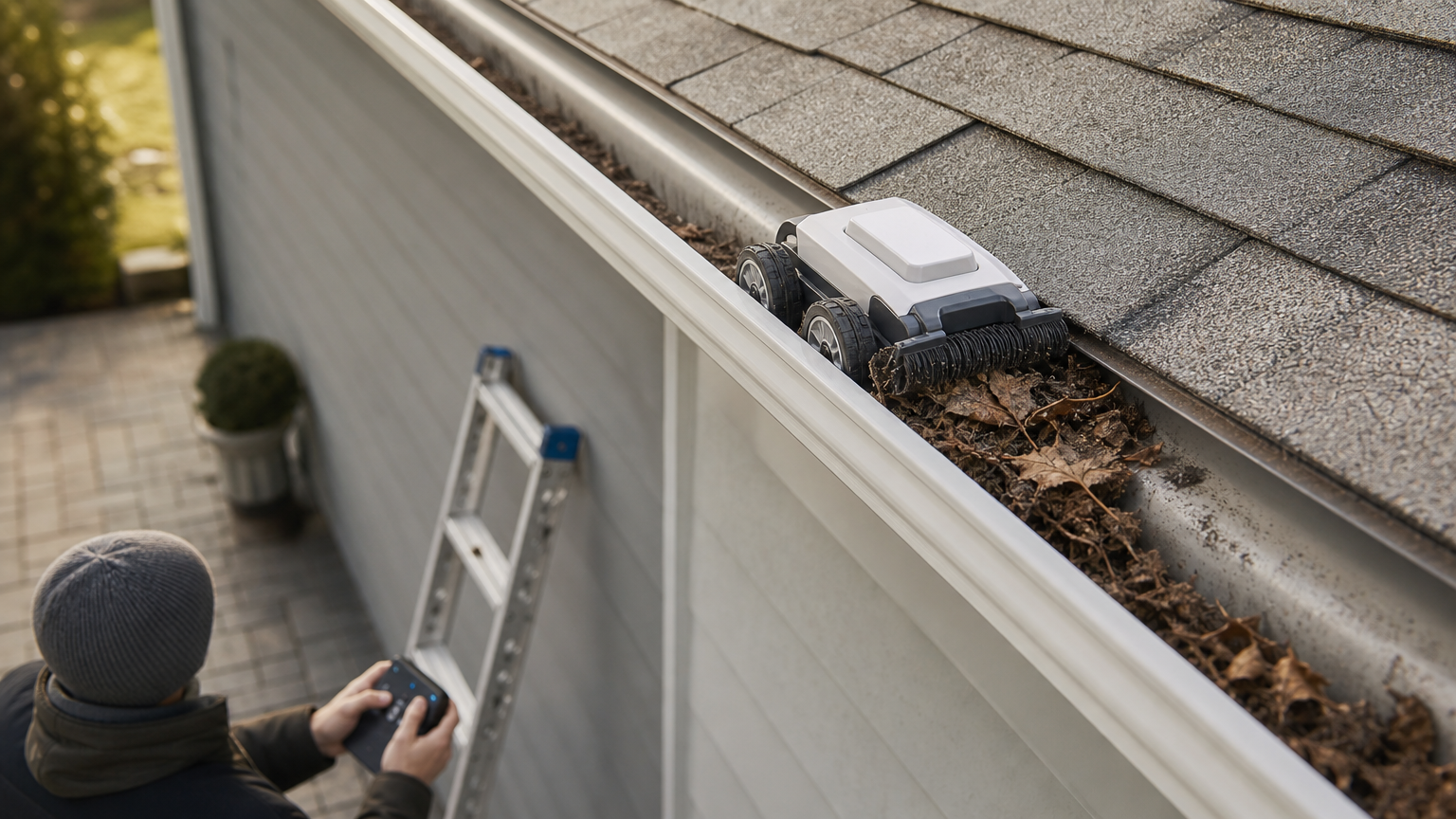
Gadget lovers and busy homeowners alike are drawn to the robotic gutter cleaner, a small remote-controlled unit that drives along the gutter channel and clears debris while you stand on the ground with a controller in hand. It’s the closest thing on this list to a true hands-off solution, though it comes with a learning curve and a price tag to match.
How it works
The robot sits inside the gutter trough on small wheels or tracks, using a spinning brush or auger to loosen debris and push it out over the edge as it crawls along the channel. You control speed and direction with a handheld remote or a smartphone app, watching its progress from below rather than climbing up to check on it. Getting the unit into the gutter still requires a ladder for setup and retrieval, so it’s not a fully ladder-free system, just one that removes the need to climb during the actual cleaning pass.
A robotic gutter cleaner removes the climbing during cleaning, but you’ll still need a ladder to place and retrieve it.
Best for
These units suit homeowners with long, straight gutter runs and a genuine interest in tech-forward home maintenance rather than the fastest or cheapest fix. They handle dry to moderately packed leaves well but struggle with tight inside corners, mitered joints, and heavy wet sludge, so they’re best paired with occasional manual touch-ups.
Reach from the ground
Once placed, the robot can traverse 30 feet or more of gutter on a single charge, covering far more linear distance per session than any pole-based tool. The catch is that initial placement still depends on ladder height, so this tool doesn’t solve the climbing problem for the tallest homes the way a telescoping wand or vacuum kit does.
What it costs
Robotic gutter cleaners run $150 to $400, making them the priciest mechanical option on this list before you even reach drone territory.
9. Gutter cleaning drone
Drones have found their way into gutter maintenance, and a gutter cleaning drone is the newest, most gadget-heavy option on this list. Instead of a pole or a crawling robot, you fly a small quadcopter fitted with a leaf blower attachment or a soft brush along your roofline, clearing debris while you watch from the yard with a controller in hand.
How it works
A downward-angled propeller or a small mounted blower generates enough airflow to knock loose leaves and dust out of the gutter channel as the drone hovers alongside it. You pilot the unit manually or, on higher-end models, follow a preset flight path that traces your roofline automatically. Battery life typically caps a session at 10 to 15 minutes, so larger homes need multiple charged packs on hand before you start.
A gutter cleaning drone clears dry debris without a ladder or a pole, but calm weather and a steady hand are non-negotiable.
Best for
This tool suits homeowners with complex or hard-to-reach rooflines, steep pitches, tall gables, or gutters tucked behind obstacles that make pole-based tools awkward. It also appeals to anyone already comfortable flying drones for photography or inspection work, since the learning curve is steeper than any other tool here. Skip it if your gutters hold wet, packed debris, since airflow alone won’t budge sludge, and skip it in windy conditions, since gusts push lightweight drones off course fast.
Reach from the ground
Unlike pole tools, a drone’s reach isn’t limited by extension length. It can clear gutters at any height, including three-story homes and steep roof valleys that no wand or claw could safely reach. The real limit is pilot skill and battery time, not physical distance from the ground.
What it costs
Purpose-built gutter drones run $300 to $800, and that’s before factoring in spare batteries or replacement propellers after an inevitable clip against a fascia board. It’s the most expensive tool on this list by a wide margin, so it makes sense mainly for larger or unusually tall properties.
Finding the right tool for your gutters
Matching the tool to your actual debris beats chasing the flashiest option. A telescoping wand or scoop handles most single-story homes with light leaf litter just fine, while wet/dry vacuum kits and pressure washer wands earn their keep on caked mud, algae, and standing sludge. Robots and drones make sense only if your rooflines are tall, complex, or you genuinely enjoy the tech. Whatever you pick, the goal stays the same: clear gutters without a ladder underfoot.
Sometimes, though, the smartest move is skipping the tool aisle entirely. If your gutters are pulling away from the fascia, sagging under debris weight, or you’d rather not spend a Saturday testing equipment, a professional cleaning costs less than most people expect and takes the risk off your plate completely. Compare free gutter cleaning quotes from local pros and weigh them against buying gear you’ll use twice a year.
What should this cost you?
Answer four questions and get a fair price range for your home.