
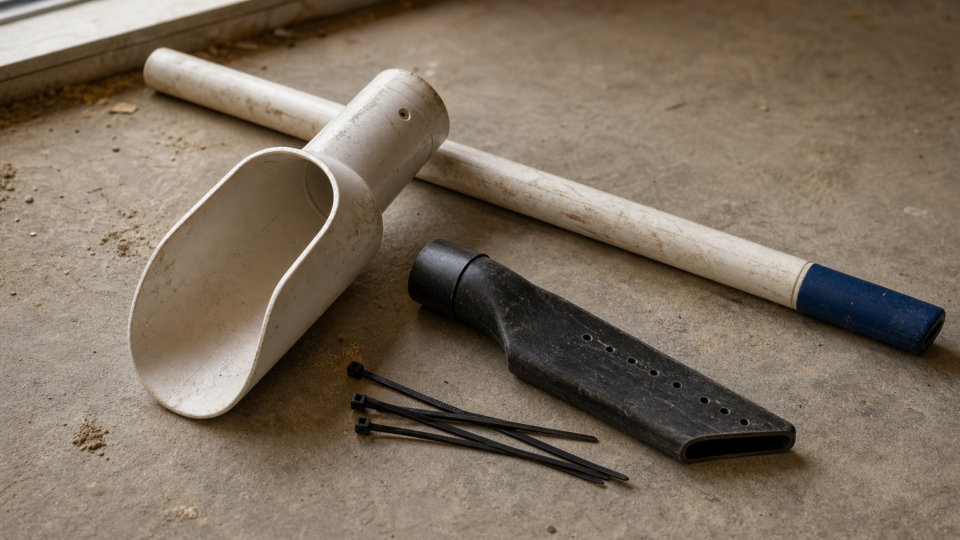
Short answer: Standing on a ladder with wet leaves sliding down your sleeve is nobody’s idea of a good afternoon. Most homeowners either pay a pro $150 or more for a job that takes twenty minutes, which is right in line with what a cleaning visit runs around the country, or they climb up anyway and hope for the best. There’s a third option: building your own diy gutter cleaning tools out of parts you probably already have in the garage or can grab at any hardware store for under $20. Ready for quotes? Compare local pros →
In this guide
This guide shows you exactly how to make homemade gutter scoops and ladder-free attachments using PVC pipe, a leaf blower, or a shop vac, so you can clear debris from the ground or without repeated trips up and down a ladder. We’ll cover the specific cuts, angles, and attachments that actually work, not just generic tips.
As a site built by a former gutter installer, we know which shortcuts save you money and which ones just make a bigger mess. Below you’ll find step-by-step builds for gutter cleaning tools diy projects ranging from a basic scoop to a pressure washer wand extension, plus guidance on when a homemade tool isn’t enough and it’s time to call a professional instead.
What you need before building a DIY gutter cleaner
Before you cut a single piece of PVC, spend ten minutes gathering the right materials and checking your gutter’s dimensions. Most DIY gutter cleaning tools fail because someone grabs whatever pipe fits in the truck bed instead of measuring first. Standard residential gutters run either 5 inches or 6 inches wide, and that measurement determines the diameter of pipe you’ll need for a scoop that actually reaches into the corners instead of just skimming the top layer of leaves.
Materials to buy or pull from the garage
Grab a tape measure and check your gutter width before you shop, since buying the wrong pipe diameter is the most common mistake first-time builders make.
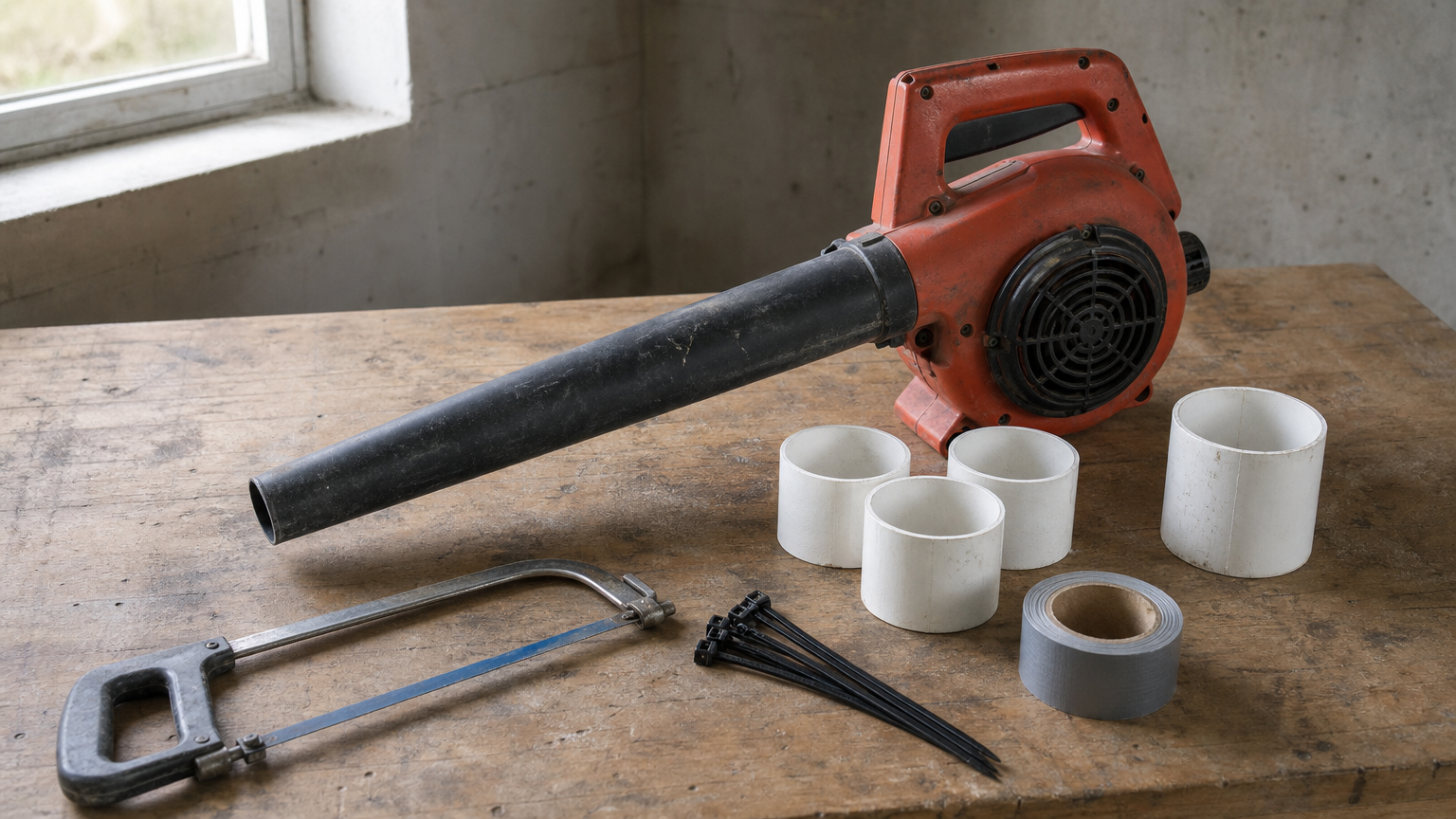
| Item | Purpose | Approx. Cost |
|---|---|---|
| 2-inch or 3-inch PVC pipe (4-6 ft) | Base of the scoop or grabber handle | $6-$12 |
| PVC end cap or elbow fitting | Shapes the scoop mouth | $2-$5 |
| Hacksaw or PVC cutter | Cuts pipe to angle | Already owned or $10 |
| Zip ties or hose clamps | Attaches nozzle to vacuum/blower tube | $3-$8 |
| Old leaf blower or shop vac | Powers the debris removal | Already owned |
| Threaded extension pole (paint pole works) | Extends reach from the ground | $15-$25 |
| Duct tape or PVC cement | Secures joints | $4-$6 |
None of this requires a trip to a specialty store. A standard Lowe’s or Home Depot run covers everything, and most homeowners already own the saw and tape.
Tools and safety gear that actually matter
Safety gear isn’t optional here, even for a homemade tool that seems low-risk. You still need to work near a ladder or extend a pole overhead, and a stray drop of debris or a slipped grip can cause real injury. Keep these on hand every time you clean gutters, homemade tool or not:
- Work gloves with a grip coating, not cotton gloves that soak through
- Safety glasses, since dried debris flakes off unpredictably
- A stable ladder rated for your weight plus tool weight, if you’re not going the ladder-free route
- A tarp or old sheet to lay under the work area for easy cleanup
A tool that keeps your feet on the ground is only as safe as the ladder you skip using it from.
That one line matters more than it sounds like it should. Homeowners get hurt not from the tool itself but from overreaching on a ladder while holding it.
Know your gutter type before you build
Different gutter setups call for different scoop shapes. Aluminum seamless gutters have smooth interior walls that let a curved PVC scoop glide easily, while older galvanized steel gutters sometimes have ridges or old sealant lumps that snag a straight-edged tool. If you’ve already installed gutter guards, standard scoops won’t work at all since the mesh or screen blocks access, and you’ll need a narrower brush attachment instead, which we cover in the shop vac section below.
Gutter cleaning tools built for DIY use also depend on your home’s height and roofline. A one-story ranch with a low-pitch roof can usually be cleaned entirely from the ground with a pole attachment, while a two-story colonial with a steep pitch may still require a stabilized ladder for at least part of the job. Measure your gutter height from the ground now, before you cut pipe, so you know exactly how long your extension pole and hose sections need to be.
What should this cost you?
Answer four questions and get a fair price range for your home.
Step 1. Choose the right DIY tool for your gutters
Before you start cutting PVC or drilling into a shop vac hose, figure out which build actually matches your situation. Not every homemade gutter cleaner suits every roof, and picking the wrong one wastes an afternoon and a pipe. The right DIY gutter cleaning tools depend on three things: how much debris you’re dealing with, how tall your gutters sit, and whether you’re willing to touch a ladder at all.
Debris type matters more than most homeowners expect. Wet, compacted leaves need a rigid scoop that can dig and lift, while dry pine needles and seed pods vacuum out easily with suction. Gutters clogged with shingle grit or standing water usually need a hose flush before any scooping tool will do much good.
| Situation | Best DIY Build | Why It Works |
|---|---|---|
| Wet, packed leaves, low roof | PVC scoop and grabber | Rigid edge breaks up compacted debris |
| Dry leaves, pine needles, pods | Shop vac attachment | Suction pulls light debris fast |
| Single-story home, ground access preferred | Extension pole with any attachment | Keeps you off the ladder entirely |
| Two-story home, steep pitch | Pole-mounted scoop plus stabilized ladder | Combines reach with control near the roofline |
| Gutters with guards installed | Narrow brush attachment | Fits through mesh without removing guards |
Match the tool to the debris, not the other way around, or you’ll spend twice as long fighting the wrong equipment.
Height is the next filter. If your gutters sit above 15 feet, an extension pole becomes mandatory rather than optional, and you should skip straight to Step 4 before building anything else. Gutters under 10 feet on a single-story home give you more flexibility since a short-handled scoop works fine without extra reach.
Guards change the equation entirely. If you’ve already got micro mesh screens over your gutters or basic screen guards installed, a standard scoop can’t get underneath them, and you’ll need the narrower brush attachment from Step 3 instead. Ignoring this step is the number one reason people build a tool, climb up, and find out it doesn’t fit.
Step 2. Build a PVC gutter scoop and grabber
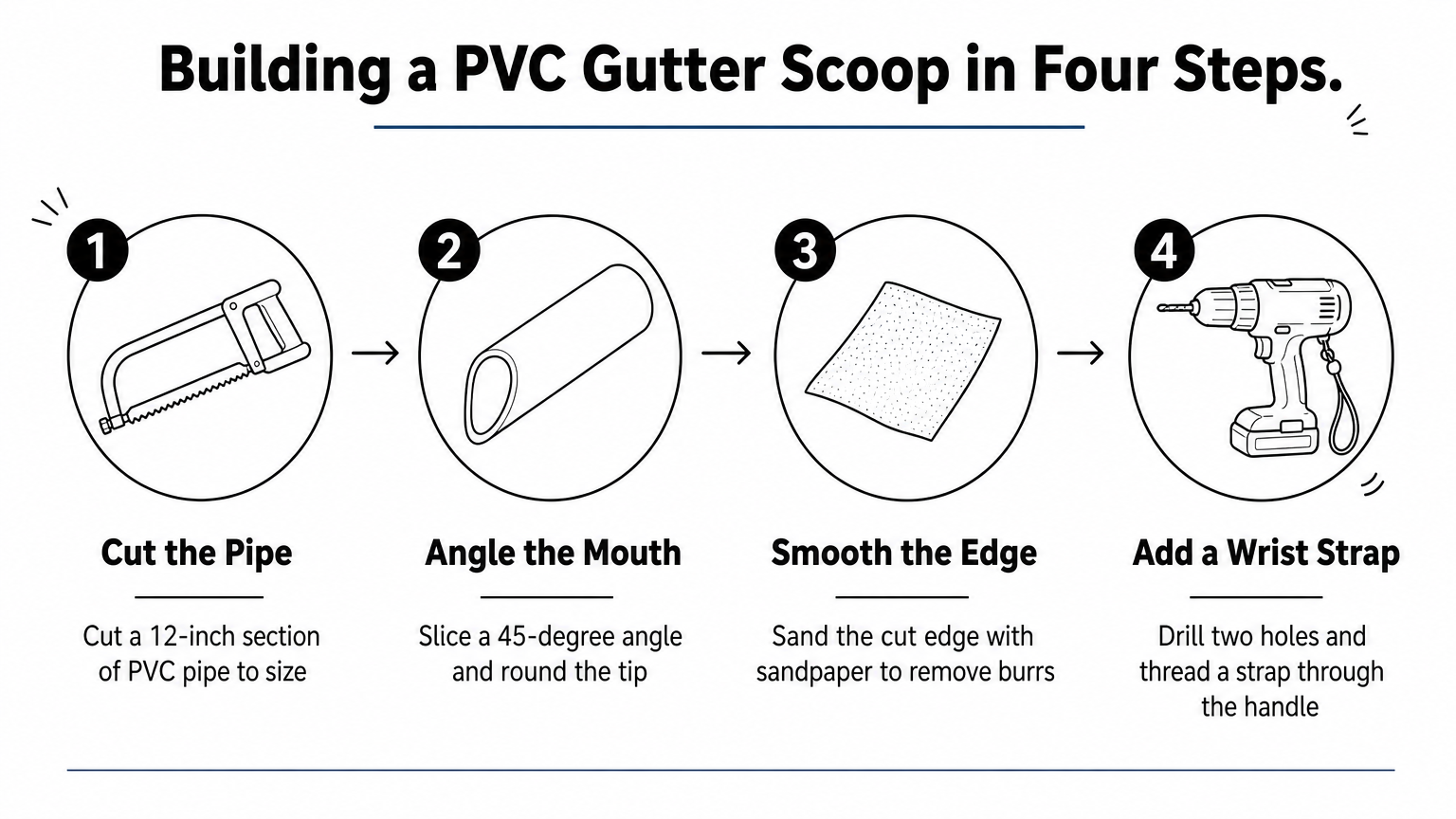
Grab the 2-inch or 3-inch PVC pipe you measured against your gutter width and cut a 12-inch section with a hacksaw. This becomes the body of your scoop, and the length gives you enough surface area to lift a full handful of leaves without the tool feeling flimsy in your grip. Cutting this piece at an angle instead of straight across is what separates a working scoop from a pipe that just pushes debris around.
Cutting the scoop mouth
Slice the pipe at a 45-degree angle along its length, then trim the pointed tip down to a rounded edge so it doesn’t gouge your gutter’s interior coating. This angled cut creates a shovel-like mouth that slides under compacted leaves instead of skimming over them.
- Mark a 45-degree line with a pencil and square before cutting
- Cut slowly with a fine-tooth hacksaw or PVC cutter to avoid cracking the pipe
- Sand the cut edge with 100-grit sandpaper to remove burrs
- Drill two small holes near the uncut end for a wrist strap
A rounded, angled scoop mouth lifts debris in one pass, while a flat cut just shoves it further down the gutter.
Handle length depends on how you plan to reach your gutters. For ladder work, an 18-inch handle keeps the tool controllable one-handed. Threading the pipe onto a longer extension pole, which you’ll build in Step 4, turns this same scoop into a ground-level tool.
Adding a grabber claw for stubborn debris
If your gutters trap twigs, acorns, or shingle grit that a scoop alone won’t lift, add a second piece to your build. Screw two thin wooden paint stirrers to the scoop’s underside with a small spring or rubber band between them, creating a simple pincer that opens when you squeeze a string threaded through the handle. It’s not elegant, but it grabs what the scoop’s edge can’t dig out.
Once assembled, test the scoop’s balance before you climb anything. Weight distribution matters more than most builders expect, since a scoop that’s front-heavy will tip debris back into the gutter on the way down. These homemade gutter scoops cost under $10 in materials and, matched correctly to your gutter width, outperform most store-bought plastic scoops that ignore the actual dimensions of your home.
Step 3. Turn a shop vac into a gutter cleaning attachment
Wet leaves call for a scoop, but dry pine needles, seed pods, and shingle grit vacuum out faster than you can dig them. Converting a shop vac into a gutter cleaning attachment takes about 20 minutes and reuses the same PVC pipe you already bought for Step 2. This build works best on gutters with light to moderate debris, since a standard shop vac motor doesn’t have the suction power to pull up soaked, compacted leaf mats.
Building the vacuum nozzle
Start with a 4-foot length of 2-inch PVC pipe and cut one end at a shallow angle so it can slide flat along the gutter floor without gouging the metal or vinyl channel. The other end needs to fit snugly inside your shop vac’s hose opening, so measure that diameter before you cut a matching coupler.
- Cut a 4-foot PVC section with one end angled at roughly 20 degrees
- Drill three or four 1/4-inch holes near the angled tip to boost airflow and prevent clogging
- Wrap the straight end with a few layers of duct tape until it fits snugly into the shop vac hose
- Secure the connection with a hose clamp or heavy-duty zip tie so suction doesn’t pop the pipe loose mid-job
A snug seal between pipe and hose is what separates real suction from a nozzle that just whistles air.
Matching suction to debris type
Not every shop vac performs the same, and running the wrong setting wastes battery or wears the motor faster than it should. Check your vac’s manual, but these settings generally hold true across most residential models.
| Debris Type | Suction Setting | Notes |
|---|---|---|
| Dry leaves, pine needles | High | Clears fastest, minimal clogging risk |
| Seed pods, small twigs | Medium-high | Watch for jams at the nozzle holes |
| Shingle grit, sand | Medium | High suction can clog the vac filter quickly |
| Wet leaves | Not recommended | Switch back to the PVC scoop from Step 2 |
Once the nozzle’s built, test it on a small section of gutter before committing to the whole roofline. Guard-equipped gutters need a narrower version of this same nozzle, since standard PVC won’t slide through mesh or screen openings. For those, swap the pipe for a 1-inch dowel wrapped in stiff bristle brush material, which slips under most guard types without needing to remove them first.
Step 4. Add an extension pole for ground-level cleaning
Once your scoop or vacuum nozzle works, the next upgrade is getting it off the ladder entirely. A threaded extension pole, the same kind used for paint rollers, turns either tool into a ladder-free attachment you can run from a lawn or driveway, much like the store-bought tools built to clear gutters from the ground. This step matters most for single-story homes and low-pitch roofs, where the extra reach eliminates ladder work completely rather than just reducing it.

Choosing the right pole length
Measure your gutter height from the ground before buying anything, since a pole that’s too short defeats the purpose and one that’s too long becomes impossible to control one-handed. Most paint poles extend from 6 to 24 feet, and threading them onto a PVC scoop or vacuum nozzle adds another 12 to 18 inches on top of that.
| Gutter Height | Recommended Pole Length | Notes |
|---|---|---|
| Under 10 ft | 6-12 ft | Lightweight pole keeps control easy |
| 10-15 ft | 12-18 ft | Standard telescoping paint pole works |
| Over 15 ft | 18-24 ft | Two-handed grip required, extra caution near power lines |
If your gutters sit above 15 feet, the pole isn’t optional anymore, it’s the only safe way to reach them.
Attaching the pole to your scoop or vacuum
Most paint poles thread onto tools with a standard acme thread, but PVC scoops and shop vac nozzles need an adapter first. Drill a hole through the flat end of your PVC handle and insert a threaded insert nut, sized to match your pole’s thread pattern, then secure it with epoxy so it doesn’t spin loose mid-job.
- Drill a pilot hole slightly smaller than the insert nut
- Tap the nut in with a hammer until flush
- Apply epoxy around the base for a permanent seal
- Let cure for 24 hours before testing weight-bearing pressure
Once attached, walk the length of your gutter line from the ground and check that the tool reaches every section without you stretching or leaning. If any stretch of gutter still requires standing directly under the roofline at an odd angle, that’s a section better handled with a stabilized ladder, which we’ll cover next.
Step 5. Test and use your tool safely
Before trusting any homemade build to a full gutter run, test it on a short, accessible section first. Ground-test your DIY gutter cleaning tools near a low stretch of gutter so you can check balance, grip, and suction strength without any real risk if something breaks loose. Fifteen minutes of testing now saves you from discovering a weak joint while you’re stretched out on a ladder later.
Running a ground test before the real job
Check these items before you commit to cleaning the whole roofline:
- Confirm the scoop or nozzle holds its angle without twisting under load
- Pull on every epoxied joint and threaded connection to check for give
- Run the shop vac for two minutes straight to make sure the hose seal holds suction
- Practice lifting a small pile of debris from ground level to check pole control
If anything wobbles, cracks, or loses suction during this test, fix it before you go near a ladder. A tool that fails at chest height on the lawn will fail the same way twenty feet up, just with worse consequences.
Test on the ground first, because a tool that fails at eye level will fail the same way at the roofline.
Working near a ladder when you still need one
Even the best pole attachment won’t reach every gutter section, especially around corners, downspout junctions, or steep roof valleys. When you do need a ladder, keep three points of contact at all times and never lean the tool’s weight against the gutter itself for support, since old fascia boards can give way under sideways pressure. Position the ladder on level ground, have someone spot you if possible, and move the ladder rather than overreaching to the side.
When a DIY tool isn’t enough
Homemade tools handle routine debris well, but they have limits. Heavy standing water, sagging sections, or a gutter that has pulled away from the fascia point to a repair problem, not a cleaning one, and no scoop or vacuum attachment fixes that. If you spot bent hangers, separated seams, or rot around the fascia while testing your tool, stop and have a local contractor estimate the repair for free before the next storm turns a small fix into a full gutter replacement.
Keeping your gutters clear season after season
Building your own diy gutter cleaning tools isn’t a one-time project. Pull the scoop and vacuum nozzle back out every fall and spring, since a tool built once and stored properly can last for years of routine cleanings. Check the epoxy joints each season before you use them again, since threaded connections loosen with repeated pole extensions and retractions over time.
Homemade tools handle the debris you’ll face most years, but they’re not a substitute for catching structural problems early. Sagging sections, rusted hangers, or rotted boards hiding behind the gutter need a trained eye, not another PVC attachment. If your gutters look tired no matter how well you clean them, or you’d rather skip the ladder altogether this season, see what local pros charge to clean your gutters with a free estimate and compare it against your own time and materials before deciding which way to go.
What should this cost you?
Answer four questions and get a fair price range for your home.